 Advances in Engineering Advances in Engineering features breaking research judged by Advances in Engineering advisory team to be of key importance in the Engineering field. Papers are selected from over 10,000 published each week from most peer reviewed journals.

Significance Statement
Dimethyl ether (DME) is a colorless gas, a clean-burning, non-toxic, potentially renewable fuel. It can be derived from many sources, including fossil fuels (coal and natural gas) and renewable materials (biomass, waste and agricultural products). Its high cetane value and quiet combustion, as well as its inexpensive propane-like fueling system, make it an excellent, inexpensive diesel alternative that will meet strict emissions standards, especially with regard to the particulate emissions. Compared to conventional diesel, the advantages of Dimethyl ether include reduced emissions of NOx, soot, hydrocarbons and carbon monoxide. Dimethyl ether fueled compression-ignition direct-injection (CIDI) engines also generate less noise than conventional diesels. Dimethyl ether is gaseous at normal temperature and pressure, but changes to a liquid when subjected to modest pressure or cooling. This easy liquefaction makes it easy to transport and store. This and other properties, including a high oxygen content, lack of sulfur or other noxious compounds, and ultra-clean combustion make Dimethyl ether a versatile and promising solution in the mixture of clean renewable and low-carbon fuels under consideration worldwide. With the concerns of the decreasing petroleum reserves, Dimethyl ether is gathering more attention as an excellent alternative to diesel for the Dimethyl ether fueled vehicles and ships.
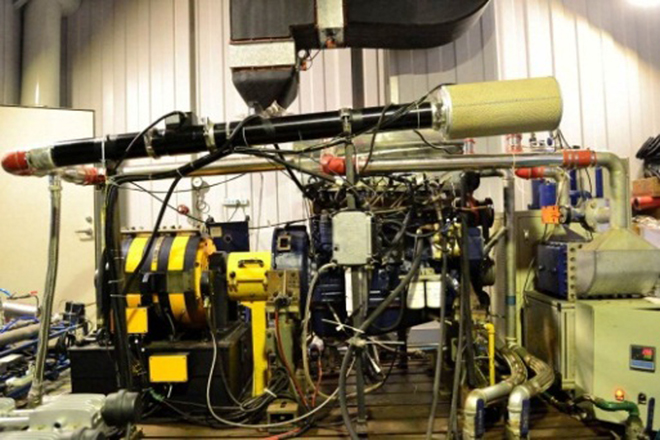
The internal combustion engine group of Shanghai Jiao Tong University (P. R. China) has developed an electronic control system of the Dimethyl ether fueled engine with an electronically operated common rail injection system to make sure the emissions meet Euro VI standard. Its power is greater than the prototype diesel engine, and its energy efficiency is equivalent to the prototype diesel engine. The on-road test of the Dimethyl ether vehicle shows its excellent performance on cold start, power output, fuel economy, noise and vibration control.



Journal Reference
Energy, Volume 86, 2015, Pages 257–266.
Dehao Ju, , Tingting Zhang, Jin Xiao, Xinqi Qiao, Zhen Huang.
Key Laboratory of Power Machinery and Engineering, Ministry of Education, Shanghai Jiao Tong University, No. 800, Dongchuan Road, Minhang District, 200240 Shanghai, PR China
Abstract
Two fuels with the compression-ignition property similar to conventional diesel–Dimethyl ether and n-heptane–are selected to analyze the evaporation performance of a bi-component droplet at different internal combustion engine conditions. A multi-component evaporation model based on UNIFAC (Universal Functional Activity Coefficient ) method and the non-equilibrium evaporation law is implemented to predict the evaporation characteristics of “each component” of the DME/n-heptane droplets with different mass fractions and different initial diameters, and to find how the two main competing factors (the consumption of latent heat for evaporation and the heat transfer into the droplet) affect the evaporation behaviors of each component. Generally, reducing the mass fractions of Dimethyl ether, increasing the ambient temperature or increasing the relative velocity between the droplet and the ambient gas enhances the evaporation of a droplet. Decreasing initial droplet diameter reduces the “peak” evaporation rate of both components. It is interesting to find that a relative constant and high evaporation rate of Dimethyl ether can last for a relative long time with an appropriate mass fraction of n-heptane. It proposes a way to change the evaporation rate of each component by altering the mass fractions in the Dimethyl ether/n-heptane mixture, in order to control the combustion of Dimethyl ether/n-heptane blended fuels.
Go To Energy