Advances in Engineering Advances in Engineering features breaking research judged by Advances in Engineering advisory team to be of key importance in the Engineering field. Papers are selected from over 10,000 published each week from most peer reviewed journals.

Significance
The power conversion efficiency of thin-film CuIn1−ξGaξSe2 (CIGS) solar cells has been previously reported to be about 22%. Generally, this efficiency compares well to the 26.7% efficiency of single-junction crystalline-silicon solar cells; however, the scarcity of indium remains the core obstacle for large-scale and low-cost production of thin-film CIGS solar cells. Were it possible to reduce the thickness of the CIGS layer without reducing the efficiency, the aforementioned shortfall would be overcome. Unfortunately, this is not the case as reduction of this thickness below a certain thickness limit lowers the efficiency significantly. As such, several techniques to offset this drawback have been proposed; they include: the use of light-trapping nanostructures, alternative back contacts, and back-surface passivation. In fact, recent publications have reported that optoelectronic simulations of thin-film Schottky-barrier solar cells with periodically nonhomogeneous absorbing layers of InGaAn and periodically corrugated backreflectors predict improvement in efficiency.
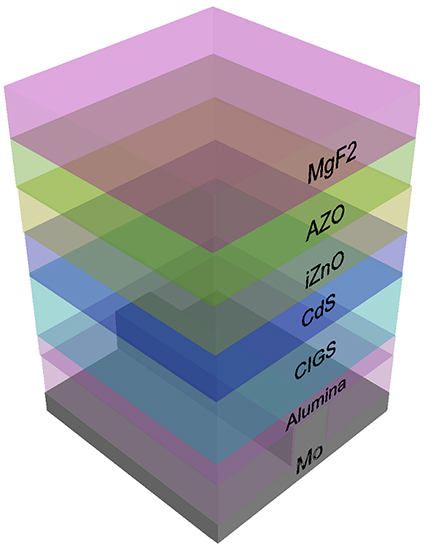
Although nonhomogeneity (i.e., bandgap grading) of the CIGS layer could increase efficiency by establishing drift fields, simple simulations as well as experiments such as the one mentioned above have shown that linear grading of the bandgap can significantly reduce the short circuit current density. Therefore, novel strategies are required for bandgap grading to maintain the current density and enhance the open circuit voltage. On this account, a team of researchers from the Pennsylvania State University: PhD student Faiz Ahmad and Professor Akhlesh Lakhtakia, in collaboration with Dr. Tom Anderson and Professor Peter Monk at the University of Delaware, engaged in a detailed optoelectronic optimization of ultrathin CIGS solar cells with a nonhomogeneous CIGS layer with back-surface passivation and backed by a periodically corrugated metallic backreflector. Their work is currently published in the research journal, Applied Optics.
In their approach, the power conversion efficiency of an ultrathin CIGS solar cell was maximized using a coupled optoelectronic model to determine the optimal bandgap grading of the nonhomogeneous CIGS layer in the thickness direction. The bandgap of the CIGS layer was either sinusoidally or linearly graded, and the solar cell was modeled to have a metallic backreflector corrugated periodically along a fixed direction in the plane.
The authors reported that their model was able to predict that specially tailored bandgap grading could significantly improve the efficiency, with much smaller improvements due to the periodic corrugations. To be specific, an efficiency of 27.7% with the conventional 2200-nm-thick CIGS layer was predicted with sinusoidal bandgap grading, in comparison to 22% efficiency obtained experimentally with homogeneous bandgap. Moreover, the researchers reported that the inclusion of sinusoidal grading increased the predicted efficiency to 22.89% with just a 600-nm-thick CIGS layer.
In summary, optoelectronic optimization was carried out for an ultrathin CIGS solar cell with a CIGS layer that was nonhomogeneous along the thickness direction and a metallic backreflector corrugated periodically along a fixed direction. Ideally, the bandgap in the CIGS layer was either sinusoidally or linearly graded. In a statement to Advances in Engineering, Professor Akhlesh Lakhtakia, the corresponding author and an internationally recognized pioneer in modeling solar cells highlighted that their reported high efficiencies arose due to a large electron–hole pair generation rate in the narrow-bandgap regions and the elevation of the open-circuit voltage due to a wider bandgap in the region toward the front surface of the CIGS layer. Overall, the bandgap nonhomogeneity, in conjunction with periodic corrugation of the backreflector, could be effective in realizing ultrathin CIGS solar cells that can help overcome the scarcity of indium.
Reference
Faiz Ahmad, Tom H. Anderson, Peter B. Monk, Akhlesh Lakhtakia. Efficiency enhancement of ultrathin CIGS solar cells by optimal bandgap grading. Applied Optics, Volume 58, No. 22 / 1 August 2019.