 Advances in Engineering Advances in Engineering features breaking research judged by Advances in Engineering advisory team to be of key importance in the Engineering field. Papers are selected from over 10,000 published each week from most peer reviewed journals.

Significance
When a mechanical structure vibrates at frequencies that do not share a common period, its motion never repeats exactly. This behaviour, known as quasi-periodic vibration, can occur when a structure is excited at several independent frequencies or when nonlinear effects introduce an additional frequency. Despite this, the motion follows an organized pattern in the mathematical space of displacements and velocities. With two independent frequencies, this pattern forms a surface called an invariant torus. Three frequencies produce a higher-dimensional torus.
To calculate these vibrations in detailed finite-element models is difficult, where structures such as beams and shells may have hundreds or thousands of degrees of freedom. Conventional frequency-domain methods describe the entire torus using mathematical functions associated with different frequencies. As more frequencies are included, the number of unknown coefficients grows rapidly, making the resulting nonlinear equations increasingly expensive to solve. Direct time integration can also require lengthy calculations and does not readily identify unstable responses that are important for understanding nonlinear vibration.
To overcome these challenges, Dr.Junqing Wu, Professor Ling Hong and Professor Jun Jiang from Xi’an Jiaotong University, together with Professor Mingwu Li from Southern University of Science and Technology, developed a Fourier series expansion-based shooting method (FSE-Shooting) to calculate quasi-periodic vibrations in nonlinear mechanical systems. The method was designed for large finite-element models, including cases where some vibration frequencies are initially unknown. Their work is now published in Mechanical Systems and Signal Processing
The researchers represented quasi-periodic motion through trajectories starting from a lower-dimensional section of an invariant torus. For a response with two independent frequencies, these starting points form a closed curve. With three frequencies, they form a two-dimensional torus. Each trajectory is followed over one period of a selected frequency. Although its endpoint generally differs from its starting point, the two positions must satisfy the phase relationships that define the quasi-periodic motion.
To calculate these trajectories, the team described the starting section using a Fourier series, with unknown coefficients defining its shape. The coefficients were converted into starting points, which were then advanced using Newmark time integration. The investigators used Fourier transform to reconstruct the ending section, and the coefficients were adjusted until the required phase relationships were satisfied. Since the trajectories can be calculated independently, the computations can run in parallel. Representing only the starting section also reduces the number of unknowns, while the Fourier formulation permits sufficient sampling to prevent frequency aliasing.
The team tested the method on a nonlinear beam subjected to excitation at two independent frequencies and found the calculated responses converged as the numerical resolution increased and closely matched those obtained using an established harmonic balance method. Both stable and unstable vibration responses were identified. Parallel processing substantially improved efficiency, with calculations running up to approximately 18.5 times faster using 32 processors than without parallelization.
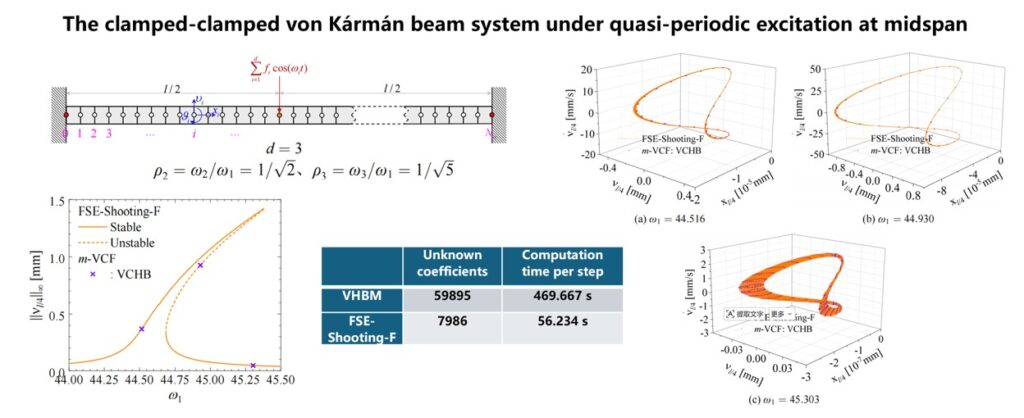
The authors then tested the same beam under excitation at three independent frequencies, producing a more complex vibration response. FSE-Shooting required fewer unknown coefficients than the established harmonic balance method and reduced computation time by a factor of four to eight. They found the calculated responses closely matched those obtained using the existing method, which confirm that the improvement in efficiency did not compromise numerical accuracy.
They used second beam model to investigate quasi-periodic vibrations that develop under excitation at only one frequency and inn this case, a nonlinear phenomenon known as a Neimark–Sacker bifurcation introduces a second frequency that is not known beforehand. The new phase conditions enabled the method to track the resulting vibrations as the excitation frequency changed. The calculated response curves and the relationship between the two frequencies agreed with those obtained using the existing method, with substantially shorter computation times.
Lastly, the researchers applied FSE-Shooting to a curved shell subjected to excitation at two independent frequencies. They refined the finite-element model in several stages, reaching 1,872 degrees of freedom, to examine how the predicted vibration response changed as the structural representation became more detailed. The frequency-response curves, shell deformations and amplitudes of the frequency components became increasingly consistent as the mesh was refined. This confirmed the reliability of the numerical results and demonstrated that the method could handle detailed three-dimensional structural models without first reducing their number of degrees of freedom.
Nonlinear structures can respond in different ways under similar excitation conditions, with some vibration responses being stable and others unstable. Identifying these responses helps explain how structural behaviour changes as the applied loading varies. The method can also determine additional frequencies generated by the structure’s nonlinear behaviour which may explain vibrations that cannot be attributed to the applied excitation alone.
The reported method also provides information for calculating Lyapunov exponents, which help assess whether small disturbances grow or decay and this adds a stability assessment to the calculated vibration responses and helps distinguish motions that can persist from those that are sensitive to disturbances.
The computational advantages are relevant to large finite-element systems, where conventional calculations can become expensive. For smaller models, simpler harmonic balance methods may be more efficient. The research therefore establishes FSE-Shooting as an effective option for investigating complex quasi-periodic vibrations in detailed structural models.




Reference
Junqing Wu, Ling Hong, Mingwu Li, Jun Jiang, Parallelized computation of quasi-periodic solutions for finite element problems: A Fourier series expansion-based shooting method, Mechanical Systems and Signal Processing, Volume 259, 2026, 114779,