Advances in Engineering Advances in Engineering features breaking research judged by Advances in Engineering advisory team to be of key importance in the Engineering field. Papers are selected from over 10,000 published each week from most peer reviewed journals.

Significance Statement
The combination of certain quantum dots with blue light emitting diodes despite positive achievable results faces some daunting challenges in the manufacture of white light-emitting diodes. For example, cases of instability, a need for capping and anion-exchange reaction between different quantum dots have been reported as limitation to a high photoluminescence quantum yield.
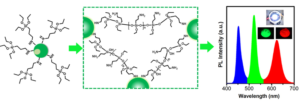
In a recent article published in the journal, Advanced Materials, a group of researchers led by Professor Yu Zhang from Jilin University hydrolyzed a (3-aminopropyl)triethoxysilane to form a silica matrix as a capping agent for perovskite quantum dots in order to produce white light-emitting diodes. Other researchers contributed to the study were Professor Xiaoyong Wang at Nanjing University and Professor William Yu at Louisiana State University.
In their experiments and following the preparation of green and red quantum dots [CsPbBr3 and CsPb(Br/I)3 ] at different temperatures, certain analytical results confirmed the successful capping of the perovskite quantum dots by the silica matrix. The average diameter of the red and green quantum dots increased from 2.7nm to 5 and 5.9nm, respectively before completion of the silica matrix formation.
The authors observed an increase in the stability of the photoluminescence quantum yield for the red and green quantum dots over a period of three months, due to the support provided by the silica matrix. Similar average photoluminescence decay lifetimes were found compared with other perovskite quantum dots, coupled with features of flexible spectra tunability. The photoluminescence quantum yields increased with size while its full width at half-maximum decreases, which indicates that high temperatures favor superior optical properties.
After further analyses they confirmed the non-existence of anion exchange reactions between the quantum dots in silica matrix, resultant white light-emitting diodes with Commission Internationale de I’Eclairage color coordinates which surpasses 120% of the National Television System Committee standard was obtained. The highest power efficiency attained was 61.2 Im W-1, far higher than that of other quantum dots composites.
The authors didn’t notice any visible change in the photoluminescence spectrum over 3 hours when operated at 20mA, indicating a high stability for the white light-emitting diode. However, as working time increases, the red quantum dots with silica matrix had a slight decrease in florescence compared to the green quantum dots with silica matrix. The white light-emitting diode has a calculated half-life of 227h.
This study was able to provide an improved performance of perovskite quantum dots for production of white light-emitting diodes.


Reference
Sun, C.1, Zhang, Y.1, Ruan, C.1, Yin, C.2, Wang, X.2, Wang, Y.1, Yu, W.W.1,3 Efficient and Stable White LEDs with Silica-Coated Inorganic Perovskite Quantum Dots, Advanced Materials 28 (2016) 10088-10094.
[expand title=”Show Affiliations”]- State Key Laboratory on Integrated Optoelectronics, College of Electronic Science and Engineering, Jilin University, Changchun, 130012, China
- National Laboratory of Solid State Microstructures and Collaborative Innovation Center of Advanced Microstructures, School of Physics, Nanjing University, Nanjing, 210093, China
- Department of Chemistry and Physics, Louisiana State University, Shreveport, LA, 71115, USA
Go To Advanced Materials