Advances in Engineering Advances in Engineering features breaking research judged by Advances in Engineering advisory team to be of key importance in the Engineering field. Papers are selected from over 10,000 published each week from most peer reviewed journals.

Significance
Electrospinning is one of the current and mainly used methods for polymeric nanofibers production. With the rapidly growing demand for polymeric nanofiber materials for various applications such as biomedical, filtration, energy generation and storage, chemical engineering and sensors, a lot has been done targeting at improving nanofiber production. Some of the conventional electrospinning techniques, employ auxiliary fields to increase the production rate of nanofibers by enhancing their electrospinning ability and regulating fiber deposition. Unfortunately, little is known about the effects of such auxiliary fields on the needleless electrospinning techniques.
Needleless electrospinning method is an improvementupgrading of conventional electrospinning. The difference is that the former does not require needle-like nozzle for fiber generation It is capable of enhancing the production of polymeric nanofibers efficiently and at high scale level. Although different, needleless techniques are available for use, the use of auxiliary fields for the needleless electrospinning has started gaining attention among researchers and industrialists.
A group of researchers at Institute for Frontier Materials, Deakin University in Australia: Dr. Guilong Yan, Dr. Haitao Niu, Dr. Hua Zhou, Dr. Hongxia Wang, Dr. Hao Shao, Dr. Xueting Zhao and Professor Tong Lin demonstrated the needleless electrospinning process using aerodynamic fields together with a second electric field for the production of polymeric nanofibers. Their main aim was to enhance the productivity of nanofibers at large scale level while also reducing the amount of energy consumption. They also investigated the effects between the two auxiliary fields used. Their research work is published in the research journal, Nanotechnology.
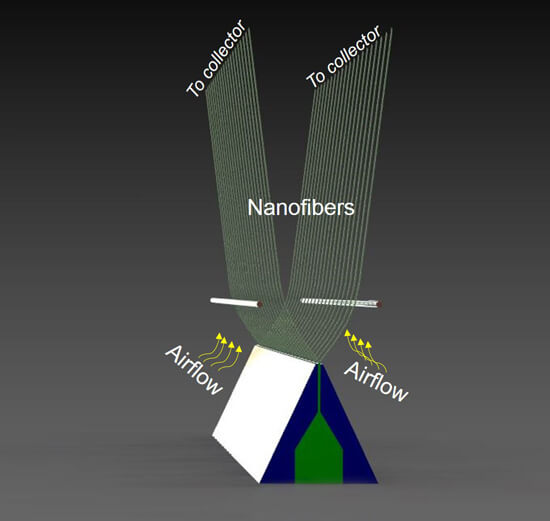
The authors commenced their work by developing a needleless spinneret model consisting of a metal roller collector, inductive electrodes, air flows and a slot spinneret. The various profiles of the electrical field intensity and the distribution of the air flow velocity in the electro-aerodynamic field aided needleless electrospinning system was analyzed using the finite element calculation method. Finally, they investigated the effect of different parameters on the electrospinning process, aboutin terms of nanofiber production and morphology.
The authors observed that the introduced electro-aerodynamic fields significantly increased the production rate of the nanofibers without compromising the size of fiber diameter. It stood at 350% higher than the electrospinning processes lacking additional auxiliary fields. Furthermore, the developed novel needleless electrospinning method is an excellent energy conserver as the amount of voltage required is much lower as compared to that needed for the normal needleless electrospinning processes.
According to the authors, the finite element analysis showed that the inductive electrodes and the air flow were the most significant factors of the process. The former increased the electric field strength especially close to the spinneret while the later was very crucial in ensuring fiber deposition onto the collector. However, the two auxiliary fields had to be applied at the same time for the successful electrospinning process.
This kind of studies is reported for the first time, it is evident that needleless electrospinning utilizing electro-aerodynamic fields can advance the production of polymeric nanofibers at large scale level and reduce the amount of energy consumption in needleless electrospinning process.



Reference
Yan, G., Niu, H., Zhou, H., Wang, H., Shao, H., Zhao, X., & Lin, T. (2018). Electro-aerodynamic field aided needleless electrospinning. Nanotechnology, 29(23), 235302.
Go To Nanotechnology