Advances in Engineering Advances in Engineering features breaking research judged by Advances in Engineering advisory team to be of key importance in the Engineering field. Papers are selected from over 10,000 published each week from most peer reviewed journals.

Significance
Mass spectrometers (hereafter MSs) are powerful analytical instruments that can determine the mass-to-charge ratios (hereafter m/z) of ions with exquisite sensitivity which make them critical in many disciplines from biochemistry to planetary exploration. The effectiveness of any MSs depends on the performance of its ion source. Among the many platforms, Time-of-Flight MSs (TOF-MSs) are notable for its speed and versatility. TOF-MSs utilize the fact that heavier ions fly slower while lighter ions fly faster; it requires pulsed ion packets synchronized with the mass analyzer’s start command (“On your marks, set…”), and determines the m/z of individual ions in the packets based on the TOFs they arrive at the detector, which is positioned at the finish line of the analyzer. Achieving these packets demands design of a special ion optics utilizing pulse voltages. The classical methods rely on a pusher electrode placed within the stream of ions, whereby ions coincidentally existing in front of the pusher at the start command moment are strongly pushed out and accelerated by a pulsed voltage applied on the pusher, causing the ions to begin flying. The pusher methods produce neat synchronization but discarding a vast fraction of ions generated outside the start window. The resulting inefficiency has been tolerated in large laboratory machines where space and power are abundant, however, it is insufficient in miniature TOF-MSs where every ion matters. Sensitivity is often a problem with small MSs; note that miniaturizing the ion optics while maintaining the mass resolution is not inherently difficult. For example, in ion optics simulations like SIMION®, reducing the length scale from 0.1 to 0.01 mm/grid would likely yield the same mass separation performance (setting aside the difficulty of fabrication). However, if the aperture, which is the part where ions are injected into the MS, is reduced to one-tenth of its size, this would directly translate to a tenfold decrease in sensitivity. This limitation has come into sharp focus with the rising demand for portable MSs, such as those involving the analysis of extraterrestrial materials aboard spacecraft—applications of interest to the authors. Power budgets on orbiters or rovers are measured in single watts, and instrument footprints must be drastically reduced without sacrificing scientific utility. Under such conditions, the conventional pusher approach no longer suffices. Sensitivity must be preserved, but auxiliary power supplies or bulky RF trapping systems are impractical. The challenge is stark: how to collect and deliver usable ion packets with minimal expenditure of energy and volume.
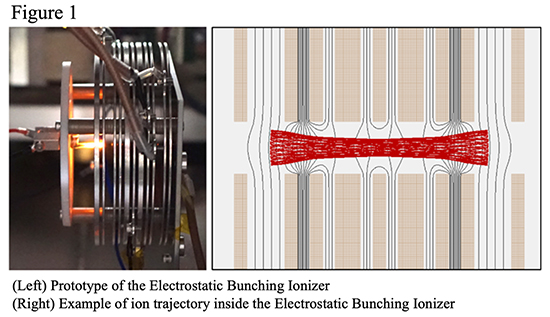
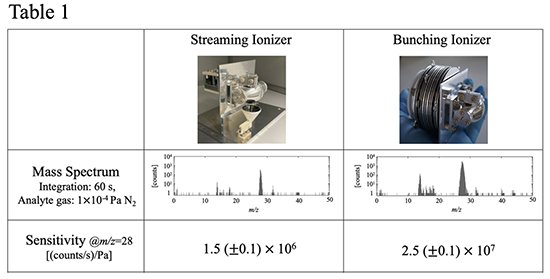
Dr. Oya Kawashima (currently postdoctoral fellow at University of Maryland) and his Japanese colleagues devised a new “efficient” ionizer that can trap ions inside with requiring only limited resources. The ionizer they developed (what they call “Electrostatic Bunching Ionizer”, hereafter EBI) is designed based on the electrostatic ion beam trap principle (Zajfman et al., 1997, Phys. Rev. A), borrowing techniques more familiar to optical cavity design than to mass spectrometry. Kawashima et al. proposed a resource-minimized analytical design of the EBI, based on ray transfer matrix formulation that defined trapping stability, and demonstrated its validity through simulations using SIMION8.0 (see right panel of Figure 1). They actually fabricated this EBI and paired it with their home-built miniature TOF-MS (Kawashima et al., 2024, IEEE), and demonstrated a more than tenfold increase in sensitivity (see Table 1) while obtaining the correlation between the ion signal intensity with respect to gas concentration (i.e., calibration curve). Their EBI operates at voltages up to only ~100 V, consumes only ~2.2 W of power, and weighs just ~100 g.
The novelty lies in demonstrating the general applicability of adapting electrostatic ion trap physics to all ion sources for TOF-MSs, enhancing their sensitivity without making them power-hungry. In this new method, ions that would otherwise be wasted are instead “bunched together and held” within the ionizer. Intuitively, this should indeed contribute to enhancing the population of ions. Excessive ion populations, another issue, can cause saturation in TOF-MSs, so if we can appropriately maximize the ion current using this method, it would be an innovative approach for improving sensitivity.
However, this novel ionizer still appears to have room for improvement. The time dispersion when using the EBI is slightly larger than when using a pusher-type ionizer, which leads to a loss in TOF-MSs’ mass resolution; this stems from the diverse states of the ion kinetic motion phase within the bunch (if marathon runners begin circling the 400 m track at their own timing, it is inevitably difficult to determine that they will all be at the same location at any given moment. “Bunching” within the EBI guarantees nothing more than that all runners are somewhere on the track). As solutions to minimize variations in the ion motion phase, the authors propose methods such as ejecting ions vertically (just like the 400 m track falls away to drop all ions into the pitfall). These approaches may enable more effective utilization of bunched ions for TOF-MSs. Future refinements could further enhance the performance; these avenues remain open, but the proof of principle is decisive: electrostatic bunching is both feasible and effective.

Reference
Kawashima, Oya & Kasahara, Satoshi & Saito, Yoshifumi & Hirahara, Masafumi & Asamura, Kazushi & Yokota, Shoichiro. (2025). Development of a Bunching Ionizer for TOF Mass Spectrometers with Reduced Resources. Journal of the American Society for Mass Spectrometry. 36. 10.1021/jasms.4c00436.