Advances in Engineering Advances in Engineering features breaking research judged by Advances in Engineering advisory team to be of key importance in the Engineering field. Papers are selected from over 10,000 published each week from most peer reviewed journals.

Significance Statement
Enhancing energy efficiency is an important way to control carbon dioxide emissions, especially since carbon-based energy will dominate the energy supply market in the foreseeable future. Currently, mainstream integrated assessment models (IAMs) treat energy efficiency improvement as an exogenous process by virtue of the autonomous energy efficiency improvement (AEEI) coefficient. This approach, however, does not support the endogenous energy efficiency improvement separated from the conventional energy-efficiency sector, and therefore fail to incorporate the impact of research and development incentives on the energy efficiency improvement. This could affect the long term substitution relationship between fossil fuels and non-fossil energy and lead to a deviation of evaluation for carbon abatement cost.
Herein, an endogenous energy efficiency improvement mechanism, i.e., energy efficiency improvement differentiated from exogenous energy efficiency improvement, has been developed in E3METL, so as to explore the role of endogenous energy efficiency improvement that is depicted by a series of key indicators such as: gross world product gains, macro-climatic loss, energy consumption, research and development investment, as well as optimal carbon tax in a carbon-constrained world.
Dr. Hongbo Duan and colleagues at University of Chinese Academy of Sciences investigated the importance of endogenous energy efficiency improvement in global climate change mitigation. The research team hoped to introduce an endogenous energy efficiency improvement mechanism in an integrated assessment model called E3METL, to explore the impacts of endogenous energy efficiency improvement on the global micro-economy, carbon dioxide emission paths and timing of carbon mitigations. Their research work is now published in Energy Efficiency.
The research team developed a special integrated assessment model (E3METL) to innovate the efficiency advancement mechanism that helped avert the possible deviation due to the fact that integrated assessment models tend to fail when it comes to separating endogenous energy efficiency improvement from exogenous energy efficiency mechanisms. They then considered two types of scenarios: the business-as-usual case and the optimal policy case where in each case they compared the results with and without the endogenous energy efficiency improvement.
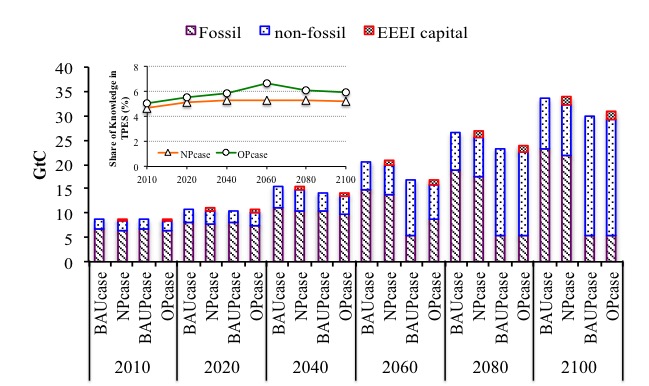
The team observed that by introducing the endogenous energy efficiency improvement, gross world product significantly improved and gained for both cases, with and without carbon restriction policies. This can be partly attributed to the reduced direct expenditure that resulting from energy savings and partly due to the fact that induced energy efficiency improvement reduces investments in energy infrastructure. They also noted that the specific research and development investments for endogenous energy efficiency improvement may crowd out other technical investments, and introducing a carbon restriction policy would ease this crowding-out effect to a large extent.
The results of their study reveal that introducing endogenous energy efficiency improvement significantly improves gross world product gains, and this positive effect is partly offset when carbon restriction policies are implemented; research and development investment dedicated to enhance energy efficiency limits research and development expenditures for other alternative technologies, and this effect will impede the development of non-fossil technologies; endogenous energy efficiency improvement may perform as one of supporting factors to delay the actions of carbon reduction; moreover, the introduction of endogenous energy efficiency improvement lowers the optimal carbon tax level by 7.8 % on average, as compared to the no endogenous energy efficiency improvement case.



Reference
Hongbo Duan, Gupeng Zhang, Ying Fan, Shouyang Wang. Role of endogenous energy efficiency improvement in global climate change mitigation. Energy Efficiency, volume 10(2017) pages 459–473.
Go To Energy Efficiency