Advances in Engineering Advances in Engineering features breaking research judged by Advances in Engineering advisory team to be of key importance in the Engineering field. Papers are selected from over 10,000 published each week from most peer reviewed journals.

Significance
Lanthanide (Ln3+)-doped upconverting nanoparticles (UCNPs) have attracted a great deal of research interest as they possess prominent advantages such as high spatial emission resolution, deep tissue penetration of near-infrared (NIR) excitation light, reduced light scattering and low autofluorescence background signal, among others. Such unique properties are at the core of the widespread applications of UCNPs in solar cells, security inks, biosensing, clinical applications and bioimaging (both in vitro and in vivo), for instance. Yet, some fundamental limitations such as the weak and narrow absorption bands of Ln3+ ions and their low absorption cross-section limit UCNPs in broadly harvesting near NIR light and producing bright upconversion luminescence, thus restricting their scope of utility in a wide range of applications.
To address these limitations, recently, enormous research input has been directed towards the development of NIR dye-sensitized UCNPs as they offer prominent advantages including a broader absorption range and enhanced upconversion efficiency. In most of the literature reports, NIR dyes have been directly anchored onto the surface of UCNPs, leading to the energy transfer across the organic/inorganic interface to the Ln3+ ions doped in UCNPs, thereby improving upconversion efficiency. However, such dye-sensitization processes using UCNPs/pristine organics-soluble dyes are mostly carried out in non-aqueous media and hence is of little use for biological imaging in the NIR-I or NIR-II window.
To overcome this bottle-neck, Prof. Ribeiro’s research group proposed to employ a water-dispersible NIR-II dye (IR-1061) to sensitize core/active shell UCNPs and achieve sufficiently high upconversion quantum efficiency in aqueous media. The core/active shell UCNPs were synthesized following modified high temperature co-precipitation method and the water dispersible dye was prepared using tip-sonication and phase transfer process.
The authors have particularly focused on achieving strong NIR-I emission rather than visible upconversion emission as the latter suffers from limitations of shallow tissue penetration depth, which again is not beneficiary for biological applications.
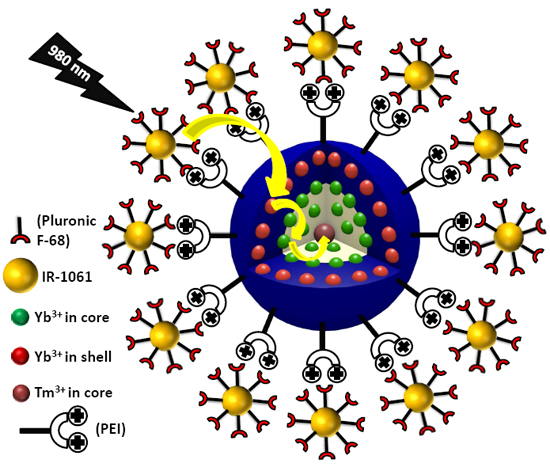
For this purpose, Pluronic F68-encapsulated water-dispersible IR-1061 dye was coupled with polyethyleneimine (PEI)-coated NaYF4:Tm3+/Yb3+@NaYF4:Yb3+ core/active shell UCNPs based on the electrostatically interactions between negatively charged water-dispersible NIR dyes and positively charged surface of UCNPs.
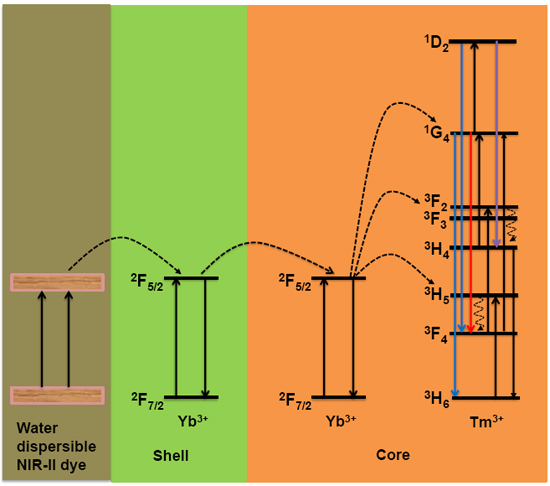
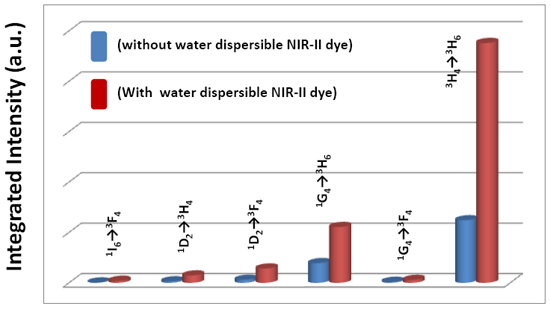
The authors achieved a 283% enhancement in NIR-I emission (i.e. 800 nm emission of Tm3+ ion) from water-dispersible NIR-II dye-sensitized core/active shell UCNPs via doping of ytterbium ions (Yb3+, 10 mol % optimal) in the UCNP shell, which bridged the energy transfer from the dye to the UCNP core. Practically, in comparison with the native form of the dye, this water-dispersible dye can also efficiently harvest irradiation energy, which is nonradiatively transferred to Yb3+ ions in the shell (via Forster mechanism) and subsequently to Yb3+ ions in the core. The later sensitizes Tm3+ ions positioned in the core, thus generating upconversion luminescence from the UCNPs. The detailed mechanistic study by Prof. Ribeiro’s research group found an optimal UCNPs/dye ratio of 1/60 for efficient energy transfer between water-dispersible IR-1061 dye and UCNPs.
In their study, the authors demonstrated a detailed characterization of their proposed dye/UCNPs system, highlighting the possible energy transfer mechanism as well as the effect of shell and core configuration and dye-loading on the upconversion response of the system, thus offering an interesting strategy to improve NIR-I emission from core/active shell UCNPs. Such water-dispersible dye/UCNPs system not only possesses greater potential for a broad spectrum of photonic applications but will also pave the way for new biological and medical applications.





REFERENCE
Chanchal Hazra, Sajjad Ullah, York E. Serge Correales, Laís G. Caetano and Sidney J. L. Ribeiro (2018) . Enhanced NIR-I emission from water-dispersible NIR-II dye-sensitized core/active shell upconverting nanoparticles. Journal of Materials Chemistry C 6, 4777-4785.
Go To Journal of Materials Chemistry C