Advances in Engineering Advances in Engineering features breaking research judged by Advances in Engineering advisory team to be of key importance in the Engineering field. Papers are selected from over 10,000 published each week from most peer reviewed journals.

Significance Statement
Brillouin optical time-domain analysis (BOTDA) sensors can realize temperature and strain sensing along many tens of kilometers with spatial resolutions in the meter or even centimeter scale, which promotes their applications in structural health monitoring, geotechnical engineering and leakage detection along pipelines, etc. The key of this technique is that the frequency corresponding to peak power of the Brillouin gain spectrum (BGS) is linearly related to the temperature and strain applied to the sensing fiber. Because the Brillouin gain or loss signal that used for BGS reconstruction is usually very weak, thus, one of the most important research topics for BOTDA sensors is to improve the signal-to-noise ratio (SNR). Several advanced techniques have been proposed to realize this goal, such as distributed Raman amplification, optical pulse coding, and different signal processing.
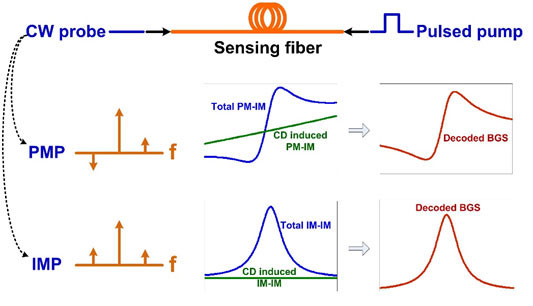
Recently, coherent detection method is employed in BOTDA sensors, resulting in several-dB or even more than 10-dB SNR improvement. Our group (led by Prof. Lianshan Yan at the Southwest Jiaotong University, China) is interested in this method, and plenty works for optimizing coherent-detection BOTDA sensors have been carried out, such as reducing the noise caused by multiple sidebands, reducing the effect of phase jitter caused by optical fiber link transmission (Opt. Express, 23(23), 23(12), 2015; 24(5), 2016). We theoretically analyze and experimentally demonstrate the effect of chromatic dispersion (CD) on coherent-detection BOTDA sensors that based on double-sideband (DSB) phase modulated probe (PMP). In which, BGS can’t be extracted correctly through the difference value between the total PM-IM conversion and CD induced PM-IM conversion, where total PM-IM conversion is contributed by both Brillouin gain and CD. However, BGS can be fully recovered by this difference value by using DSB intensity modulated probe (IMP), meanwhile system stability is enhanced, i.e., measured BGS under different probe powers and extinction ratios are almost the same. Besides, sensor performance can be further improved by using single-sideband (SSB) IMP instead of DSB-IMP, which is independent of the sensing fiber length and modulation frequencies as demonstrated by our newest published paper (PJ, vol. 8 (1), 6800908 (2016)). Until now, a spatial resolution of 2m along 40-km sensing fiber with a temperature resolution of 0.97°C has been realized by our group.


Journal Reference
Opt Express. 2015 Nov 16;23(23):30483-90.
Li Z, Yan L, Shao L, Pan W, Luo B.
Center for Information Photonics & Communications, School of Information Science & Technology, Southwest JiaoTong University, Chengdu, Sichuan,610031, China
Abstract
An approach for reducing chromatic dispersion (CD) induced Brillouin gain spectrum (BGS) distortion and measurement instabilities in coherent Brillouin optical time domain analysis (BOTDA) sensing systems is proposed and experimentally demonstrated. By utilizing intensity modulated probe (IMP) instead of phase modulated probe (PMP), sensing performance is obviously improved. Reduction of ~6-MHz decoding error caused by the CD induced BGS distortion is achieved in the measurement of Brillouin frequency shift (BFS) along the whole 40-km sensing distance. Enhanced system stabilities are demonstrated by testing the BGS under different conditions.
Go To Optics Express.