Advances in Engineering Advances in Engineering features breaking research judged by Advances in Engineering advisory team to be of key importance in the Engineering field. Papers are selected from over 10,000 published each week from most peer reviewed journals.

Significance
Seismic design is a critical process in ensuring the safety and functionality of structures during and after an earthquake. With numerous older reinforced concrete structures being vulnerable to seismic forces, it becomes essential to strengthen and retrofit them to withstand such stresses. Various techniques have been developed, including steel jacketing, reinforced concrete jacketing, externally bonded fiber-reinforced polymer jacketing, and the near-surface mounted technique. However, these methods have their drawbacks, such as increasing weight and rigidity, being ineffective at enhancing lateral strength, and posing flammability risks.
One promising technique that shows potential for increasing the strength of columns is the near-surface mounted (NSM) technique. This method involves cutting grooves in the concrete cover, filling them with a bonding agent, and inserting steel or fiber-reinforced polymer bars in the grooves. Another promising material for reinforcing concrete structures is ultra-high-performance concrete (UHPC). While previous studies have separately investigated the effectiveness of UHPC jacketing and the NSM technique in strengthening reinforced concrete columns with continuous longitudinal reinforcements, there is still limited research on their effectiveness in seismic design.
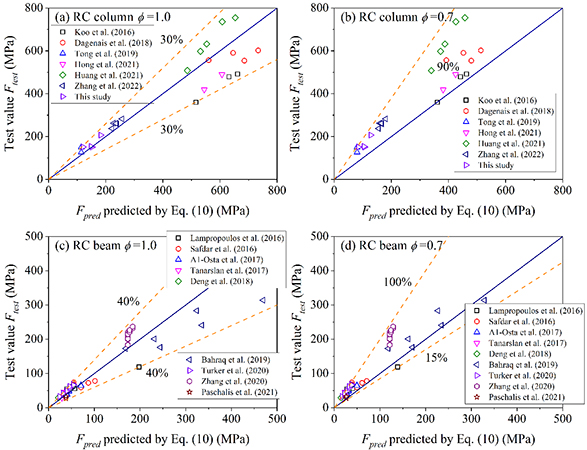
To address this research gap, Professor Gao Ma, Cheng Wu, and Kang Liu from Hunan University conducted a new study published in the peer-reviewed Journal Engineering Structures. They presented a simplified theoretical method to predict the flexural strength of reinforced concrete members strengthened or retrofitted with UHPC and the NSM technique. The researchers evaluated the accuracy of their method by comparing the prediction results with test results for reinforced concrete columns and beams.
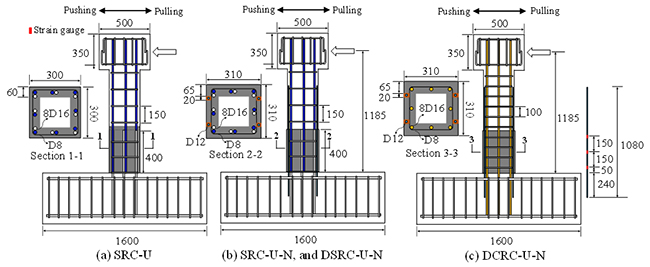
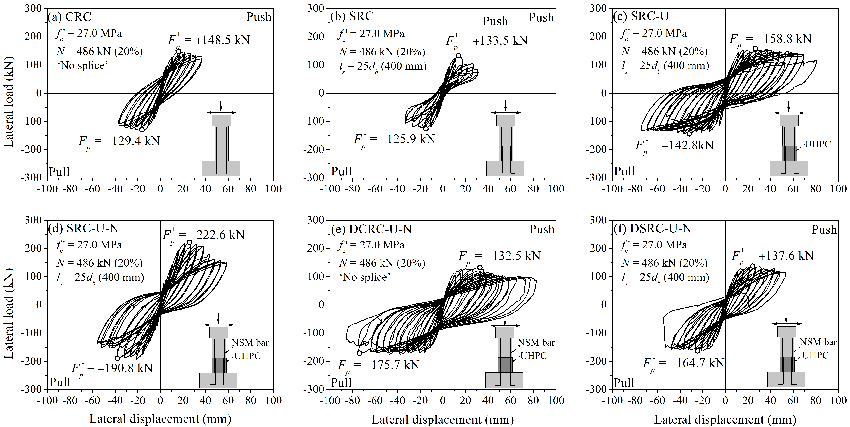
The researchers performed cyclic loading tests on large reinforced concrete columns with lap-spliced rebars in the plastic hinge region. Two substandard columns were retrofitted with UHPC jacketing and the NSM technique, while two damaged columns were also retrofitted with the same techniques. The test specimens had a 300 mm × 300 mm cross-sectional area and a shear span-depth ratio of 3.75. The material properties of the steel bars and UHPC jacketing used were crucial to the experiment. The compressive strength of the concrete was found to be 27.0 MPa, while the UHPC jacketing had an average compressive strength of 140.3 MPa and a tensile strength of 8.1 MPa.
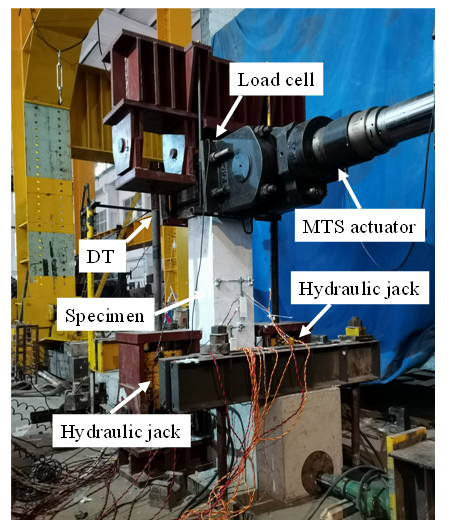
During the tests, the researchers monitored the behavior of the test samples using various measuring instruments. They measured the vertical displacement of each column on each loading side using displacement transducers. Strain gauges were attached to the spliced bars on the two loading sides to investigate the strain distribution of the longitudinal reinforcements. Additionally, strain gauges were mounted near the surface of the NSM bars.
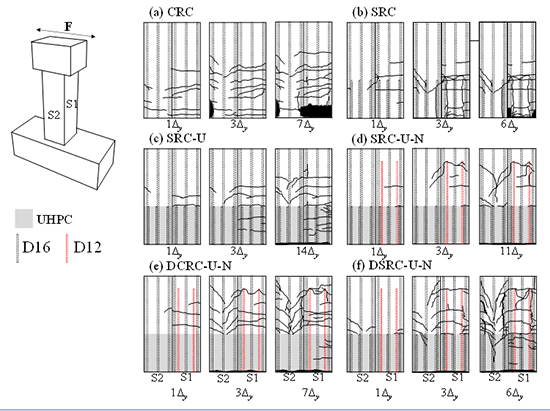
Through their experiments, the research team observed crack progression and failure patterns in column specimens. Conventional reinforced concrete specimens near the column base exhibited flexural, diagonal shear, and vertical cracks. Defective lap splices caused bond failure and vertical bond-splitting cracks. Flexural failure occurred in specimens strengthened with UHPC, except for one that failed due to shear-flexural failure. The retrofitted specimens showed higher peak strengths, indicating improved seismic performance.
The researchers analyzed several parameters, including stiffness degradation, residual displacement, hysteretic energy dissipation, equivalent viscous damping ratio, and column curvature. They found that near-surface mounted UHPC reduced stiffness degradation, and both UHPC and the NSM technique reduced lap splice column residual displacement. Retrofitted specimens demonstrated improved seismic performance by enhancing hysteretic energy dissipation and the equivalent viscous damping ratio.
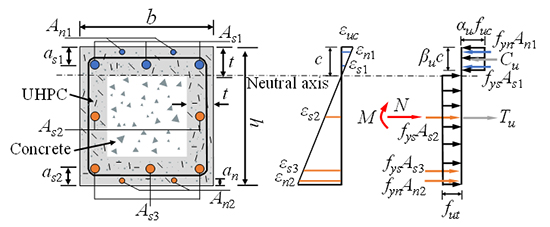
To predict the flexural strength of reinforced concrete members retrofitted with UHPC and the NSM technique, the researchers developed a simplified theoretical method. This method considered the confinement and bond behavior of UHPC. The proposed method’s accuracy was assessed by calculating the average ratio of test results to predictions and the coefficient of variation. The findings indicated that the proposed method could reasonably predict the flexural strength of reinforced concrete members strengthened or retrofitted with UHPC. However, further research is necessary to determine its applicability under different conditions and assumptions.
In conclusion, Professor Gao Ma and his associates presented a theoretical approach to predict the flexural strength of reinforced concrete members retrofitted with UHPC and the NSM technique. By comparing the predicted results of their method with experimental results for reinforced concrete columns and beams, they evaluated its accuracy. The study demonstrated that the proposed method can make reasonably accurate predictions for flexural strength. Nevertheless, additional research is needed to determine its effectiveness in different scenarios and assumptions.



Reference
Gao Ma, Cheng Wu, Kang Liu. Seismic performance of lap-spliced pre-damaged and intact concrete columns strengthened or retrofitted with UHPC and NSM. Engineering Structures, Volume 277, February 2023, 115431.