 Advances in Engineering Advances in Engineering features breaking research judged by Advances in Engineering advisory team to be of key importance in the Engineering field. Papers are selected from over 10,000 published each week from most peer reviewed journals.

Significance
Thermal radiation is important in solar energy conversion and high-temperature engineering because its thermodynamic energy quality changes with wavelength. This matters in systems that direct different parts of the spectrum to photovoltaic, photothermal, or thermophotovoltaic conversion. Radiative exergy describes how much useful work can be obtained from this radiation by considering both its energy and entropy. Classical treatments of radiative exergy have been developed most fully for blackbody radiation. Petela’s formulation provides a widely accepted description of total blackbody radiative exergy, and spectral formulations based on radiative entropy and radiation temperature extend the analysis to individual wavelengths. Engineering radiation, however, frequently departs from ideal blackbody behavior. Diffuse gray surfaces provide one important case, but contemporary micro/nanostructured absorbers and emitters create significantly stronger spectral selectivity and their emittance may change sharply with wavelength and, in some systems, with direction. This is why a single material temperature or wavelength-independent emittance cannot characterize accurately the thermodynamic quality of the resulting radiation field.
Assigning exergy to monochromatic radiation requires accounting for how radiation quality changes with photon frequency. Although the energy of a photon is fixed by its frequency, that thermodynamic quality decreases as the frequency is reduced during an ideal conversion process. A single Carnot efficiency evaluated at one temperature therefore cannot fully describe this behavior. Equivalent temperature provides a way to relate photon frequency to radiation quality, with shorter-wavelength radiation corresponding to higher energy quality and a higher spectral equivalent temperature. For non-blackbody radiation, radiative intensity becomes the key quantity, while emittance describes how the material surface constrains the resulting photon field.
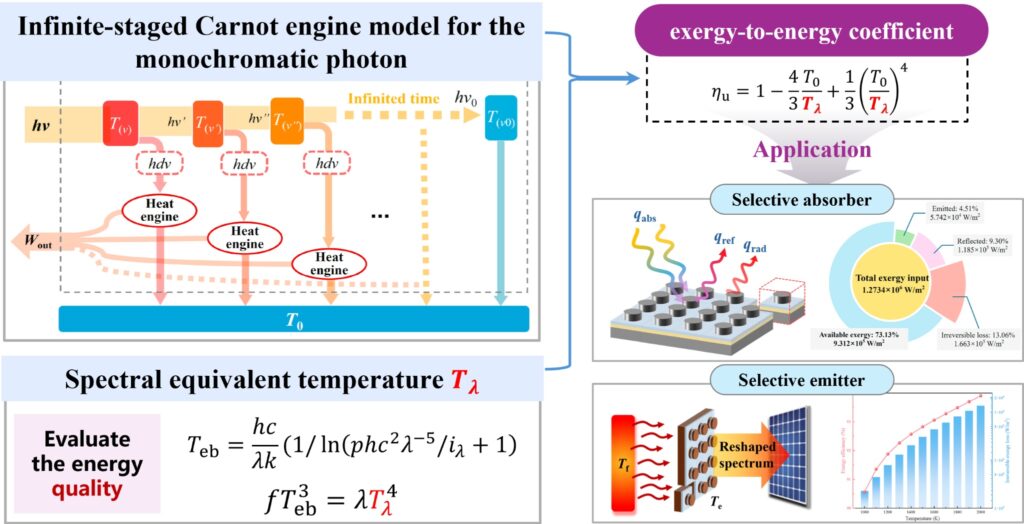
In a recently published research paper in Energy, Professor Shiquan Shan and Dr. Ziying Cheng from Zhejiang University developed an analytical spectral exergy model for non-blackbody radiation by combining equivalent temperature with an infinite-staged Carnot engine description of monochromatic photons. They also formulated a more general non-blackbody method that derives an equivalent blackbody temperature directly from spectral radiative intensity, allowing wavelength-dependent emissive behavior to be treated without a constant-emittance assumption. The new approach links the exergy of individual photons to the total radiative exergy and provides practical methods for analyzing blackbody, graybody, and spectrally selective radiation. The authors then applied these methods to concentrated solar absorbers and combustion-driven thermophotovoltaic systems. The researchers’ analysis begins from an infinite-staged Carnot engine representation of a monochromatic photon. An incident photon is progressively reduced in frequency through infinitesimal reversible steps. At each step, the small decrease in photon energy is converted into thermal energy and passed through an ideal Carnot engine operating between the corresponding equivalent radiation temperature and the ambient temperature. The process continues until the photon reaches a frequency whose equivalent temperature equals the ambient temperature, leaving no further extractable work. Because the frequency change is treated as infinitesimal, the accumulated work represents the monochromatic photon exergy. This approach follows how radiation quality gradually decreases as photon frequency is reduced, instead of applying a single Carnot factor to the photon’s entire energy.
Shan and Cheng then connected this photon-level construction to established graybody thermodynamics. They linked the spectral exergy across all wavelengths to the total exergy of graybody radiation, which allowed them to define the corresponding spectral equivalent temperature. They found the resulting exergy-to-energy coefficient follows the same general form as Petela’s expression, but uses a wavelength-dependent equivalent temperature. This temperature varies with wavelength, radiation temperature, and, for graybody radiation, emittance. The calculations showed also that radiative exergy decreases at longer wavelengths and increases with radiation temperature and emittance. At high temperatures and high emittance, the model closely matched the reference calculations. The authors identify temperatures above 500 K and emittances above 0.5 as the principal operating range for the analytical graybody model; at lower emittance it remains useful across the dominant spectral interval around the emission peak. For general non-blackbody radiation, the authors used a method that assigns an equivalent blackbody temperature to each wavelength based on the measured radiative intensity. This makes it possible to calculate spectral exergy even when emittance changes across the spectrum. Their results agreed closely with established reference calculations over a wide range of conditions, including cases with strongly wavelength-dependent emittance and good agreement was also maintained in low-emittance regions, supporting the method for non-blackbody radiation.
The engineering examples show what exergy analysis adds to a standard energy balance. For the solar absorber, it distinguished ordinary energy losses from losses in radiation quality during conversion. In the combustion-driven thermophotovoltaics system, higher emitter temperature increased the quality of the available radiation despite greater absolute exergy loss. The method can evaluate radiation fields shaped by material design. In concentrated solar systems, micro/nanostructured absorbers capture solar radiation while reducing long-wavelength thermal emission. The authors’ formulation allows this spectral selectivity to be assessed thermodynamically, rather than only through absorbed and emitted energy. It therefore becomes possible to determine which portions of the spectrum retain high available work after absorption and which portions contribute most strongly to exergy degradation. Such information can support optimization of absorber spectral response and operating conditions.
A similar role appears in thermophotovoltaic systems. Selective emitters are designed to reshape broadband high-temperature radiation into spectral bands that correspond more closely to the response of photovoltaic cells. The equivalent-temperature approach gives engineers a way to evaluate whether this spectral redistribution concentrates radiative exergy into useful wavelength intervals. In addition to total emitted power, the analysis distinguishes radiation according to its thermodynamic quality. This can guide the design of multilayer and periodic microstructures intended to suppress poorly utilized long-wavelength emission and strengthen spectral regions that contribute more effectively to electricity generation.
The new method can also be applied to combustion-based energy systems, where flame radiation is often approximated as graybody radiation. Radiative exergy analysis can show how much useful energy remains before the radiation is converted into lower-temperature heat, which is valuable in thermophotovoltaics and other cascaded conversion systems. This helps determine how radiative energy can be used before the remaining heat is recovered. The method can also evaluate how exergy varies with wavelength and emission direction. For materials whose emittance changes with wavelength or emission angle, this permits designers to evaluate how optical architecture influences both the magnitude and quality of emitted radiation. The analysis can consequently serve as a design and diagnostic tool for solar selective absorbers, high-temperature selective emitters, and related micro/nanostructured radiative-control devices, where energy-efficiency analysis can be complemented by information on the thermodynamic quality of the radiation.


Reference
Shiquan Shan, Ziying Cheng, Non-blackbody radiation exergy analysis model based on equivalent temperature method for energy conversion application, Energy, Volume 348, 2026, 140494,
Go to Energy