Advances in Engineering Advances in Engineering features breaking research judged by Advances in Engineering advisory team to be of key importance in the Engineering field. Papers are selected from over 10,000 published each week from most peer reviewed journals.

Significance
Before any mechanical part is approved for its relevant application, thorough testing is done so as to ensure high reliability of the component in actual use and minimize damages under severe conditions. Recently, roller bearings in rotary wind turbines have been reported to fail prematurely. A systematic cross-examination of the failed bearings has revealed the presence of cracks in the bearing steels. Further optical metallographic inspections have revealed white etching matter along the cracks in the steel. Presently, the existing literature concerning white etching matter gives a mixed reaction with no precise resolution to this issue. For example, while some reports suggest that the white etching matter formed along the cracks is the root cause of bearing damage, other reports suggest white etching matter is formed as result of the crack faces rubbing. In addition, there is no conceptual understanding on how white etching cracks are generated during the bearing operation and why these were often seen in bearings of wind turbines. In this regard, there is urgent need for further investigations in order to elucidate on the mechanisms associated with white etching cracks (WECs) formation.
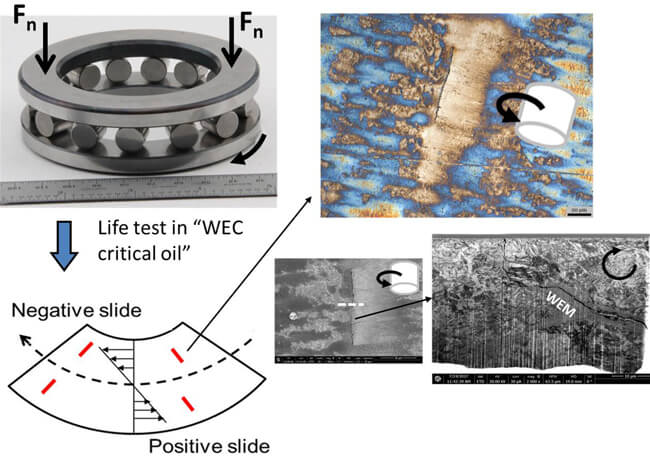
Recently, a team of engineers from the Timken Company’s World Headquarters in the United States: Dr. Mohanchand Paladugu, Douglas Lucas and Dr. Scott Hyde investigated how and why the white etching cracks are generated in bearings. The engineers of the TIMKEN achieved this understanding by life testing the Cylindrical Roller Thrust Bearings (CRTBs) in different lubricant oils including the one known for generating white etching cracks (called “WEC critical oil”) and depicting respective damage mechanisms. Their work is currently published in the research journal, Wear.
Because of their geometry, the CRTBs have about 10-11% slide to roll ratios generated along the rolling contact line during their operation. The engineers employed different microcopy techniques, including optical microscopy, scanning electron microscopy and scanning ion microscopy to reveal the mechanism of white etching cracking. The life tested CRTBs were examined in detail by these microscopy techniques..
Following these empirical investigations, the authors observed that the bearing life in the WEC critical oil was less than 5% of life in the mineral oil. Additionally, they noted that with respect to the oils used, varying damage modes were observed in the sliding zones. The WEC critical oil produced a tribo-film in the sliding zones that was seen to be primarily composed of the additive elements of the oil. In addition to the tribo-film, the WEC critical oil caused micro “line-cracks” generation on the tribo-surface along the rolling contact line, and these line cracks propagated deep into the subsurface and had white etching matter along the cracks. Based on the crack morphologies and the crack orientations with respect to the roller movement and respective applied traction forces, in the case of the WEC critical oil, the root cause for line cracks (white etching cracks) generation was traced to the high surface shear forces applied on the contacting surfaces. As a consequence of high surface shear stresses, deeper tribo-surface deformations were observed. In this specific case, high surface shear forces were caused by the tribo-film formed on the tribo-surface and the sliding forces generated along the rolling contact line. In addition, the engineers postulated that the locations of the line cracks were determined by the local intensity of asperity contacts at the tribo-surface and respective local surface shear stress.
Dr. Mohanchand Paladugu and colleagues study has successfully revealed the generation mechanism of white etching cracks based on the above observed damage features in the CRTBs. From the logical interpretation of the results, the engineers have acknowledged that the morphological similarity between the line cracks and the axial cracks in the bearings of wind turbine gear boxes suggests that the formation of the axial cracks is associated with high tribo-surface shearing forces and sliding that generate in wind turbine applications. Altogether, this study has elucidated the generation mechanism of white etching cracks by testing the bearings in rolling-sliding conditions and different lubricant oils.

Reference
Mohanchand Paladugu, Douglas R. Lucas, R. Scott Hyde. Effect of lubricants on bearing damage in rolling-sliding conditions: Evolution of white etching cracks. Wear, volume 398–399 (2018) pages 165–177
Go To Wear