Advances in Engineering Advances in Engineering features breaking research judged by Advances in Engineering advisory team to be of key importance in the Engineering field. Papers are selected from over 10,000 published each week from most peer reviewed journals.

Experimental and numerical study
Significance
One crucial consideration in ensuring the safety of buildings and structural components is ensuring minimal seismic effects. In response to major earthquakes that have been witnessed in human history, together with implications on both life and economy, seismic design codes were created to guide the design and construction activities with the core aim of protecting them from earthquakes. However, the current seismic codes mainly focus on preventing building collapse when subjected to earthquake vibrations.
Whereas this has remained a key focal point in developing seismic design codes, it has some vital design limitations that hinder it from achieving the intended functions. For instance, structural components are generally designed to dissipate energy through hysteretic plastic deformation. This may not go well since these components form part of the gravity-resisting system and often result in residual drift and structural damages. Repairing such damages after earthquakes is often difficult and costly. Therefore, overcoming these challenges demands that the seismic design codes consider the seismic resilience of structural components.
The seismic resilience of structures has recently gained considerable research attention. Previous research has demonstrated that utilizing energy-dissipated devices decoupled from gravity-resisting systems offers an effective approach for controlling structural damage and improving seismic resilience. These energy dissipaters concentrate the damages and can be easily replaced in the post-earthquakes without interfering with the gravity-resisting systems. Among the available energy-dissipaters, metallic dampers are widely preferred owing to their remarkable shear, flexural and buckling properties. In particular, different metallic dampers with flexural-tensile behaviors have been extensively studied save for their performance, installation and application limitations that need further investigation.
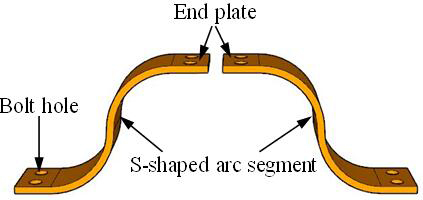
On this account, a group of Central South University researchers: Dr. Zhipeng Zhai, Professor Wei Guo, Dr. Zhiwu Yu, Chongjian He (Ph.D. student), and Zhefeng Zeng (Ph.D. student) developed a novel metallic structural fuse named S-shaped steel plate damper (SSPD) for seismic resilience applications. Unlike most metallic dampers, SSPD was welding-free and was thus considered convenient for fabrication, installation, replacement after earthquakes and inspection. Practical design formulas for the novel damper were proposed. Their work is currently published in the research journal, Engineering Structures.
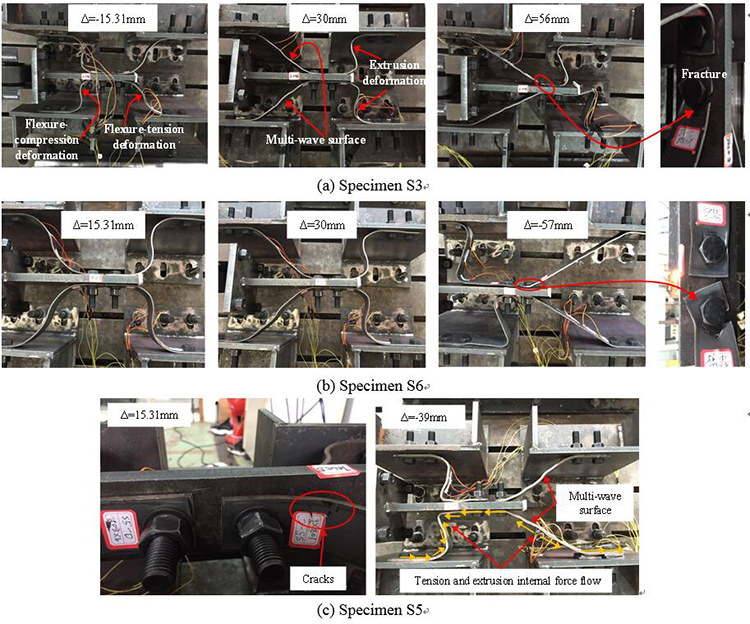
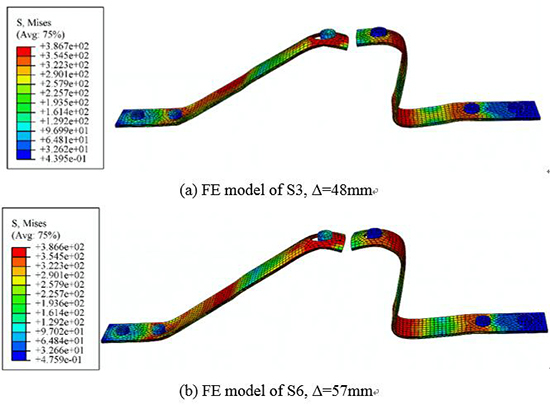
In brief, the proposed SSPD consisted of two S-shaped plates fabricated by cold-forming of normal steel and connected to structural components by bolts. Ten specimens were tested by cyclic and monotonic loadings to study the mechanical behaviors, failure mode, and seismic performance of the damper. Also, a finite element model was developed and verified through the test results. Finally, the authors assessed the various factors affecting the performance of SSPD and recommended potential improvement ideas and practical design formulas.
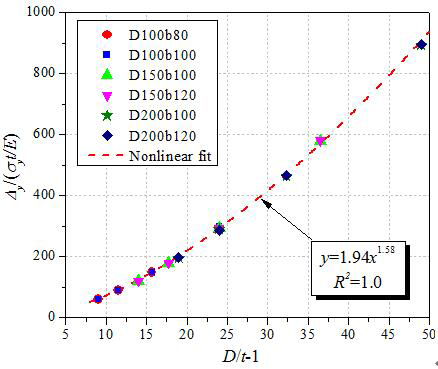
Results demonstrated that the seismic energy was dissipated through plastic deformation of the S-shaped plate in small and medium displacements, while the deformation shifted from flexural to tensile behaviors under large displacements. Due to the dominant flexural-tensile behavior of the damper, a corresponding force-displacement relationship, as well as the practical design formulas for critical damper parameters, were established. The SSPD exhibited remarkably stable hysteresis loops, energy dissipation and large deformation capacity attributed to the high tensile strength effects. Moreover, the finite element model could accurately predict the flexural-tensile behavior and failure mode of the damper. The parametric studies revealed that the height-thickness ratio was a vital determinant of the damper’s stiffness and ductility properties.
In a nutshell, the authors presented a new metallic energy dissipator, which dissipate energy through inelastic deformation of flexural-tensile behavior. Based on the results, practical design formulas and recommendations for improvement were proposed. Some of the recommendations made for improving the performance of SSPD included merging the top ends of the S-shaped steel plate to improve the damper’s integrity and adding restraining plates on the end-plates to enhance its stiffness and strength. The study increased the understating of the seismic resilient application of SSNP and would pave ways for developing more robust dampers for similar applications.



Reference
Zhai, Z., Guo, W., Yu, Z., He, C., & Zeng, Z. (2020). Experimental and numerical study of S-shaped steel plate damper for seismic resilient application. Engineering Structures, 221, 111006.