Advances in Engineering Advances in Engineering features breaking research judged by Advances in Engineering advisory team to be of key importance in the Engineering field. Papers are selected from over 10,000 published each week from most peer reviewed journals.

Significance Statement
Slurry bubble column reactors (SBCRs) are three-phase systems, in which gaseous bubbles are dispersed through a liquid-solid slurry in a vertical column. These reactors are becoming more competitive due to their advantages and are used in many industrial applications. The hydrodynamics of slurry bubble column reactors are strongly influenced by the type of the flow regime in the column. There are three types of flow regimes in bubble columns; 1) Homogeneous regime (bubbly flow), where the superficial gas velocities are low and the rise velocities and sizes of the bubbles are relatively uniform. 2) Heterogeneous regime (churn-turbulent flow), where the gas bubbles are more interacted by coalescence and break up, because of the increase in gas velocities. 3) Slug flow regime; which is encountered in small diameter columns. In this case, when the gas velocity increases, the bubbles of the gas will coalesce to form slugs with large diameters.
The detection of the boundaries between the regimes is very important because of the significant changes in the hydrodynamic behavior of the slurry bubble column reactor for each flow regime. Since the flow regime transition depends on different parameters, the boundaries between the regimes are not exact and there exist a transition regime where each flow regime can prevail depending on the experimental setup and system used.
Most of the previous studies in flow regime transitions were carried out for air/water systems. In this paper, the flow regime transition is specified for a high temperature helium gas injected in a mixture of liquid water and alumina solid particles. In the literature, no work has been reported regarding detailed hydrodynamic studies of slurry bubble columns with high temperature helium gas. Also, because of the large difference in densities between helium gas and air, and due to the significant impact of the gas density on hydrodynamics of bubble columns, it is not suitable to use the previous literature results of air/water systems to predict the regime boundaries of the helium/water systems. Therefore, the present work seeks to fill this gap by investigating experimentally the slurry bubble column using alumina-water slurry at 22oC and helium gas at 90oC. The importance of using helium gas lies in being a perfect fluid for transferring heat because of its high thermal conductivity and specific heat as well as it is inert and safe to use.

Journal Reference
Experimental Thermal and Fluid Science, Volume 74, June 2016, Pages 404-410.
M.W. Abdulrahman
Faculty of Engineering and Applied Science, UOIT, Oshawa, ON L1H 7K4, Canada
Abstract
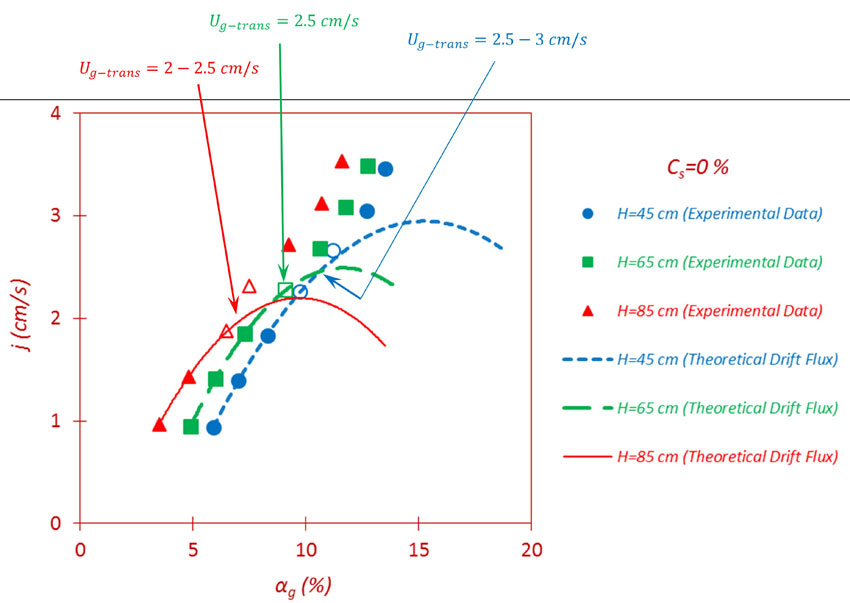
In this paper, the transition velocity is investigated experimentally for a helium gas at 90 °C injected through a slurry of water at 22 °C and alumina solid particles in a slurry bubble column reactor. This paper examines the effects of superficial gas velocity, static liquid height and solid particles concentration, on the transition velocity of the slurry bubble column reactors. From the experimental work, it is found that the transition velocity between homogeneous and churn turbulent flow regimes, decreases by increasing the static liquid height and/or the solid concentration. It is also found that there is no slug flow regime in the industrial slurry bubble column reactors
Go To Experimental Thermal and Fluid Science