Advances in Engineering Advances in Engineering features breaking research judged by Advances in Engineering advisory team to be of key importance in the Engineering field. Papers are selected from over 10,000 published each week from most peer reviewed journals.

Significance
Steel is among the most important and commonly used engineering and construction materials. Different steels with different properties have been developed to satisfy different application prospects. Among them, ultra-high strength steel (UHSS) with nominal yield strength exceeding 1000 MPa has been increasingly used. Compared with normal-strength steel, UHSS has several advantages, including reduced structural members, welding, construction works and transportation. They also require less space. However, the application of UHSS is restricted as it fails to meet some material property requirements defined by current design codes.
The mechanical properties of UHSS are very critical for their structural design. Although UHSS is generally characterized by high specific strength, good weldability and formability, sufficient toughness, their ductility tends to decrease with an increase in yield strength. Recent findings revealed that subjecting UHSS to successive plastic strain cycles with identical magnitude results in isotropic cyclic softening characterized by a decrease in the size of the elastic range. The nonlinear decrease in softening response is often associated with accumulating plastic strain and component and structure scale.
Numerous constitutive models have been developed to simulate and capture the response features in high-strength steels. Generally, these models consist of kinematic hardening involving isotropic hardening and yield space changes in space and size. Additionally, most of the models are developed based on Chaboche plasticity model. Despite the extensive study of the properties and behaviors of high-strength steels, most have concentrated on those with nominal yield strength ranging from 460 – 960 MPa. However, there are limited studies on the cyclic performance of UHSS with nominal strength exceeding 1000 MPa. In particular, there is a need for an in-depth understanding of the influence of initial residual strain and strain amplitude on the cycle behavior of UHSS.
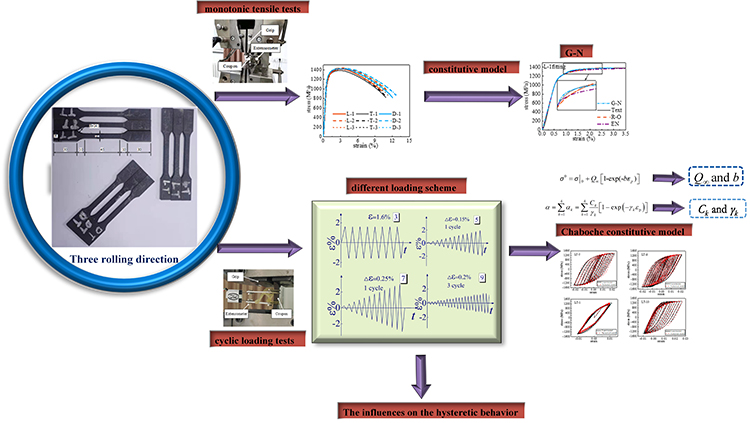
Herein, Ms. Yun Zhang, Dr. Yuan-Zuo Wang, Professor Lu Yang and Dr. Fei Yin from Beijing University of Technology investigated the hysteretic behavior of Q1100 UHSS with a nominal yield strength of 1100 MPa. To achieve this objective, they carried out monotonic tensile and cyclic loading tests. Cyclic loading tests involved combining variable and constant amplitude loading schemes to study the influence of loading schemes on the hysteresis properties of the UHSS. The hysteresis curves were analyzed in terms of anisotropy, ductility, retained strength, strength softening and energy dissipation capacity. Their work is currently published in the journal, Thin-Walled Structures.
The authors showed the response of the UHSS under monotonic loading differed significantly from its response under cyclic loading. It exhibited significant softening behavior under cyclic loading characterized by a rapid decrease in strength at the start of the cyclic loading before stabilizing. Notably, the strength decrease appeared more slowly with large residual strains. The Q1100 UHSS recorded a 0.87 yield ratio and 12% elongation at fracture under monotonic tensile loading. An increase in the strain amplitude resulted in a corresponding increase in the energy dissipation coefficient of Q1100 UHSS.
Furthermore, cyclic loading tests were conducted on specimens with different sampling directions. The results showed no significant differences in sampling directions, suggesting that Q1100 UHSS is isotropic. By using an automatic calibration method, a nonlinear combined hardening constitute model was successfully calibrated for various cycling loading schemes. As a result, it was possible to predict the cyclic behavior of Q1100 UHSS with satisfactory results.
In summary, the new study investigated experimentally the structural behavior of Q1100 UHSS under both cyclic and monotonic loading. A total of 9 tensile tests and 24 cyclic tests were carried out to establish the monotonic mechanical properties and hysteresis behavior of the UHSS, respectively. The findings provided more insights into the hysteric behavior of Q110 UHSS. In a statement to Advances in Engineering, the lead and corresponding author, Professor Lu Yang said their study would contribute to the design of high-performance UHSS for extended applications.

Reference
Zhang, Y., Wang, Y.Z., Yang, L., & Yin, F. (2023). Experimental study on hysteretic behavior of Q1100 ultra-high strength steel. Thin-Walled Structures, 182, 110291.