Advances in Engineering Advances in Engineering features breaking research judged by Advances in Engineering advisory team to be of key importance in the Engineering field. Papers are selected from over 10,000 published each week from most peer reviewed journals.

Fast, low-cost, facile and reproducible electrodeposition method
Significance
Surface-enhanced Raman scattering (SERS) has become increasingly popular in the scientific community as an analytical technique capable of fast detection of analytes at low concentrations and molecular levels. SERS has demonstrated its high efficiency to increase the Raman signal of chemical and biological species through the amplification of electromagnetic fields generated by the excitation of localized surface plasmons.
Such detection is particularly important when working with harmful or highly polluting species, whether biological or chemical in nature, even at trace levels. Various nanomaterials are being used as suitable surface enhanced Raman scattering substrates. However, greater preference is for those with anisotropies, peaks, roughness, angles, and edges as they have shown remarkable response by increasing Raman signal.
Dendrites are hierarchical superstructures with a high number of branches with numerous edges, corners, and staggered atoms, which make them excellent surface-enhanced Raman scattering substrates. Galvanic replacement is an easy technique for the preparation of bimetallic dendrites, but long times or strong conditions for the dendrite’s formation have continued to plaque the technique. Therefore, electrodeposition has been fronted as a suitable technique for the preparation of bimetallic dendrites. It’s a one-step process and has the benefits of short preparation time and outstanding reproducibility.
Ag nanostructures are known to have an excellent plasmonic performance; the incorporation of Cu has shown an improvement on SERS effect and it diminishes the cost of the substrate. Thus, Ag-Cu nanodendrites prepared by electrodeposition offer benefits compared to other materials. It represents a fast, low-cost, and facile approach, with a great potential for highly reproducible SERS measurements aimed at the identification, analysis, and quantification of SERS-active analytes for ultra-sensitive detection of biomolecules and chemical substances. Potentials applications include the trace level detection of organic pollutants, aromatics, dyes, drugs, pathogens, biomarkers, DNA, etc. For example, in national security it can be applied to the detection of narcotics, explosives, radioactive cations, and forensic chemistry. In medical diagnosis, it can be applied in the early detection of cancer and other chronic degenerative diseases. In environmental contamination, polluted air, water, soil, and mixtures can be examined.
Scientists from Centro de Investigación en Materiales Avanzados, S.C. (CIMAV) in Mexico: Dr. Rubén Darío Rivera-Rangel, M.Sc. Maria Edith Navarro-Segura, Dr. Ana Arizmendi-Morquecho and Dr. Margarita Sánchez-Domínguez synthesized bimetallic silver-copper nanodendrites by an electrodeposition process and studied their utility as surface-enhanced Raman scattering substrates. Their work is currently published in the journal, Nanotechnology.
In their study, electrodeposition was performed in a galvanic cell layout and bimetallic dendrites obtained using a 5V constant potential at short times. Bimetallic dendrites were also obtained and tested at 4 V and 20 seconds, but the obtained electrodeposits were majorly self-assembled nanoparticles structured in a dendrite-like arrangement. For an atomic ratio of 1:1, dendrites were obtained, but for an atomic ratio of 1:3, mounds of interconnected nanoparticles were formed. Consequently, electrodeposition of Ag-Cu with a 5 V potential at 30 s was found to be the optimum condition for the formation of silver-copper nanodendrite structure with a 1:1 atomic ratio.
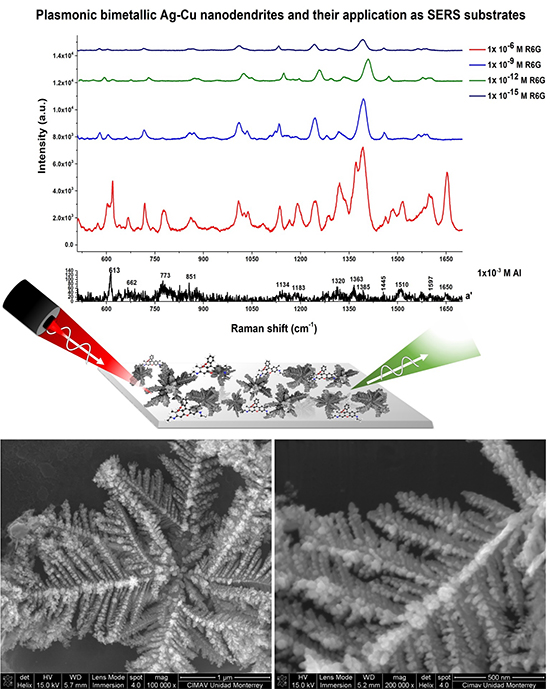
The authors used Surface-enhanced Raman Scattering measurements using Rhodamine 6 G (R6G) as the probe molecule with a 633nm laser wavelength. Raman spectra of bare aluminum sheet and Al/Ag-Cu nanodendrites substrates with R6G were also acquired. They found the most characteristic Raman peaks were obtained with Aluminum/silver-copper (Al/Ag-Cu) nanodendrites substrate. Its effectiveness was observed as a significant increase of the signals for very dilute R6G solutions. Significantly more intense signals were recorded in the surface-enhanced Raman scattering spectrum as compared to bare aluminum.
The SERS effect of the Ag-Cu nanodendrites obtained using R6G as probe molecule indicates that the substrate is highly active in SERS; the presence of nanoparticles decorating the arms and branches of the nanodendrites, coupled with the effect provided by the nanodendrite itself generated many hot-spots responsible for the low limit of detection (LOD) for R6G. With this substrate, R6G was detected up to 0.6560 attomoles equivalent to a 1.3114×10⁻¹⁵ mol L-1 with an analytical enhancement factor in the order of 1012. Therefore, aluminum/silver-copper (Al/Ag-Cu) substrate offers an excellent choice for analyte detection. A very low limit of detection for R6G using (Al/Ag-Cu) nanodendrites substrate was observed. Indeed, this was the lowest limit of detection ever achieved and reported using silver-copper dendritic materials.
In all, the study by CIMAV scientists compared with silver-copper nanodendrites obtained in other studies offers several advantages. The electrodeposition process had several benefits such as short deposition time of less than one minute, and the aluminum substrate is cheaper than substrates used in other studies (e.g. graphene). As for the SERS measurements and performance, no incubation time with the analyte is needed, no signal from the substate interferes with the analyte spectrum, and low LOD and high reproducibility are achieved. The study provides an efficient way for the preparation of excellent silver-copper SERS substrate that could be used for molecule detection even at trace levels. The electrodeposition process presented could be extended for the fabrication of other plasmonic bimetallic dendrites.




Reference
Ruben Darío Rivera-Rangel, M Edith Navarro-Segura, Ana Arizmendi-Morquecho and Margarita Sanchez-Domínguez. Electrodeposition of plasmonic bimetallic Ag-Cu nanodendrites and their application as surface-enhanced Raman spectroscopy (SERS) substrates. Nanotechnology, issues 31 (2020) 465605 (8pp)