Advances in Engineering Advances in Engineering features breaking research judged by Advances in Engineering advisory team to be of key importance in the Engineering field. Papers are selected from over 10,000 published each week from most peer reviewed journals.

Significance Statement
“In parts of Europe with temperate climate, designers consider buildings as heating driven. However, statistical data show that large portion of Europe’s residential building stock is not comfortably cool during summer. In order to eliminate increase in energy consumption due to air conditioning of buildings, the performance of passive strategies like thermal mass application and night time ventilation need to be further investigated.” Dr. Mitja Košir.
An increase of environmental temperature and intensity of solar irradiation during summer leads to overheating of buildings. This can eventually result in discomfort of indoor environment. Overheating of buildings needs to be managed and this can be done by a proper building design with the application of passive solar architecture features. The thermal response of buildings should be predicted in order to better understand the design and to ensure comfort in indoor environments. Hot conditions in dwellings during the summer are the result of inappropriate building design that is not properly adapted to the environmental conditions of a specific region.
The indoor environmental conditions can be improved by bioclimatic approach instead of using air conditioning systems. Night time ventilation applied to buildings helps to reduce indoor temperature. The latter results in the reduction of cooling energy consumption demand. The cooling potential of night time ventilation varies based on the local climatic conditions and the building’s thermal properties. Air change rate per hour (ACH) also has an effect on the cooling potential. The influence of night time ventilation depends on the thermal mass of the buildings. Light weight buildings with low thermal mass underperform in providing thermal comfort in comparison to heavy weight construction buildings.
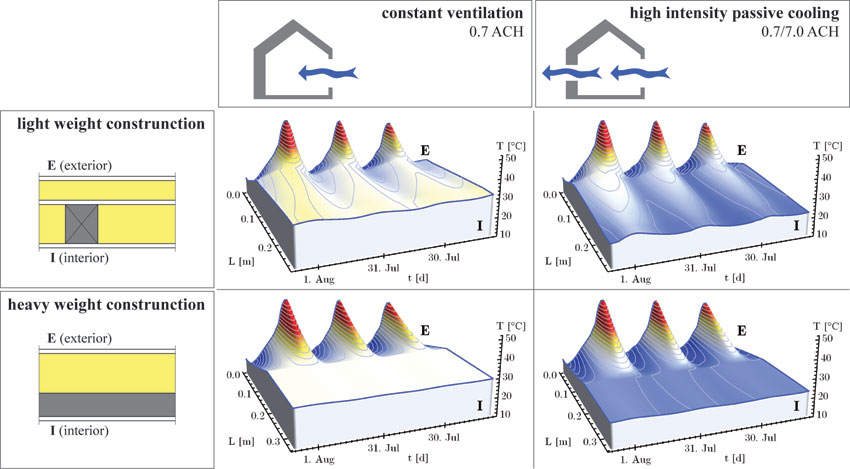
Researchers led by Dr. Mitja Košir from University of Ljubljana in Slovenia evaluated the overall thermal response of various building envelope construction systems with and without the influence of high intensity passive cooling, under realistic Central European climatic conditions (Slovenia). The study is now published in a peer-reviewed journal, Applied Energy.
A non-stationary analysis has to be used for the study of thermal behavior of light weight and heavy weight construction buildings. Based on this analysis method, the performance of different multilayer external wall envelopes was studied with a numerical model and the results were compared after the execution of two-dimensional numerical simulations. The building envelope systems were subjected to different modes of ventilation for a particular duration and the thermal response was analyzed. The thermal response is affected by solar radiation, external ambient temperatures and internal heat gains. The minimum and maximum indoor air temperatures were noted for all the construction systems.
Un-insulated thick massive walls, such as brick, stone and reinforced concrete wall, possess high thermal capacity and have the highest thermal stability. In these walls, excess heat gets accumulated and the heat flow will be higher during the day than during the night. Later, the in-wall stored heat is released during the night, making the interior thermal conditions less comfortable. In the case of un-insulated heavy weight construction more heat is gained through the external surface during the day than in the case of insulated walls. Some heat is released during the night through the external surface, while some gets transmitted through the wall to the interior. In the end, it was noted that the behavior of reinforced concrete wall is quite different from that made of brick or stone as their thermal capacity is different. Similarly, results of the insulated walls were analyzed. On comparing the results of insulated and un-insulated walls, the fluctuations of heat flow in both types were similar whereas the amplitude is lower for insulated walls. Based on the thermal conductivity, the speed of heat flow varies, while the indoor thermal conditions are mainly influenced by the thermal capacity and the position of thermal insulation. It was also noted that thermally insulated light weight constructions, such as timber-framed or cross-laminated timber walls, have inferior thermal performance in comparison to heavy weight constructions.
High intensity, passive cooling was shown to be an effective strategy for passive cooling of buildings regardless of the building envelope type. The internal layer of the walls, which possess high thermal mass (externally insulated heavy weight constructions) performed better than the walls which possess low thermal mass (light weight constructions). The heat capacity of the internal layer prevents overheating and thus stored heat gets dissipated during nights with the use of night time ventilation.
This study succeeded in evaluating non-stationary thermal performance and making comfortable indoors through various approaches.




Journal Reference
University of Ljubljana, Faculty of Civil and Geodetic Engineering, Jamova 2, SI-1000 Ljubljana, Slovenia.
Go To Applied Energy