Advances in Engineering Advances in Engineering features breaking research judged by Advances in Engineering advisory team to be of key importance in the Engineering field. Papers are selected from over 10,000 published each week from most peer reviewed journals.

Significance
Ultraviolet-C (UV-C) photonics occupies a distinctive yet historically constrained niche within modern optical science. Spanning wavelengths from 100 to 280 nm, this spectral region enables interactions with matter that are fundamentally inaccessible at longer wavelengths, including strong electronic absorption, bond-specific photochemistry, and nanoscale spatial resolution. These properties underpin applications ranging from sterilization and lithography to ultrafast spectroscopy and non-line-of-sight optical communication. Yet, despite decades of progress in ultrafast optics, UV-C photonics has remained technologically fragmented. The generation and detection of coherent, femtosecond UV-C light have typically evolved along separate and often incompatible trajectories, limiting system-level integration and real-world deployment. The core challenge arises from materials and device constraints at both ends of the photonic chain. On the source side, compact and efficient UV-C lasers remain rare. Excimer lasers, while powerful, are bulky, energy-intensive, and poorly suited to high-repetition-rate ultrafast operation. Semiconductor-based emitters, including AlGaN devices, remain limited by low output power and manufacturing immaturity. Nonlinear frequency conversion from near-infrared femtosecond lasers offers an elegant alternative, yet only a narrow set of nonlinear crystals can support phase-matched processes in the UV-C, and their efficiency is tightly constrained by group-velocity mismatch, absorption, and thermal effects. Detection presents an equally formidable barrier. Conventional UV-C detectors such as photomultiplier tubes and silicon photodiodes either lack temporal resolution, require high operating voltages, or suffer from poor compatibility with scalable integration. Recent advances in two-dimensional semiconductors have opened promising avenues, particularly for wide-bandgap materials capable of room-temperature operation. However, most prior demonstrations rely on continuous-wave illumination, exfoliated flakes, or slow photo-gain mechanisms that obscure true ultrafast response. As a result, the ability to directly sense femtosecond UV-C pulses across a wide dynamic range remains largely unexplored. To this end, new research paper published in Light and conducted by Benjamin Dewes, Tim Klee, Nathan Cottam, Joseph Broughton, Mustaqeem Shiffa, Tin Cheng, Sergei Novikov, Oleg Makarovsky, & Professor Amalia Patané from the University of Nottingham in collaboration with Professor John Tisch from the Imperial College of London, the researchers developed an integrated femtosecond UV-C photonic platform that combines high-efficiency cascaded harmonic generation with scalable two-dimensional semiconductor detectors. They demonstrated room-temperature detection of femtosecond UV-C pulses with both linear and super-linear photoresponse, depending on material architecture. Crucially, the work reveals new ultrafast carrier dynamics in GaSe and Ga₂O₃ heterostructures that are inaccessible under continuous-wave excitation.
The research team generated femtosecond UV-C pulses via cascaded second-order nonlinear processes and probing their interaction with two-dimensional semiconductor detectors under realistic operating conditions. A near-infrared ytterbium-based femtosecond laser served as the fundamental source, delivering sub-300 fs pulses with adjustable repetition rates extending to tens of kilohertz. These pulses were first frequency-doubled in a bismuth triborate crystal to produce visible light, which was subsequently doubled again in beta-barium borate to yield fourth-harmonic radiation at 256 nm. Careful selection of crystal thickness, phase-matching geometry, and spacing allowed the authors to suppress back-conversion and temporal walk-off, achieving an unusually high conversion efficiency approaching 20 % from the near-infrared to the UV-C regime. The authors confirmed temporal characterization and that the UV-C pulses preserved femtosecond duration, with cross-correlation measurements which showed pulse widths near 240 fs. Spatial profiling showed a near-Gaussian beam matched to the active area of the detectors, ensuring uniform excitation without localized damage. Importantly, the UV-C pulse energy could be continuously tuned from sub-nanojoule to microjoule levels, enabling systematic exploration of detector response across several orders of magnitude. They also examined two complementary material systems: Gallium selenide layers grown by molecular beam epitaxy exhibited exceptionally strong UV-C absorption, with only the top few nanometers participating in carrier generation due to the short absorption length. Interdigitated gold contacts formed planar metal–semiconductor–metal devices that operated reliably at room temperature. Under femtosecond excitation, these GaSe detectors produced sharp electrical pulses whose integrated charge scaled linearly with incident pulse energy. This linearity persisted across a wide range of repetition rates until limited by the RC time constant of the measurement circuit, demonstrating genuine ultrafast detection rather than slow photo-gain effects. The team found when GaSe was intentionally oxidized to form ultrathin β-Ga₂O₃ layers on graphene-terminated silicon carbide. These heterostructures retained low dark current and spectral selectivity in the UV-C, yet displayed a super-linear photocurrent response to pulse energy and average power. Rather than saturating at high excitation levels, the responsivity increased, revealing a non-intuitive amplification mechanism. Analysis ruled out multiphoton absorption at the employed intensities and instead pointed toward power-dependent occupation of defect states and photo-thermionic carrier injection at the graphene interface. The temporal evolution of the signal further suggested dynamic filling of recombination centers, effectively extending carrier lifetimes under intense pulsed illumination.
In conclusion, the research work of Professor Amalia Patané and her colleagues establishes a practical pathway toward compact, high-speed UV-C photonic systems and indeed developed for the first time, a fully integrated platform capable of generating and sensing UV-C laser pulses on femtosecond timescales. Moreover, the study establishes a foundation for UV-C systems that are no longer confined to laboratory curiosities by showing that compact nonlinear sources and two-dimensional semiconductor detectors can operate coherently within the same ultrafast regime.
Additionally, the observation of linear and super-linear photoresponse under femtosecond excitation challenges conventional assumptions about UV detector behavior. In most photodetectors, increasing optical power leads to recombination-dominated saturation and declining efficiency. Here, the opposite trend is observed in Ga₂O₃-based heterostructures, suggesting that ultrafast excitation accesses carrier dynamics that are invisible under continuous-wave illumination. The implication is profound: detector performance can be enhanced, rather than degraded, by operating in regimes of high peak power but low average heating, a paradigm well-suited to modern ultrafast lasers. Technologically, the use of scalable growth techniques and planar device architectures positions this platform for practical adoption. Unlike photomultiplier tubes or exotic vacuum-based sensors, these detectors function at room temperature, at low bias, and on technologically relevant substrates. The nonlinear source, while high-performance, relies on established crystals and commercially available femtosecond lasers, making miniaturization and ruggedization plausible. Together, these attributes lower the barrier to deploying UV-C photonics beyond specialized research environments. The demonstration of free-space UV-C communication underscores the broader impact of this integration. UV-C wavelengths offer inherent advantages for secure and non-line-of-sight transmission due to strong atmospheric scattering and low background noise. When combined with femtosecond pulse encoding and fast detectors, this opens new possibilities for short-range communication between autonomous systems, robotic platforms, and sensing networks operating in cluttered or hostile environments. We believe the new platform invites reconsideration of how ultraviolet light is used in ultrafast science and applications such as time-resolved spectroscopy, surface chemistry, and nanoscale imaging stand to benefit from reliable femtosecond UV-C sources paired with detectors that faithfully capture pulse-to-pulse dynamics. The work of the British scientists also points toward future device concepts, including monolithically integrated source-sensor chips and engineered heterostructures that exploit defect physics for tailored photoresponse.
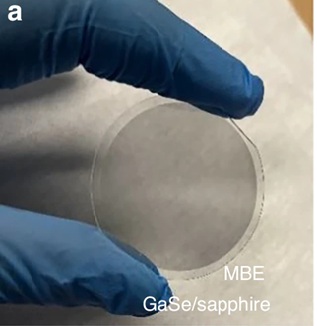
FIGURE: Image of GaSe grown by MBE on a 2 inch sapphire wafer. Credit: Light: Science, 2025; 14 (1) DOI: 10.1038/s41377-025-02042-2.


Reference
Benjamin T. Dewes, Tim Klee, Nathan D. Cottam, Joseph J. Broughton, Mustaqeem Shiffa, Tin S. Cheng, Sergei V. Novikov, Oleg Makarovsky, John W. G. Tisch, Amalia Patané. Fast ultraviolet-C photonics: generating and sensing laser pulses on femtosecond timescales. Light: Science, 2025; 14 (1) DOI: 10.1038/s41377-025-02042-2