Advances in Engineering Advances in Engineering features breaking research judged by Advances in Engineering advisory team to be of key importance in the Engineering field. Papers are selected from over 10,000 published each week from most peer reviewed journals.

Significance
Ceramic–matrix composite laminates are important structural materials, especially for parts that must work under high temperature and mechanical loading. When these materials contain a circular hole, blunt notch, or similar strain-concentrating feature, their behavior is more complicated than standard elastic stress analysis can explain. In these laminates, they can also activate matrix cracking, interfacial sliding, fiber bridging, fiber fracture, and other inelastic displacements that reshape how load is carried across the net-section. In a conventional elastic analysis, the highest stress is expected at the notch edge, and design logic follows directly from that peak. For ceramic–matrix composites, however, matrix cracking can relax the stress concentration while increasing local strain concentration. The material is not simply weaker because it contains a notch; its apparent notch sensitivity depends on how damage-mediated inelastic deformation redistributes load. A proper description must therefore capture both the reduction of local stress and the growth of local strain, instead of treating one as a substitute for the other. The difficulty is partly one of scale. The macroscopic stress–strain field depends on damage processes occurring across individual layers, fiber orientations, matrix cracks, and fiber–matrix interfaces. Transverse layers may crack first near the notch, cracks may extend into longitudinal layers, and broken fibers may undergo sliding and displacement governed by interfacial shear. These events are not just microscopic details. They leave measurable signatures that influence, and reflect, the stress state in the concentration region. However, a direct connection between these microstructural features and the macroscopic mechanical response has remained difficult to quantify.
In a recent research paper published in International Journal of Mechanical Sciences, Dr. Xiaoyi Guan and Professor Zhengmao Yang from the Institute of Mechanics at the Chinese Academy of Sciences, working with Dr. Yana Wang and Dr. Jian Jiao from the National Key Laboratory of Advanced Composites at AECC Beijing Institute of Aeronautical Materials, examined how stress and strain redistribute ahead of notches in ceramic–matrix composite laminates and how those macroscopic fields relate to damage features observed by X-ray tomography. The researchers built their analysis around three linked modeling levels. At the laminate scale, they used an inelastic constitutive model implemented in finite element analysis to describe the nonlinear stress–strain response of the composite. Alongside this, they developed an analytical model based on Neuber’s theory to predict stress and strain concentration behavior associated with matrix-cracking-induced inelasticity. At the microscale, they used a shear-lag-based model to connect fiber break displacement with local distal stress. The finite element model provides a more detailed field calculation, the analytical model offers a faster route to stress–strain prediction, and the micromechanical model gives physical meaning to damage features extracted from tomography.
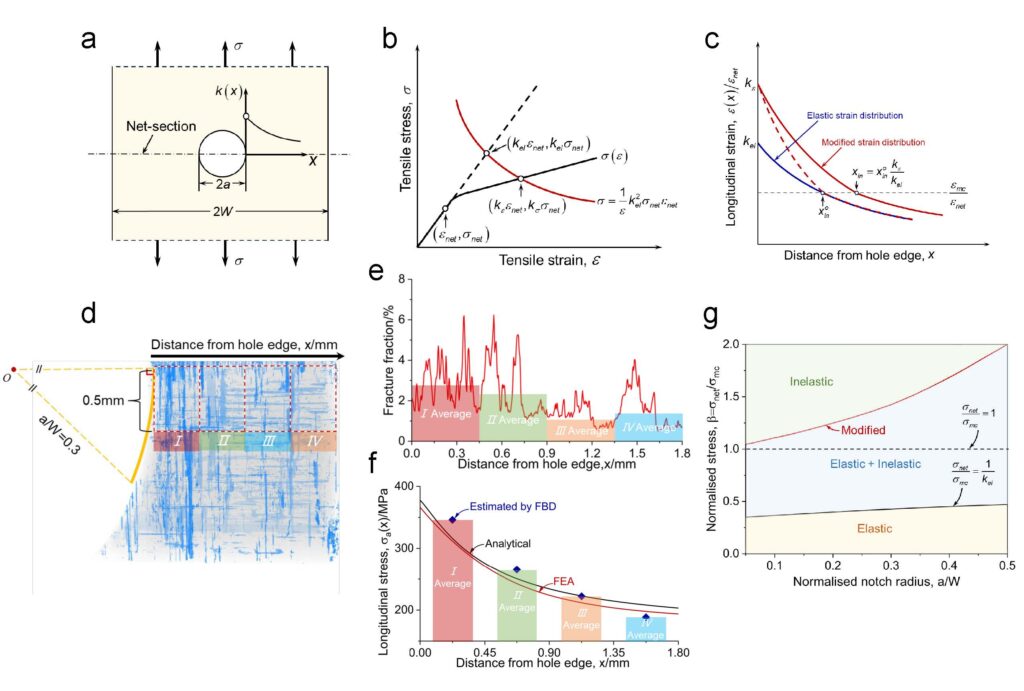
The material system was a SiC fiber/SiC matrix laminate with a thin BN coating between fiber and matrix, fabricated through a prepreg–melt infiltration route. The laminate had a [0°/90°] arrangement, with specimens containing circular holes across several diameter-to-width ratios. Monotonic tensile tests, supported by two-dimensional digital image correlation, provided load–displacement curves and local strain fields. The use of DIC was important because the central question depended not only on global strength or stiffness, but on the spatial distribution of strain along the net-section near the notch. The load–displacement responses changed systematically with notch size. Specimens with smaller diameter-to-width ratios showed a clearer sequence of elastic deformation, matrix-cracking-related stiffness reduction, and a later fiber-dominated load-bearing stage. Larger holes shortened or suppressed this staged behavior, indicating that the notch geometry changed how much damage tolerance remained before final failure. The finite element model reproduced the elastic response closely and captured the strain fields under representative loading conditions. Its prediction of matrix cracking stress was also close to the experimental value, while the later stages of failure were treated more cautiously because additional damage mechanisms become increasingly important near ultimate failure. The comparison between the analytical model and finite element calculations is one of the more useful parts of the study. For stress concentration, both models gave closely aligned predictions over important ranges, especially before and around the onset of broader inelastic deformation. As inelastic displacements developed near the notch, the stress concentration factor decreased rapidly; around the matrix-cracking stress level, the reduction relative to the elastic state reached roughly 30–35%. The strain behavior moved in the opposite direction. Strain concentration increased when inelasticity occurred, with a peak near the condition where stress relief was strongest. In physical terms, local inelastic strain is the mechanism through which peak stress is moderated.
The spatial stress and strain distributions along the net-section sharpen this interpretation. Near the notch edge, elastic analysis overestimates stress once inelastic deformation begins, because matrix cracking and related deformation relax the local stress. Farther from the notch, however, equilibrium requires load redistribution, and the stress can be higher than an elastic calculation would suggest. This means that the region of greatest design concern cannot be inferred from elastic peak stress alone. For strain, both the finite element and analytical approaches gave predictions that generally lay within the DIC-measured bands, with the analytical model often providing the safer estimate under moderate strain conditions. A further contribution is the elastic–inelastic domain map. By plotting the transition behavior as a function of applied stress and notch size, the researchers separated regions where the analytical model is efficient and adequate from regions where finite element prediction using the inelastic constitutive model is preferable. The same boundary applies to both stress and strain analyses, which makes the map particularly useful as a practical modeling guide rather than a purely descriptive result.
The tomography analysis then connected these macroscopic fields to local damage. In the fractured specimen with a larger notch, crack distributions differed between 0° and 90° layers, with the 90° layers showing more transverse cracking. Fracture fraction generally decreased with distance from the notch edge. Fiber break displacement in the 0° layers followed a similar spatial trend, becoming smaller farther from the notch. When these measured displacements were inserted into the micromechanical relation, the estimated stress distribution correlated strongly with the stresses predicted by both the finite element and analytical models. The design choice to use fiber break displacement rather than crack opening displacement was scientifically consequential, because fiber breaks remained identifiable in the tomographic images even when matrix cracks could appear closed after fracture.
The research work of Professor Zhengmao Yang and colleagues has several engineering applications, most notably in the design, modeling, and damage assessment of ceramic–matrix composite components that contain notches, holes, or other geometric features, particularly in structures exposed to high temperature and mechanical loading. The clearest application is in aero-engine and other high-temperature structural parts made from SiC/SiC ceramic–matrix composites. These components often include holes, cut-outs, joints, cooling passages, attachment points, or similar features that disturb the local stress field. The study gives engineers a more realistic way to understand what happens around these features. Instead of assuming that the highest elastic stress alone controls the response, it shows how stress and strain can redistribute once matrix cracking and other inelastic mechanisms begin. In notched CMC laminates, matrix cracking and local inelastic deformation can reduce the peak stress near the notch while increasing the local strain concentration. That means engineers should not assess these components only by the elastic stress concentration factor. For practical design, both stress redistribution and strain concentration need to be considered when selecting notch sizes, hole diameters, ligament widths, and allowable load levels. The study also supports damage-tolerant design of CMC laminates. Smaller notches may still allow a more gradual damage process, beginning with elastic response, followed by matrix cracking and later fiber-dominated load bearing. Larger notches, by contrast, can shorten this staged response and reduce the remaining damage tolerance. This distinction is important for components that must continue to carry load even after local matrix cracking has started. There is also a clear application in finite element modeling and structural simulation. The hierarchical framework gives engineers a way to decide when a faster analytical model is sufficient and when a more detailed inelastic finite element analysis is needed. The domain map is useful in this respect because it links model choice to applied stress, notch size, and the elastic–inelastic state of the laminate. By linking fiber break displacement observed through X-ray tomography with the local stress distribution, the study offers a way to interpret damage patterns after loading or fracture. In practical terms, tomography of damaged CMC parts could help engineers identify where stress concentration was most severe and how damage developed around notches.
Reference
Xiaoyi Guan, Yana Wang, Jian Jiao, Zhengmao Yang, Hierarchical modeling of strain-concentrating effect in notched ceramic–matrix composite laminates, International Journal of Mechanical Sciences, Volume 304, 2025, 110641,
Go to International Journal of Mechanical Sciences