Advances in Engineering Advances in Engineering features breaking research judged by Advances in Engineering advisory team to be of key importance in the Engineering field. Papers are selected from over 10,000 published each week from most peer reviewed journals.

Significance Statement
Nanoparticle-embedded glasses are important building blocks that can be important to overcome the limitations that are inherent to bulk materials and enhance the versatility of single-phase materials. A good example of this is the development of a new class of optical fiber lasers as well as amplifiers implementing luminescent ion-doped silica as the host glass. Nanoparticles in optical fibers offer augmented intrinsic features since they blend in the low cost and sturdiness of silica with specific spectroscopic characteristics that are not inherent in pure silica local environment.
As nanoparticles encapsulate the luminescent ions, for instance, the rare-earth ions, they generate engineered spectroscopic features. However, in an attempt to avoid optical losses induced by light scattering, it is necessary to tune the size of the particles. Another aspect of nanoparticle-embedded optical fibers depend on their capacity to develop random lasers. In addition, the optical features of these lasers count on the size of the nanoparticles.
Heat treatment has been investigated to control nucleation growth, which in turn tunes the size of the resultant nanoparticles. Nevertheless, this process has been observed to lessen the mechanical attributes of the optical fiber. However, nanoparticles must already be present in the preform. In addition, rheological and thermodynamical effects have also been identified to modify the attributes of the nanoparticles.
Thin rod of glass embedded in a polymer cladding has been identified to lead to the formation of nanoparticles. This structure can be tailored via the formation of capillary instabilities initiated by heat treatment. Cold drawing can also be implemented to form nanoparticles with controlled sizes out of this structure.
Manuel Vermillac, Jean-François Lupi , François Peters and Wilfried Blanc at the University of Cote d’Azur in collaboration with Martiane Cabié and Thomas Neisius at Aix Marseille University, Philippe Vennéguès at CNRS, and Courtney J. Kucera and John Ballato at Clemson University reported the evolution of nanoparticles during the fiber draw process and demonstrated that fiber drawing itself could induce break-up of particles via rheological mechanisms. They also indicated that it was possible to take advantage of this high-temperature elongation stage to tune the size of the nanoparticles. Their research work is published in Journal of American Ceramic Society.
The authors synthesized the nanoparticles and dispersed them in 100mL of ethanol in a bid to elaborate the doping solution. The preform fabrication was possible through the conventional modified chemical vapor deposition method. The authors drew the optical fiber on a drawing tower through heating the preform to about 2000 °C with a tensional force varying between 0.42 to 0.44 N.
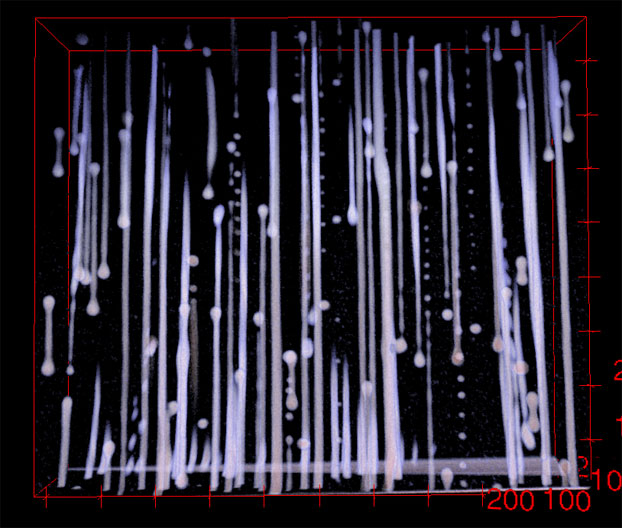
To analyze the shape of the particles in the drawing direction, the researchers used a 3D method of focused ion beam tomography.
The authors were able to fabricate silica-based optical preform composed of lanthanum-rich particles within its core. They then obtained the optical fiber by heating and pulling the preform. When the material began to flow, viscous stress induced deformation of particles into long threads. The researchers also observed that part of the particles underwent break-up. These mechanisms offer new possibilities for tuning the size and shape of particles with some interest in optical property tailoring.
The study by Manuel Vermillac et al. also highlighted that scanning electron microscopy measurements on the converse portions of the optical fibers, just as already reported in literature, were inadequate to characterize the shape and particle size distribution.
Reference
Vermillac, J.-F. Lupi, F. Peters, M. Cabie, P. Vennegues, C. Kucera, T. Neisius, J. Ballato, W. Blanc. Fiber-draw-induced elongation and break-up of particles inside the core of a silica-based optical fiber. Journal of American Ceramic Society 2017;100:1814–1819.
Go To Journal of American Ceramic Society