Advances in Engineering Advances in Engineering features breaking research judged by Advances in Engineering advisory team to be of key importance in the Engineering field. Papers are selected from over 10,000 published each week from most peer reviewed journals.

Journal Reference
Chemistry. 2013 ;19(14):4556-62.
Xu J, Jia L, Jin N, Ma Y, Liu X, Wu W, Liu W, Tang Y, Zhou F.
Key Laboratory of Nonferrous Metal Chemistry and Resources Utilization of Gansu Province, State Key Laboratory of Applied Organic Chemistry, College of Chemistry and Chemical Engineering, Lanzhou University, Lanzhou 730000, PR China.
Abstract
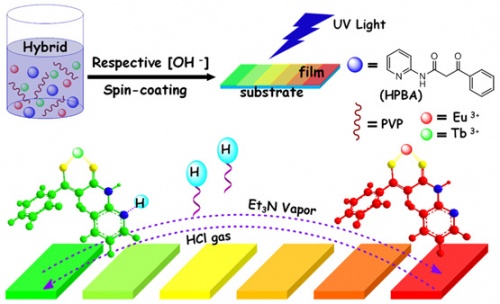
Full-color lanthanide (Ln) photoluminescent materials have attracted considerable interest owing to their potential applications in display systems and lighting technologies. Herein, full-color photoluminescent films have been designed and fabricated facilely with a fixed-component Ln-based (Ln=Tb and Eu) polymer hybrid doped with a proton-sensitive amide-type {Beta}-diketonated photosensitizer, N-(2-pyridinyl)benzoylacetamide (HPBA). The tunable photoluminescence emissions of the films are achieved by changing the amounts of OH(-) in the hybrid rather than varying the relative concentrations of the lanthanide ions and photosensitizers, thus representing a new paradigm for full-color displays. The emission color can also be finely tuned through the variation of the excitation wavelength, and white-light emission can be achieved when the given film is excited at the visible region (405 nm). The photophysical properties and the mechanisms of the intra- and intermolecular energy transfer before and after deprotonation have been investigated in detail. Meanwhile, the films might find application as vapoluminescent sensors due to their good stability, sensitivity, reversibility, and quick response when triggered by a base-acid vapor.
Copyright © 2013 WILEY-VCH Verlag GmbH & Co. KGaA, Weinheim.