Advances in Engineering Advances in Engineering features breaking research judged by Advances in Engineering advisory team to be of key importance in the Engineering field. Papers are selected from over 10,000 published each week from most peer reviewed journals.

Significance Statement
Emerging multimedia applications, such as video on demand, HD TV, cloud computing, social network, peer-to-peer file sharing, online gaming and Internet of things, have been driving the Internet bandwidth explosion in the past decade and gradually penetrate into our daily lives from home to workplace. According to Julius Genachowski, former chairman of US Federal Communications Commission, “bandwidth abundance is essential to driving innovation and unleashing the benefit of broadband, including increased education, healthcare, and job-creation opportunities across the country.” [1] As pervasive broadband services has become a national imperative for future social and economic development, many countries including USA, European Union, Russia, China and Japan, are implementing National Broadband Plans to boost innovations and growth [2]. To provide broadband Internet access and multimedia services, access networks are built to connect end users. Through broadband access networks, integrated voice, data and video services are provided to subscribers for various multimedia applications.
To satisfy the insatiable bandwidth demands from end-users, passive optical networks have been deployed worldwide by service providers to provide triple-play services (voice, data and video). Many countries witness a steady increase in the number of FTTx (fiber-to-the-x, x stand for home, curb, neighborhood, office, business, premise, user, etc) users in recent years and there are now more subscribers to optical broadband services than any other fixed broadband technologies. The global fiber-to-the-home subscribers (high-speed Internet users with fiber-to-the-home services) reached 285 millions, and annual sales of passive optical network equipment surpassed more than $3 billion in 2015 [3].
So far, a number of passive optical network (PON) systems have been standardized to provide broadband access services for multimedia applications, including broadband passive optical network (BPON, defined by International Telecommunication Union in ITU-T standard G.983), gigabit-capable passive optical network (GPON defined in ITU-T standard G.984), and Ethernet PON (EPON defined in IEEE 802.3ah standard). These networks employ time-division multiplexing to achieve cost-effectiveness and have been widely accepted as the current-generation optical access solution. In the mean time, next-generation PON architectures and technologies are being developed by the research community and the telecommunication industry. These technologies include 10 gigabit-capable passive optical networks (10G PON) which can provide 10 Gb/s aggregated capacity to a certain number of users (typically 32 or 64 homes). In addition, future generation of PON technologies such as TWDM PON (time and wavelength division multiplexed passive optical network) and WDM PON (wavelength division multiplexed passive optical network) are being explored to provide an aggregated bandwidth of more than 40 Gb/s and guaranteed bandwidth of 1000 Mb/s for each user. However, many technical challenges remain to be solved for future deployment of TWDM PON and WDM PON systems. Technology development and engineering solutions of TWDM PON systems and optical transceiver modules must be made commercially viable for manufactuerability and cost-effectiveness.
For future large scale development of TWDM PON, a R&D group at Futurewei Technologies (also known as American Research Center, Huawei Technologies), lead by Dr. Ning Cheng, have developed world’s first integrated OLT transceiver module and tunable ONU transceiver module for TWDM PON systems [4]. For OLT transceiver module in TWDM PONs, performance, power consumption and footprint is very important, so the integration of both electronics and optics is a primary task. By solving many challenges in optical/electrical and high density integration of optics and electronics, Dr. Cheng’s group developed a compact 4-channel OLT transceiver for 40G TWDM PON. This OLT transceiver consists of 4×10Gb/s transmitters, 4×2.5 Gb/s burst-mode optical receivers, optical mux/demux and integrated optical amplifiers in an enhance CFP (C Form Factor Pluggable) module. On ONU side, transceiver module design is less complicated but low cost is the utmost goal. Meanwhile, it still needs to achieve good performance. Hence, the trade-off between cost and performance is necessary. The low-cost ONU transceiver includes a tunable laser and a tunable receiver in SFP+ (Small Form Factor Pluggable) package. The average transmitted power of the OLT module is larger than 10 dBm and its receiver sensitivity is better than -36 dBm, while the tunable ONU achieves more than 4 dBm average transmitted power and -26 dBm sensitivity. Error-free performance and zero packet drop rate with 36 dB power budget were demonstrated using these transceivers in a TWDM PON system shown in the following figure. The TWDM PON prototype system has been showcased at OFC’2014 and tested by major telecom companies.
Based on the integrated OLT and ONU transceiver technologies developed at Futurewei Technologies, Dr. Cheng further proposed and developed, for the first time, a flexible TWDM PON system which allows pay-as-you-grow in capacity, load balancing among different ODNs (optical distribution networks) and power saving at OLT [5]. With only passive components added in the ODNs, the prototype system allows pay-as-you-grow deployment of OLT transceiver modules and smooth upgrade of the total capacity in each ODN. Load balancing can be achieved in a single ODN and among different ODNs. Furthermore, power saving at OLT is demonstrated using EMLs (electroabsorption modulated lasers) with 100GHz thermal tuning range. Hence, the flexible TWDM PON prototype demonstrates enhanced capacity and offers more flexibility compared to standard TWDM PON systems. Not only does it allow load balancing in a single ODN, but also provides bandwidth wherever is needed among multiple ODNs. In addition, this flexible TWDM PON achieves significant power saving at OLT side and enhances resilience against OLT transceiver failures.
On top of the TWDM PON, Dr. Cheng’s group also developed a cost-effective WDM overlay (i.e. WDM PON) scheme providing services to small, medium business and enterprise customers, as well as mobile fronthaul/backhaul applications. Such development results in the convergence of residential, business and wireless applications over passive optical networks. It makes possible a single optical access platform for converged broadband access, providing 100 times faster Internet access than current state-of-art and supporting all the possible multimedia services for voice, data, video and mobile applications. Ultimately, it could lead to a ubiquitous infrastructure for anyone, anytime, anywhere and any-media communications. For technical details, Optical Fiber Technology published an invited paper in December 2015 (Flexible TWDM PON with WDM overlay for converged services, by Dr. Ning Cheng), summarizing the contributions from Dr. Cheng’s group on TWDM PON development.
[1] Connecting America: The National Broadband Plan, by US Federal Communications Commission, available at www.fcc.gov/national-broadband-plan. [2] The State of Broadband 2014: Broadband for All, by ITU (International Telecommunication Union) and UNESCO (United Nation Education, Scientific and Cultural Organization). [3] Market Share Report 1Q15: FTTx, DSL, and CMTS, by Ovum. [4] World’s First Demonstration of Pluggable Optical Transceiver Modules for Flexible TWDM PONs, by Ning Cheng, et al, European Conference on Optical Communications (ECOC 2013), paper PD4.F.4, London, England, September 2013. [5] Flexible TWDM PON system with pluggable optical transceiver modules, by Ning Cheng, et al, Optics Express, vol. 22, pp. 2078-2090, 2014.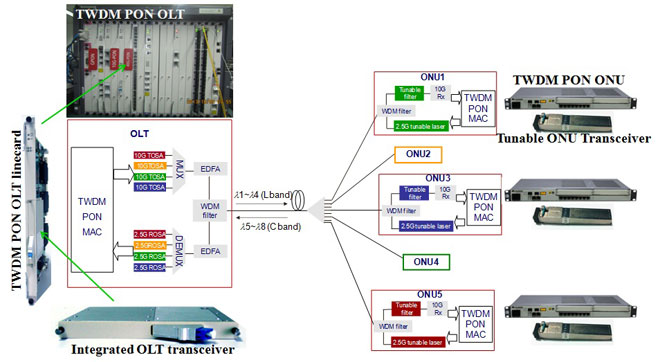

Journal Reference
Optical Fiber Technology, Volume 26, Part A, December 2015, Pages 21–30.
Ning Cheng.
American Research Center, Huawei Technologies, 2330 Central Expressway, Santa Clara, CA 95050, USA
Abstract
This paper reviews recent developments of flexible TWDM PON (time- and wavelength-division multiplexed passive optical network) with pluggable transceivers for pay-as-you-grow deployment, load balancing, channel protection and power saving. Different architectures for TWDM PON with WDM (wavelength division multiplexed) overlay for converged broadband services are discussed and experimental results are presented for WDM overlay using low-cost self-seeded RSOA (reflective semiconductor optical amplifiers). Challenging issues and possible solutions for future evolution toward software defined flexible PONs (FlexPONs) are also discussed with respect to dynamic lambda flow, elastic bandwidth and flexible reach.
Go To Optical Fiber Technology