Advances in Engineering Advances in Engineering features breaking research judged by Advances in Engineering advisory team to be of key importance in the Engineering field. Papers are selected from over 10,000 published each week from most peer reviewed journals.

Significance
Among the available solid-state light sources, light emitting diodes exhibits high efficiency and relatively long lifespan. Generally, it is a two-lead semiconductor device comprising of a p-n junction that emits light upon activation. Energy in form of photos is produced due to recombination of the electrons and holes when a suitable current is applied to the leads. In particular, white light emitting diodes have attracted significant attention of researchers. As such, efforts have been paid to improve their color uniformity and light extraction.
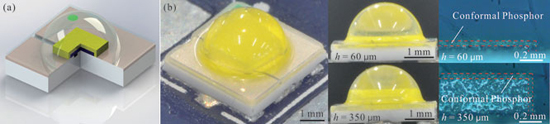
Various techniques have been proposed to improve the color uniformity of white light emitting diodes. For instance, the structure optimization of phosphor-converted elements have resulted in high color uniformity. Unfortunately, most of them have only remained at simulation levels due to difficulties in the manufacturing of phosphor-converted elements. Therefore, researchers have been looking for alternative methods and have identified pulse-spraying as a way of fabricating white light emitting diodes with uniform phosphor-converted elements, which are so called as conformal white light-emitting diodes. Numerous studies, however, have majorly on the design and fabrication of phosphor-converted elements with little emphasis on the influence of the geometrical characteristics of the light emitting diodes chips, such as their heights, on their optical performance.
Recently, a group of researchers at South China University of Science and Technology in China : Zongtao Li, Yong Tang, Jiasheng Li, Caiman Yan, and Binhai Yu in collaboration with Xinrui Ding at University of California provided a comprehensive design guide for conformal white light emitting diodes taking into consideration the effects of the chip height on the optical performance. Their main aim was to enhance the color uniformity and light efficiency of the white light emitting diodes. Their research work is published in the research journal, Optics Letters. Zongtao Li and Jiasheng Li are also affiliated with Foshan Nationstar Optoelectronics Company Ltd.
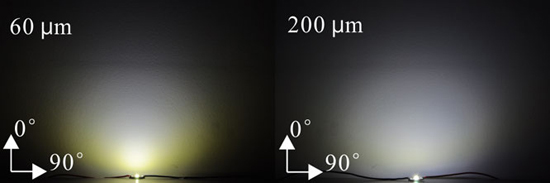
From the conducted experimental results, the authors observed that a relatively larger chip height resulted in a reduction in the radiant power as well as the luminous flux. This was attributed to the dramatic increase in the backward emission loss of phosphor light from the laterally aligned phosphor layers. Despite this, it led to an increase in the emission of the chip light from the lateral surface and leading to a corresponding increase in the correlated color temperature especially at the edge angles. Furthermore, they demonstrated that the color uniformity depended on the selected chip height. For instance, a chip height of 200µm produced a deviation of correlated color temperature of 168K, which represented a decrease of about 69.1% as compared to a sample with a height of 60µm, contributing to a better color uniformity.
The study has successfully presented a novel design guideline for white light emitting diodes taking into consideration the effect of flip-chip height. Thus, it provides a new insight into improving the color uniformity without having to use special elements or change the phosphor structure. It enables selection of the chip height depending on the lumination requirements. Furthermore, it provides a platform for future research work to simultaneously improve the color uniformity and luminous flux of white light emitting diodes, which is a key consideration in enhancing their performance.



Reference
Li, Z., Tang, Y., Li, J., Ding, X., Yan, C., & Yu, B. (2018). Effect of flip-chip height on the optical performance of conformal white-light-emitting diodes. Optics Letters, 43(5), 1015.
Go To Optics Letters