Advances in Engineering Advances in Engineering features breaking research judged by Advances in Engineering advisory team to be of key importance in the Engineering field. Papers are selected from over 10,000 published each week from most peer reviewed journals.

Significance
Taylor-Couette flow is used in the experimental and computational study of various fluid flow dynamics. Generally, Taylor-Couette flow is that type of flow confined between two counter-rotating cylinders that are independently driven and over the years this setup has been proven as a prototypical system to study complex systems and nonlinear dynamics. Its advantages lie in its simple geometry that allows performing controlled experiments and validation of numerical simulations to provide more insights into the complex flow dynamics, flow structure, pattern formation as well as the imminent transition into hydrodynamic turbulence. Thus, Taylor-Couette flow holds potential applications in numerous areas, for instance with a radial flow, such as vortex flow reactors and rotation filtration.
Typically, such applications of Taylor-Couette flow are based on the radial flow from the inner cylinder to the outer cylinder wall. Thereby the walls can be either porous or solid with discrete holes or other shaped in- and outlets. To enhance performance efficiency, the separation is performed continuously with the mixture entering on one side while clean flow exiting on the other to create what is popularly known as an intrinsic axial flow. Although this method has been primarily applied in the extraction of plasm from the human body, it has been successfully extended to many other applications, which require a thorough understanding of such flows and the location of instabilities. However, the underlying mechanism responsible for the stability of Taylor-Couette flow in the presence of radial flow is poorly understood.
Regarding radial through-flow between differentially rotating porous cylinders, previous research has revealed that both strong diverging flow and converging radial flow have a stabilization effect on the Taylor instability, i.e. moving the primary bifurcating flow state to larger control parameters. Moreover, counter-rotating cylinders can achieve a destabilizing effect for weak diverging flows for all values between the cylinder gaps. Since helical flow structures become realized through a wide gap and strong radial flow, Hopf bifurcation can give rise to more complex solutions, e.g. spiral vortex flows (SPIs) and ribbons (RIB). However, complex helical structures like SPI, their related superpositions to RIB and mixed ribbons (mRIB) as well as their interactions under radial flow are largely underexplored.
Herein, Dr. Sebastian Altmeyer from Universitat Politècnica de Catalunya investigated the effects radial mass flux and associated interactions on various stability mechanisms on Taylor-Couette flow in counter-rotating configuration where Hopf bifurcation produce branches of nontrivial solutions. Through direct numerical simulation, the stability characteristics, flow structures, dynamics and bifurcation behavior of the flow solutions were elucidated in detail in the parameter space spanned by the radial mass flux and Reynolds number. His work is currently published in the journal, Physical Review Fluids.
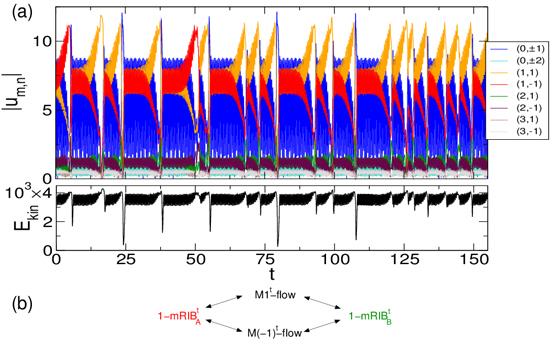
Dr. Sebastian Altmeyer Results showed that both strong radial inflow and strong radial outflow had stabilizing effects on the system, while weak radial outflow had destabilizing effects. Stable RIBs and mRIBs with low azimuthal wave numbers were detected without any symmetry restrictions. Whereas RIB and mRIB solutions could either be stable or unstable saddles, alterations between two saddles with different symmetry relations generated different heteroclinic cycles for the case of unstable saddles. Depending on the control parameters, the persistence time between two symmetrically related saddles was found to be almost constant for alternating stationary ribbons. In contrast, the persistence time for heteroclinic cycle of alternating mRIBs exhibited a more complicated dependence with variations in the control parameters, which appeared to follow a type III intermittency scenario.
In summary, the impact of radial mass flux in a wide gap Taylor-Couette flow between two counter-rotating porous cylinders with radial through-flow was reported. The heteroclinic connection was found to be either oscillatory or non-oscillatory type depending on whether the symmetrically related solutions were time-dependent or stationary. The study was inspired by centrifugal instabilities, and the findings could provide more insights for extensive applications. In a statement to Advances in Engineering, Dr. Sebastian Altmeyer explained his study findings can contribute to more effective flow control, desirable for many related applications.

Reference
Altmeyer, S. (2021). Flow dynamics between two concentric counter-rotating porous cylinders with radial through-flow. Physical Review Fluids, 6(12).