Advances in Engineering Advances in Engineering features breaking research judged by Advances in Engineering advisory team to be of key importance in the Engineering field. Papers are selected from over 10,000 published each week from most peer reviewed journals.

Significance Statement
Analysis of gases is a developing specialty and many physical and chemical measurement methods have been adopted for analysis application. Physical sensors are in most cases based on optical operation or a gas sensitive metal oxide layer. Chemical sensors, on the other side, are based on solid electrolyte gas sensing. Apart from these two principles, the thermal principle is based on gas thermal conductivity measurement in order to analyze the gas.
However, thermal conductivity measurement of a continuous gas stream has not yet been addressed by the use of thermal principle. Thermal conductivity measurement of a continuous gas stream is desirable for application in the biogas plants. Here, thermal conductivity of streaming gas needs to be determined. In a recent paper published in Sensors and Actuators A Christoph Hepp and colleagues presented a sensor measuring the thermal conductivity of flowing gases independent of flow rate. They applied key sensing design and constant power excitation features in the thermal system.
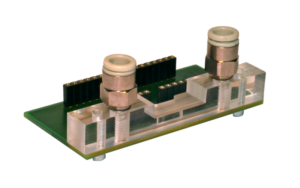
The aim of the authors was to come up with flow independent gas sensitive region in which they could determine thermal conductivity. They adopted a system with a heating unit and a sensing element on either side of the heater configured in several design geometries They designed the system featuring a membrane surrounded by a substrate, which serves as heat sink. The platinum elements – heater and temperature sensor are embedded in this membrane. Changing the gap between the temperature sensor and the heater enabled them to adjust the temperature plateau. Therewith, it is possible to adjust the sensitivity and the flow range in which this method can be applied.
The authors adopted a mass flow controller calibrated to nitrogen to establish the normal flow in the channel. At the bottom of the flow channel was embedded the sensor. They then established the average flow rate from the relationship of flow speed and the channel cross-section. Sensor excitation was necessary to keep it at constant power mode. Therefore, a constant power was applied on the heater by varying the voltage drop across the heater with respect to the gas used as well as flow speed. On the downstream element, they applied a constant current of 0.1mA and acquired the voltage drop across this element using an input channel of the data acquisition module.
They established the downstream element resistance and converted to temperature using a mathematical relationship of the two variables. The authors obtained results that exhibited a relationship between the simulation results in the temperature plateau as a function of downstream element flow rate and confirmed the relationship between gas thermal conductivity and the downstream temperature. They recorded maximum temperature at the flow independent region where the variation was about 1%. They also observed that an increasing value of the thermal conductivity resulted in lower temperature at the plateau.
This study managed to successfully fabricate a sensor to measure gas stream thermal conductivity independent of the gas flow rate. The research team obtained a gas sensitive flow rate independent temperature plateau and found that the distance between the heater and the sensor was a key design parameter that would enable them to move the plateau consistent with application requirements.
Reference
Christoph J. Hepp1,2, Florian T. Krogmann1, Gerald A. Urban2,3. Flow rate independent sensing of thermal conductivity in a gas stream by a thermal MEMS-sensor – Simulation and experiments. Sensors and Actuators A 253 (2017) 136–145.
[expand title=”Show Affiliations”]- Innovative Sensor Technology IST AG, Stegruetistrasse 14, 9642 Ebnat-Kappel, Switzerland
- Laboratory for Sensors, Department of Microsystems Engineering (IMTEK), University of Freiburg, Georges-Koehler-Allee 103, 79110 Freiburg, Germany
- Freiburg Institute for Advanced Studies (FRIAS), University of Freiburg, Albertstrasse 19, 79104 Freiburg, Germany
Go To Sensors and Actuators A