 Advances in Engineering Advances in Engineering features breaking research judged by Advances in Engineering advisory team to be of key importance in the Engineering field. Papers are selected from over 10,000 published each week from most peer reviewed journals.

Significance
Cell competition is a surveillance mechanism that ensures tissue integrity by removing less fit or aberrant cells. It is indispensable during development, immune defense, and tumor progression. While biochemical pathways mediating competition have been widely explored, the precise role of mechanical forces remains ambiguous. Most prevailing theories suggest that mechanical winners compress their neighbors, ultimately driving weaker cells into apoptosis or extrusion. Yet these accounts often fail to reconcile contradictory observations across different tissues and experimental systems, leaving gaps in understanding the true mechanical underpinnings of competition. One fundamental problem is that measuring forces at cell–cell interfaces in living tissues is technically demanding. This has left unresolved the question of whether the critical determinant is the magnitude of force generation or the ability of cells to transmit these forces across a tissue. A particular point of interest is the role of E-cadherin, the core component of adherens junctions, which provides intercellular mechanical coupling. Mutations or loss of E-cadherin are frequently associated with tumor invasion and metastasis, underscoring its biological relevance. Yet, whether differences in E-cadherin–mediated adhesion directly translate into a competitive advantage had not been established.
To this account, new research paper published in Nature Materials and conducted by Andreas Schoenit, Siavash Monfared, Lucas Anger, Carine Rosse, Varun Venkatesh, Lakshmi Balasubramaniam, Elisabetta Marangoni, Philippe Chavrier, René-Marc Mège, Amin Doostmohammadi & led by Professor Benoit Ladoux from the Université Paris Cité, CNRS, Institut Jacques Monod in France and Department of Physics, Friedrich-Alexander-Universität Erlangen-Nürnberg in Germany, the researchers developed two complementary models to dissect mechanical cell competition. A minimal energetic model showed that elimination requires more work for cells with higher intercellular adhesion, suggesting an intrinsic resistance mechanism. A detailed three-dimensional multiphase field model captured extrusion dynamics, demonstrating that stress fluctuations localize at interfaces when adhesion is weak, driving elimination. Together, these models establish that efficient stress transmission, not absolute force magnitude, underpins competitive advantage
The researchers began with patient-derived metaplastic breast cancer xenografts, chosen because these tumors contain epithelial sub-populations with strong E-cadherin expression alongside mesenchymal cells lacking it. Live imaging revealed that epithelial clusters expanded over time while surrounding E-cadherin–negative cells were progressively eliminated, but only when direct contact occurred. This indicated that differential adhesion creates a competitive imbalance rather than passive segregation.
To generalize, they turned to Madin–Darby canine kidney (MDCK) epithelial cells. When E-cadherin knockout (KO) cells were co-cultured with wild-type (WT) cells, the KO population consistently lost, regardless of initial ratios. Even more strikingly, E-cadherin KO cells could themselves dominate cadherin double-knockouts that lacked all adherens junctions, while WT cells were eliminated by E-cadherin–overexpressing counterparts. These hierarchical outcomes confirmed that relative adhesion strength, not absolute viability, determines the winner. Parallel assays with breast epithelial MCF10A cells produced identical results, underscoring the universality of this principle
Force-mapping experiments added unexpected nuance. Bayesian inversion stress microscopy showed that, in breast tumor samples, winners (E-cadherin+) were under tension while losers (E-cadherin–) were compressed—consistent with classical models. Yet, in MDCK competitions, winners (WT) were compressed and losers (KO) were tense, directly contradicting the prevailing view that losers are always squeezed. Laser ablation and traction-force assays confirmed these results, ruling out measurement artifacts. Importantly, most KO cells were extruded alive, only later dying due to loss of anchorage, demonstrating that elimination was mechanically, not biochemically, triggered.
To test environmental influence, the team cultured cells on substrates of varying stiffness. Although stress states inverted depending on substrate properties, the competitive outcome never changed: cells with stronger adherens junctions always won. Neither growth rates, apoptosis inhibition, nor differences in homeostatic density explained the observations. Intriguingly, KO cells showed larger focal adhesions, stronger traction, and greater stiffness than WT cells—factors previously thought to confer advantage. Instead, these traits correlated with their tension and inability to dissipate stress, ultimately leading to their extrusion. Further imaging localized extrusions predominantly at the interface between populations. These regions were enriched with actomyosin activity and dynamic protrusions from KO cells, producing heightened stress fluctuations. Inhibiting actin protrusions or reducing contractility suppressed elimination, confirming the causal link between mechanical noise at interfaces and extrusion events.
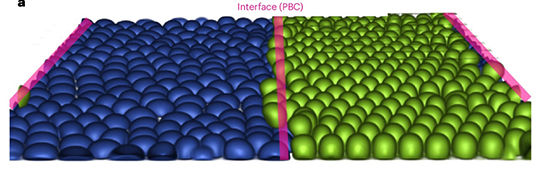
To probe the underlying physics, the team employed a three-dimensional multiphase field model of cell monolayers. Simulated competitions recapitulated experimental findings: cells with weaker cell–cell adhesion extruded preferentially at interfaces due to stress fluctuations that could not be transmitted away. Susceptibility analyses revealed that WT-like cells maintained correlated stress fields, whereas KO-like cells localized fluctuations into out-of-plane stresses, making extrusion energetically favorable. Thus, both experiments and modeling converged on a single conclusion: effective force transmission across adherens junctions confers resilience in competition
The discovery that force transmission, rather than raw force generation, dictates mechanical competition reshapes our understanding of how tissues regulate themselves. It introduces a paradigm in which survival is determined by collective resilience against fluctuating stresses, not individual strength. This mechanism explains why cells with stronger substrate adhesion or contractility may still lose if they cannot distribute stresses effectively across neighbors. It also clarifies longstanding inconsistencies in the literature, offering a unifying principle.
From a biological perspective, these findings highlight intercellular adhesion as a universal safeguard for tissue integrity. Strong adherens junctions allow cells to form a mechanically cohesive network, capable of buffering local perturbations by spreading forces broadly. In contrast, cells with weakened coupling localize stresses at interfaces, leading to their extrusion. This principle has profound implications during morphogenesis, when tissues must sculpt boundaries and remove misplaced cells without relying solely on programmed cell death. It also resonates with epithelial turnover in adult tissues, where extrusion maintains homeostasis. In cancer, the implications are equally compelling. Many tumors display heterogeneous cadherin expression, with subsets of cells downregulating adhesion to facilitate invasion. The present work suggests that such heterogeneity may itself trigger competitive interactions within tumors, selectively eliminating weakly adherent populations or, conversely, promoting invasive escape if extrusion events allow viable cells to disseminate. The interface-based fluctuation mechanism may thus contribute to metastasis, where mechanical surveillance fails or is subverted. Moreover, it raises the possibility that therapeutic strategies aimed at reinforcing intercellular adhesion could suppress malignant expansion by restoring tissue-level mechanical resilience.
The study also opens theoretical avenues. Stress fluctuations at interfaces resemble noise-driven instabilities observed in other physical systems, suggesting parallels between tissue mechanics and condensed matter phenomena. By showing that mechanical information flow, not force magnitude, governs outcomes, the authors underscore the need to incorporate collective stress transmission into models of tissue dynamics. This perspective could inspire new approaches to engineer synthetic tissues or design biomaterials that harness competitive elimination for regenerative medicine. Ultimately, the work establishes force transmission as a master regulator of mechanical cell competition. It broadens our view beyond the dichotomy of winners compressing losers and introduces a richer narrative where mechanical fluctuations, buffered or amplified by adhesion, decide cellular fate. This framework not only reconciles disparate experimental findings but also suggests that the ability to withstand and dissipate mechanical noise may be as fundamental to tissue survival as genetic stability or biochemical signaling.

Reference
Schoenit, A., Monfared, S., Anger, L. et al. Force transmission is a master regulator of mechanical cell competition. Nat. Mater. 24, 966–976 (2025). https://doi.org/10.1038/s41563-025-02150-9