 Advances in Engineering Advances in Engineering features breaking research judged by Advances in Engineering advisory team to be of key importance in the Engineering field. Papers are selected from over 10,000 published each week from most peer reviewed journals.

Significance
By description, functionally graded materials (FGMs) are a class of non-homogeneous composites with discrete or continuous variation of material composition over a definable geometrical length. Technically, the spatial composition gradation in FGMs leads to the variation of physical and mechanical properties along the gradient direction, enabling multiple functionalities and making these materials applicable to a range of engineering applications, from biomedical to automotive and aerospace industries. As such, there have been numerous studies attempting to characterize the response of graded materials and structures subjected to thermal and/or mechanical loading. Overall, the fracture behavior of FGMs has also been a topic of interest for decades. Noteworthy fracture mechanics studies have already established that the asymptotic structure of displacement and stress fields at the crack tip area in FGMs retain the classical inverse square root singularity. Contrary, minimal literature has been published that focuses on analyzing the fracture response of transversely graded structures. In a previous publication, the same group here engaged in a study where the effect of an FGM’s elastic profile was highlighted and documented to substantially influence the fracture initiation response.
Property gradation along a crack front makes conventional fracture mechanics analyses challenging. Therefore, to build on this past work, Professor Behrad Koohbor from the Rowan University (formerly at the University South Carolina) in collaboration with Mr. Milad Rohanifar and Professor Addis Kidane at the University of South Carolina proposed to further characterize the fracture response of a Ti/TiB FGM, this time focusing on both crack initiation and propagation stages. The team aimed to address inherent drawbacks as stated above through a combination of full-field measurements and modeling. Their work is currently published in the research journal, Composite Structures.
In their approach, the researchers developed a novel experimental setup that consisted of a synchronous dual Digital Image Correlation (DIC) system, facilitating in situ measurement of displacement and strain fields on both sides of a transversely pre-cracked multi-layered structure subjected to uniaxial tensile load. Further, they measured the evolution of stress intensity factors developed on opposite sides of the sample and explored the mechanisms of crack initiation and propagation in the examined graded sample. Lastly, based on experimental and numerical observations, the researchers developed a simple model that allowed for the prediction of critical far-field loads at which transversely graded structures fail.
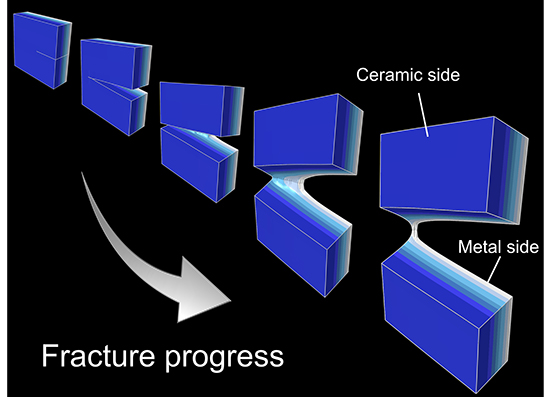
The authors were able to demonstrate that non-uniform crack propagation occurs in a cracked transversely graded material as the stress intensity factor on the ceramic side reaches the fracture toughness of the most brittle ceramic layer. Additionally, the non-uniform crack propagation process studied via finite element modeling was shown to be governed by the property gradient and thickness distribution of the layers in the sample.
In summary, the study implemented an experimental approach that enabled characterization of the fracture response in cracked transversely graded structures. The capability of the proposed model in predicting tensile failure loads was demonstrated through a brief study of the influence of gradient function on the load-bearing and fracture resistance in various graded structures. In a statement to Advances in Engineering, Professor Behrad Koohbor explained that they anticipate their work will provide an insight into the practical design and optimization of both discretely-layered and continuously graded structures with enhanced strength and fracture resistance.

Reference
Behrad Koohbor, Milad Rohanifar, Addis Kidane. Characterizing fracture response of cracked transversely graded materials. Composite Structures, volume 229 (2019) 111439.