Advances in Engineering Advances in Engineering features breaking research judged by Advances in Engineering advisory team to be of key importance in the Engineering field. Papers are selected from over 10,000 published each week from most peer reviewed journals.

Significance Statement
Mortar is an essential material in constructions. Lime mortar has been used for centuries and there is historic evidence that it is durable and compatible with traditional materials. However, several research studies aiming to reproduce historic mortar recipes show the failure of the materials, especially when exposed to severe weathering agents involving water ingress, like freeze-thaw cycles and salt crystallization. In freeze-thaw cycles, the water crystalizes and liquefies in the interior of the mortar pores and it is one of the most severe causes of damage in cold climates.
In order to prevent degradation associated with water ingress, water repellent admixtures are added to the mortar bulk (internal hydrophobization). Several admixtures have been used since the classical era with this purpose. Recently, there is increased interest in the use of vegetable oils as water repellents in civil engineering and in building conservation industry thanks to their advantages when compared to other chemical agents (e.g. calcium stearate, sodium oleate). Vegetable oils are environment-friendly, cost effective and its availability is abundant in nature.
In this research paper, Drs. Cristiana Nunes and Zuzana Slížková from the Institute of Theoretical and Applied Mechanics in the Czech Republic investigate the effect of linseed oil as a water repellent admixture in lime-based mortars. Its influence on the durability to frost damage in lime and lime with metakaolin mortar is determined. It is found that mortar with oil provided better results. When a part of lime (25 wt.%) is substituted by metakaolin, the mechanical strength is increased and the frost resistance is improved.
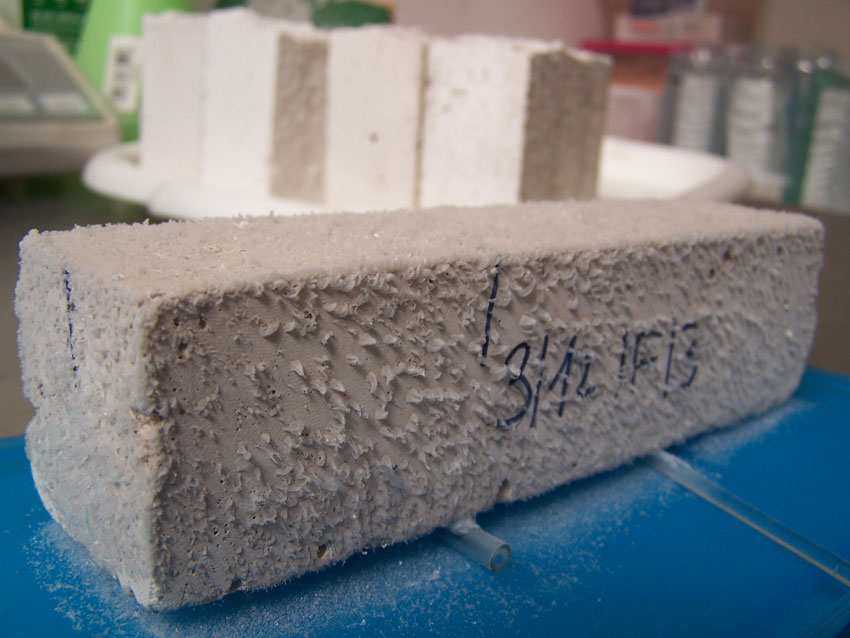
The authors prepared four types of mortar mixtures (lime, lime with linseed oil, lime with metakaolin, and lime with metakaolin and oil). Linseed oil was mixed with the dry mortar components prior to adding water. The amount of kneading water added to each mortar mix aimed achieving the same consistency in all mortars. Standard prismatic mortar specimens were prepared and cured for six months. The characterization of the hardened mortar specimens included the determination of the mechanical strength, open porosity, saturation degree, water absorption by capillarity, pore size distribution, microstructure observed under the optical microscope, and mineralogical analysis with X-ray diffraction.
The resistance to freeze-thaw cycles was performed by subjecting the water saturated samples to cycles of freezing at a negative temperature and thawing at room temperature. The degradation was monitored by visual observation, by registering the mass variation, and by ultrasonic pulse velocity measurements. At the end of the cycling program, the mechanical and microstructural properties of the aged specimens were assessed.
The authors found out that the increase in kneading water in mortars with oil leads to higher porosity, but the rate of water absorption by capillarity is significantly reduced in comparison to the reference mortars because the pores formed are lined with hydrophobic molecules. The addition of oil reduced the mechanical strength of the lime mortar. In contrast, the addition of oil to metakaolin mortar improved the mechanical strength. This mortar also showed a higher amount of hydration products in comparison to the reference. The addition of oil to both mortars significantly improved the frost resistance. The better performance of the mortars with oil was attributed to the combination of several properties: low rate of water absorption by capillarity, low saturation coefficient, the presence of large spherical pores, low surface energy and good mechanical performance.
Lime-metakaolin with oil mortar showed the lowest degradation degree and the highest mechanical strength after the largest number of freeze-thaw cycles performed while maintaining a significant level of water-repellency. According to the authors, “in cold climates where constructions are exposed to the intense action of water, the combination of lime with metakaolin and linseed oil can give a durable repair mortar. To verify its efficiency in real conditions, this mortar has been applied as a render in a selected area of a traditional building.”


Journal Reference
Cristiana Nunes, Zuzana Slížková, Freezing and thawing resistance of aerial lime mortar with metakaolin and a traditional water-repellent admixture. Construction and building materials, Volume 114, 2016, Pages 896-905.
Institute of Theoretical and Applied Mechanics, Prosecká 809/76, 190 00 Prague, Czech Republic
Go To Construction and Building Materials