Advances in Engineering Advances in Engineering features breaking research judged by Advances in Engineering advisory team to be of key importance in the Engineering field. Papers are selected from over 10,000 published each week from most peer reviewed journals.

Significance Statement
Neuromuscular electrical stimulation (NMES) is commonly used in clinical settings to enhance motor function rehabilitation of paralyzed individuals following stroke, traumatic brain injury, multiple sclerosis, cerebral palsy, or spinal cord injury. Among the neuromuscular electrical stimulation control methods, surface electromyography (sEMG) is often used to control the stimulation patterns. For neuromuscular electrical stimulation, three parameters, i.e., the pulse amplitude, the pulse width, and the frequency, can be altered to control the force output. However, existing EMG-controlled neuromuscular electrical stimulation systems often control the stimulation amplitude using EMG amplitude-based time-domain (TD) features, and therefore are only able to modulate the number of recruited motor units (MUs). In contrast, during voluntary contractions, the central nervous system (CNS) controls muscle force by modulating both the number of activated MUs (recruitment coding) and the activation frequency (rate coding). For traditional sEMG-controlled neuromuscular electrical stimulation, their non-physiological recruitment order and inability to alter recruitment patterns and modulate firing frequency result in increased energy demand for a given task and rapid onset of muscle fatigue.
The present work demonstrates that a pulse width and frequency co-modulation stimulation strategy based on sEMG TD features (MAV/NSS dual-coding (MNDC) algorithm) exhibited a better voluntary force reproduction and stronger fatigue resistance than the traditional sEMG proportional control strategy when the same pulse width modulation range and a similar average total charge were utilized in both strategies. The MNDC strategy tended to use a longer average pulse width and a lower stimulation frequency to recruit more muscle MUs with relatively lower firing rates, which could reduce the metabolic demand on each MU. Due to the simplicity of the transfer functions designed to map the sEMG activity into stimulation patterns, the MNDC strategy can be effectively used in real-time sEMG-controlled neuromuscular electrical stimulation systems and may help to extend the duration of sEMG-controlled FES applications.
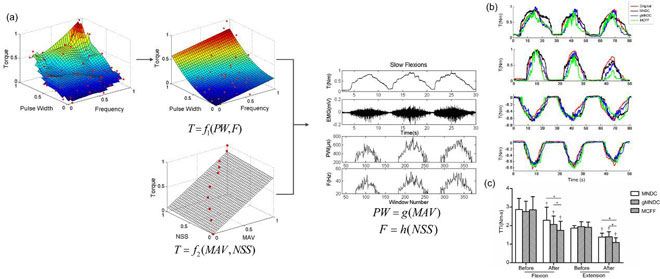
Figure Legend: (a) The flowchart for constructing the MNDC strategy; (b) the wrist torque reproduction comparison for different strategies; (c) and the fatigue resistance comparison.



Journal Reference
Journal of Neural Engineering, Volume 13, Number 1. (2016)
Yu-Xuan Zhou1, Hai-Peng Wang2, Xue-Liang Bao1, Xiao-Ying Lü1,3 and Zhi-Gong Wang2,3
[expand title=”Show Affiliations”]- State Key Lab of Bioelectronics, Southeast University, 210096 Nanjing, People’s Republic of China
- Institute of RF- & OE-ICs, Southeast University, 210096 Nanjing, People’s Republic of China
- Co-innovation Center of Neuroregeneration, Nantong University, 226001 Nantong, People’s Republic of China
Abstract
Objective. Surface electromyography (sEMG) is often used as a control signal in neuromuscular electrical stimulation (NMES) systems to enhance the voluntary control and proprioceptive sensory feedback of paralyzed patients. Most sEMG-controlled neuromuscular electrical stimulation systems use the envelope of the sEMG signal to modulate the stimulation intensity (current amplitude or pulse width) with a constant frequency. The aims of this study were to develop a strategy that co-modulates frequency and pulse width based on features of the sEMG signal and to investigate the torque-reproduction performance and the level of fatigue resistance achieved with our strategy.
Approach. We examined the relationships between wrist torque and two stimulation parameters (frequency and pulse width) and between wrist torque and two sEMG time-domain features (mean absolute value (MAV) and number of slope sign changes (NSS)) in eight healthy volunteers. By using wrist torque as an intermediate variable, customized and generalized transfer functions were constructed to convert the two features of the sEMG signal into the two stimulation parameters, thereby establishing a MAV/NSS dual-coding (MNDC) algorithm. Wrist torque reproduction performance was assessed by comparing the torque generated by the algorithms with that originally recorded during voluntary contractions. Muscle fatigue was assessed by measuring the decline percentage of the peak torque and by comparing the torque time integral of the response to test stimulation trains before and after fatigue sessions.
Main Results. The MNDC approach could produce a wrist torque that closely matched the voluntary wrist torque. In addition, a smaller decay in the wrist torque was observed after the MNDC-coded fatigue stimulation was applied than after stimulation using pulse-width modulation alone.
Significance. Compared with pulse-width modulation stimulation strategies that are based on sEMG detection, the MNDC strategy is more effective for both voluntary muscle force reproduction and muscle fatigue reduction.
Published 8 December 2015 • © 2016 IOP Publishing Ltd
Go To Journal of Neural Engineering