 Advances in Engineering Advances in Engineering features breaking research judged by Advances in Engineering advisory team to be of key importance in the Engineering field. Papers are selected from over 10,000 published each week from most peer reviewed journals.

Significance
The mechanical and thermal properties of composite materials depend on the shape and arrangement of their reinforcing fibers or particles. Many reinforcements have complex cross-sectional shapes, including bilobed, pea-shaped, and irregular polygonal profiles with inward-facing regions which can influence how stresses develop within the surrounding matrix and how the material responds to loading, therefore accurate representation of the reinforcement geometry is important in predicting composite behavior.
To study these effects, researchers commonly use representative volume elements (RVEs), which are small computational models designed to reproduce key microstructural features such as inclusion volume fraction, orientation, and spatial distribution. Numerical simulations can then be used to predict the material’s effective properties and examine its mechanical response.
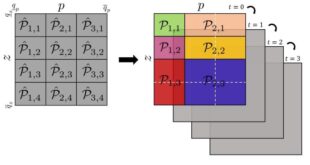
Building accurate RVEs is more difficult when the inclusions have concave shapes, especially at high volume fractions and many current generation methods are designed for circular or convex particles which are easier to handle. Concave inclusions can have several contact regions with neighboring particles, making overlaps more difficult to detect and eliminate.. Replacing these shapes with convex outlines can simplify the process but removes geometric features that can influence local stresses and damage. The problem becomes more complicated in densely packed materials, where small particle movements can create new overlaps. The models must also satisfy periodic boundary conditions, meaning particles crossing one edge must continue consistently across the opposite edge. Meeting these requirements while preserving the characteristic concave geometry and prescribed orientation statistics is a significant computational challenge. Researcher Ying Ye, Professors Lehua Qi, and Wenlong Tian from Northwestern Polytechnical University developed a computational method to address these difficulties. They focused on generating densely packed periodic RVEs that preserve the characteristic geometry of concave inclusions and maintain their prescribed orientation statistics. The research work is now published in Computers & Structures.
The new approach begins by determining the required number of inclusions from the target volume fraction and randomly placing them within a two-dimensional domain. Initial overlaps are permitted to facilitate the construction of densely packed configurations, which are subsequently relaxed to eliminate interpenetration. The inclusion orientations are then adjusted to match prescribed orientation statistics before the overlap-removal process. .
To handle the complex boundaries of concave inclusions, the researchers divided each shape into smaller convex polygons. They first split the shapes into triangles and then merged adjacent triangles to form larger convex regions while preserving the original polygonal boundaries. For inclusions with curved edges, they constructed closely fitted polygons that retained the main concave features. This made it easier to detect overlaps between neighboring particles.
To separate overlapping inclusions, the researchers used the Gilbert–Johnson–Keerthi algorithm to detect intersections between convex sub-polygons and the Expanding Polytope Algorithm to determine the corresponding penetration depths and separating directions. The resulting pairwise corrections were applied symmetrically and combined across multiple contacts to update each inclusion’s position. This process was repeated until the overlaps were eliminated within a prescribed tolerance, with interactions across opposite boundaries handled consistently.. The procedure could also maintain a minimum gap between neighboring particles by temporarily enlarging them during separation.
To reduce computational effort, the team used periodic spatial cell lists and hierarchical geometric checks based on enclosing circles and bounding boxes to identify particle pairs that might overlap. Only those passing these initial checks required detailed intersection analysis, reducing unnecessary computations in densely packed configurations.
They tested the method using three types of inclusions: concave polygonal, bilobed, and pea-shaped. The researchers generated periodic microstructures containing 60% inclusions, with both random and aligned orientations. They also examined how densely each shape could be packed and found that, under the selected conditions, the method achieved volume fractions of approximately 67% for concave polygonal inclusions and 71% for bilobed and pea-shaped inclusions.
The team studied the generated microstructures to determine whether the separation process introduced unwanted spatial patterns. The statistical analyses showed that the prescribed orientation distributions were maintained, with no strong artificial clustering at larger distances. Neighboring particles were frequently separated by small gaps, as expected in densely packed materials.
The researchers then used the generated RVEs in finite-element simulations to examine how fiber geometry affects composite mechanical properties. For glass-fiber-reinforced epoxy composites, the predicted effective elastic modulus was approximately 15.9 GPa for concave polygonal fibers and 14.3 GPa for pea-shaped fibers, with bilobed fibers giving an intermediate value. The shear modulus followed the same trend. Since the material properties, fiber volume fraction, and orientation conditions were unchanged, the differences reflected the influence of fiber cross-sectional geometry on the predicted stiffness.
The thermal simulations provided further evidence of the importance of fiber shape. For carbon-fiber-reinforced epoxy, the predicted thermal expansion coefficients were close to experimental measurements. A separate analysis of carbon-fiber/copper composites showed a stronger influence on thermal conductivity. The predicted value for bilobed fibers was around 46 W/(m·K), close to the experimental value of 45 W/(m·K). In comparison, the model containing circular fibers predicted around 71 W/(m·K). These differences highlighted the sensitivity of the predicted thermal response to fiber cross-sectional geometry and the resulting heat-conduction paths through the composite. Finally, the generated microstructures were used to simulate damage under transverse tension and compression. Damage initially developed near fiber–matrix interfaces, where local stresses were concentrated. Under tension, interfacial separation spread into the surrounding matrix, forming connected damage paths between neighboring fibers. Under compression, damage was more dispersed, with localized matrix deformation and interfacial separation. The concave polygonal fibers showed stronger damage concentration around sharp corners and narrow gaps, whereas the smoother bilobed and pea-shaped fibers produced less concentrated damage patterns.
The study by the Northwestern Polytechnical University researchers shows why preserving the actual cross-sectional geometry of reinforcing fibers matters when modeling composite materials. Two microstructures can have the same fiber volume fraction, orientation distribution, and material properties but respond differently because of their inclusion shapes. This distinction is especially relevant when examining local stresses and damage, where small geometric features can influence how deformation develops and spreads through the matrix.
The method provides a practical means of constructing densely packed periodic microstructures without replacing the characteristic concave features with simplified convex shapes. It also enables researchers to prescribe particle orientation statistics and quantitatively characterize the resulting spatial arrangements,, making it possible to examine the influence of different microstructural characteristics on composite behavior.
By using the generated models to study elastic properties, thermal response, and damage development, Professor Wenlong Tian and colleagues demonstrated their suitability for different types of composite simulations. The approach provides a useful computational tool for investigating how reinforcement geometry affects material properties and failure behavior, while offering a foundation for further extensions beyond two-dimensional microstructures.

Reference
Ying Ye, Lehua Qi, Wenlong Tian, A geometry-consistent decomposition–migration framework for constructing dense periodic RVEs with concave inclusions, Computers & Structures, Volume 331, 2026, 108408,