Advances in Engineering Advances in Engineering features breaking research judged by Advances in Engineering advisory team to be of key importance in the Engineering field. Papers are selected from over 10,000 published each week from most peer reviewed journals.

Significance
Rocks are normally subjected to three-dimensional stress state in their natural state. As such, studying their strength and underlying failure modes especially under polyaxially compression conditions is of great importance. Presently, laboratory testing is widely used in the investigation of the underlying rock mechanics as well as the true-triaxial loading and unloading conditions. Unfortunately, it is difficult to characterize the influence of the intermediate principal stress using conventional compression triaxial tests. The challenge was, however, addressed by Mogi in the late twentieth century by assuming a homogenous stress distribution, taking into account the role of the intermediate principal stress in the strength and failure modes of rocks subjected to true-trial axial conditions. This paved the way for extensive research on the rock strength and fracturing under polyaxial compression.
Despite several laboratory tests attempts based on true-triaxial apparatuses, numerical simulation of the process and rock behavior is not fully explored. Taking the advantage of the advanced computing technology, numerical simulation is considered the game-changer in reducing the cost of studying the rock behavior as well as enhancing the efficiency and accuracy as it can permit investigations of various stress combinations. However, the main challenge associated with the numerical simulations is the inability of the existing constitutive models to reflect the actual rock behavior and failure characteristics under true-triaxial stress conditions. In an attempt to address the aforementioned drawback, researchers have been looking for alternative solutions and have proposed Mogi-Coulomb failure criterion as a promising solution.
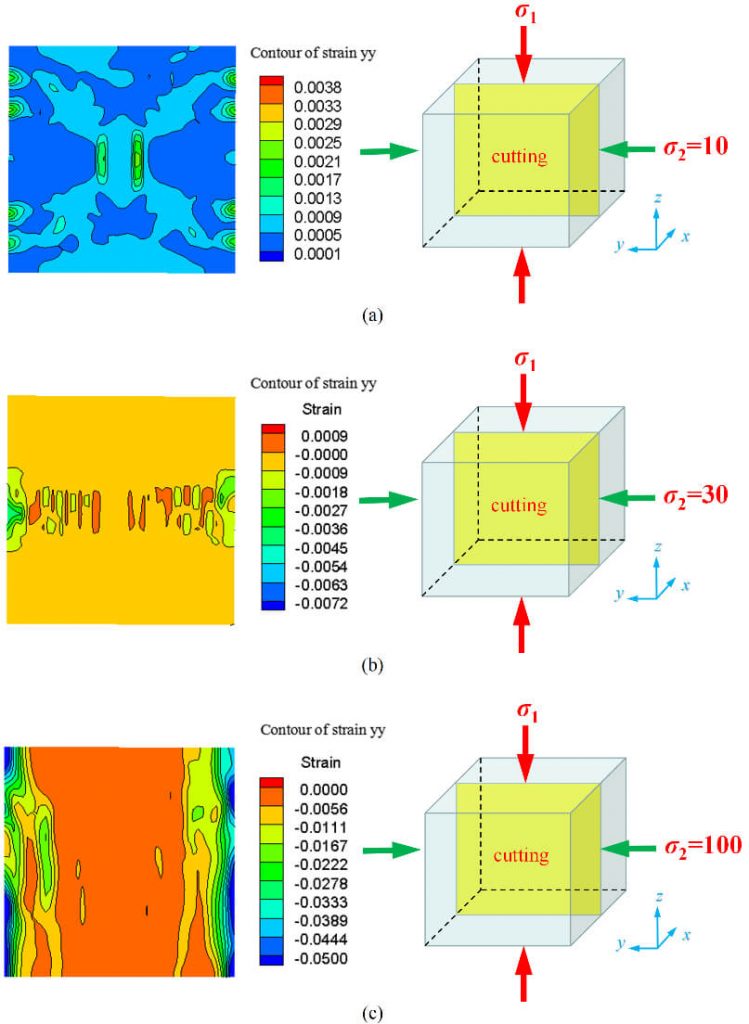
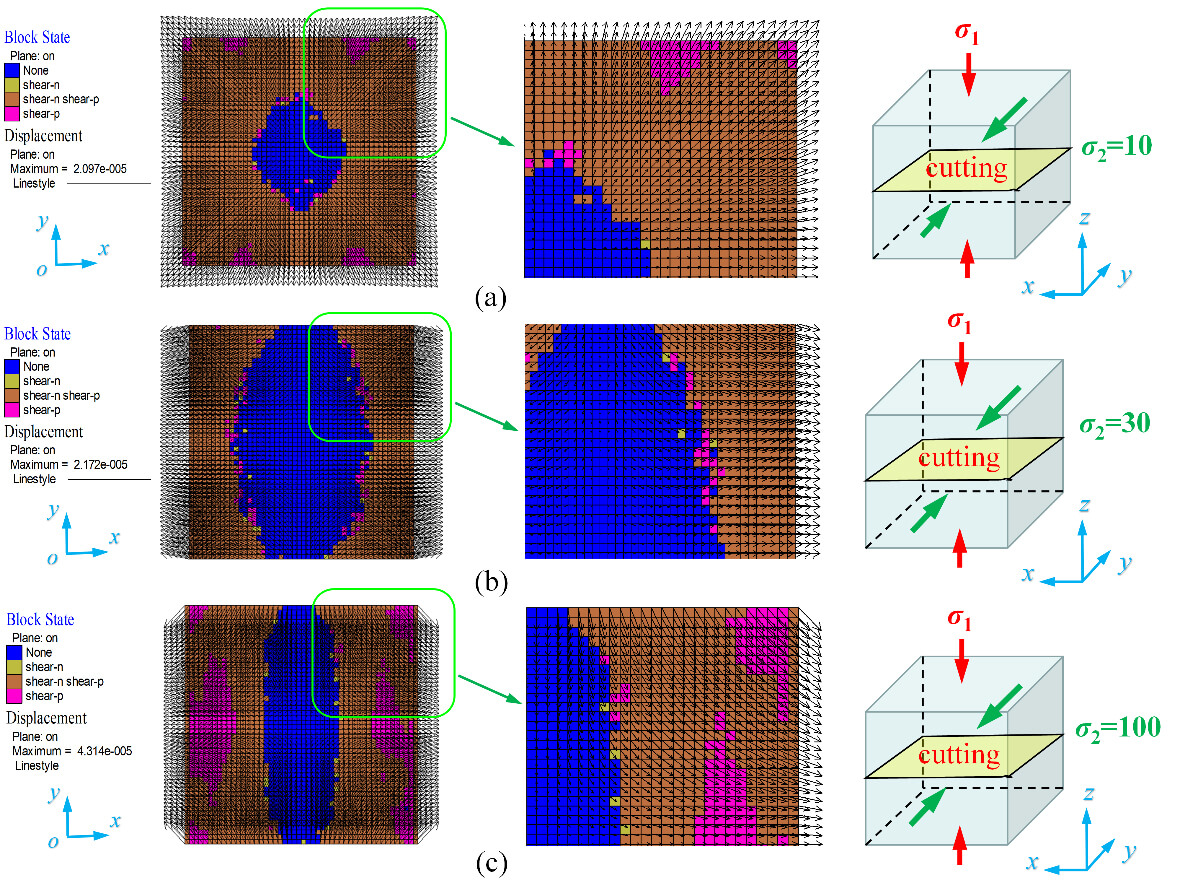
To this note, Shandong University of Science and Technology and Central South University-based researchers: Dr. Fan Feng, Professor Xibing Li, Dingxiao Peng, Diyuan Li, and Professor Kun Du together with professor Jamal Rostami at Colorado School of Mines modeled hard rock strength and fracturing under polyaxial compression based on the Mogi-Coulomb failure criterion. They used a commercially available finite-difference program to simulate the relevant parameters obtained from triaxial tests to determine the effects of intermediate principal stress on fracture characteristics taking into consideration the material strain-softening properties. A dynamically linked library was used to compile the results obtained from the user-defined model interface. To validate the effectiveness and accuracy of the developed approach, the numerical results were compared to the previous experimental data. The work is published in International Journal of Geomechanics.
The authors observed brittle rock failure under high intermediate stress owing to a decreasing trend in the fracture angle. This was equally confirmed through both visual and microcosmic observations of the failure modes on the samples. Additionally, it was established that the Mohr-Coulomb model does not take into account the effects of the intermediate stress and thus cannot offer a better representation of strength characteristics of failure modes under polyaxial compression conditions. This gave credits to the effectiveness of Mogi-Coulomb based model in simulating hard rock failure characteristics under polyaxial compression conditions, and especially those involving high intermediate stress. Their study indeed provides vital information that will pave way for better understanding of the stain-hardening and strain-softening behavior based on the current and newly developed constitutive models.



Reference
Feng, F., Li, X., Rostami, J., Peng, D., Li, D., & Du, K. (2019). Numerical Investigation of Hard Rock Strength and Fracturing under Polyaxial Compression Based on Mogi-Coulomb Failure Criterion. International Journal of Geomechanics, 19(4), 04019005.
Go To International Journal of Geomechanics