Advances in Engineering Advances in Engineering features breaking research judged by Advances in Engineering advisory team to be of key importance in the Engineering field. Papers are selected from over 10,000 published each week from most peer reviewed journals.

Significance Statement
Iwafune and Yagita (2016) examined seasonal panel data analysis and higher resolution using commercial home energy management system data to identify parameters that determine Japanese household electricity consumption. The work published in journal, Energy and Buildings, made use of home energy management systems HEMS database which analyzes structure of household electricity consumption offering higher resolution than smart meter.
Previous research implemented to understand the structure of household energy consumption has been based on two approaches; the top-down and bottom-up. The top-down approach uses econometrics and statistical or regression method for aggregated residential sector while bottom-up approach focuses on individual households estimating electrical consumption using features such as physical, social, behavioral and demography per household.
Most bottom-up model used in some studies are of smart meter data which supplies whole consumption data only without individual usage data providing insufficient in-depth understanding of the structure of residential electricity consumption.
Hence, home energy management systems database could be employed in order to correct the limitations possessed by smart meters due to its higher resolution.
For implementation of this research, Iwafune and Yagita (2016) made use of 740 household datasets from three sites collected between December 2013 and November 2014 for home energy management systems database after screening for outliers and missing values. Home energy management systems measurement methods differs for three sites because those systems were from different manufacturers.
Power consumption for space heating and water heater in the home energy management systems which only measured currents was corrected by multiplying 0.9 as the power factor.
Explanatory variables in regression modelling were gotten from data obtained from household developers and residents via questionnaires. The variables were classified in four categories such as household and facilities, environment, appliance possession and appliance usage with specification.
Two types of regression model; basic and additional model were used to address situations where response rate for questions related to model number in appliances and behavior factors were low.
Results obtained from seasonal panel data analysis gave annual, average density consumption for whole house at 7135KW/h, significantly higher than average electricity consumption of 5155KW/h in Japanese households in 2013. The higher figure is as a result of more recently built house samples which include larger square footage and electric hot water use coupled with higher ratio of detached houses.
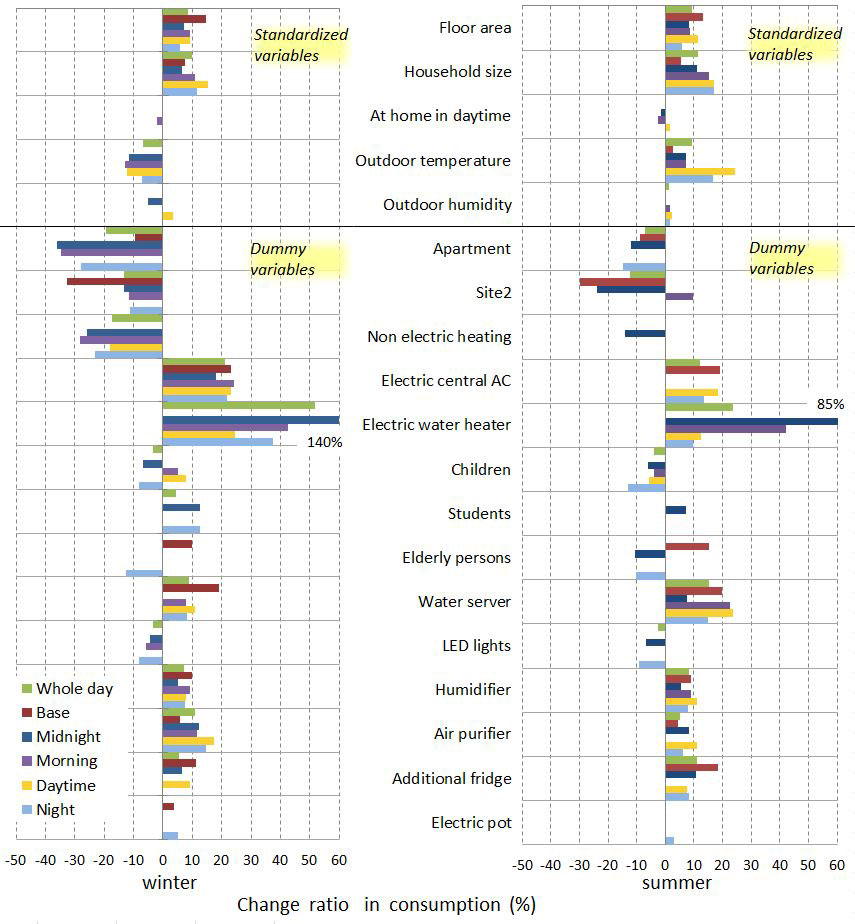
Use of electrical central air conditioning system and an electric water heater had positive coefficients in total electricity consumption of 1148KWh/year and 1975KWh/year respectively with the latter larger than 1375KWh/year of average consumption for electric water heater meaning that electricity water heater consumes more electricity than other appliances. There was also significant difference in other appliances such as water server, additional refrigerator, portable humidifier and air purifier having 844KWh/year, 885KWh/year, 491KWh/year and 443KWh/year respectively.
Space heating and cooling in dwellings with a central air conditioning system consumed more energy than homes without such systems by 5.9 and 0.7KWh/day compared to 7.7KWh/day and 2.5KWh/day respectively.
It was further discovered that living in an apartment house and use of non-electric heating system resulted in lower consumption of electricity for space heating and cooling load had a positive relationship with floor area, household size and ratio of persons at home during the day time in weekdays.
Presence of an electric water heater had the greatest impact on electric hot water usage with average consumption of 1357KWh/year. Annual increase in hot water demand and other appliances was calculated to be 147KWh/year and 495KWh/year respectively with a decrease in existence of children to be 174KWh/year and 230KWh/year respectively.
Possession ratio of more than one refrigerator and water server had 6 and 5% respectively which may be considered in conserving energy in Japanese households. LED lamps usage generally consumed 0.8KWh/day less compared to households using incandescent or fluorescent lamps in water.
Other usage of appliances such as hours of television viewing and television rated power consumption, use of rice cooker warming function, use of clothes dryer and bathroom dryer coupled with dishwasher had positive impact on other appliance at certain seasons.
When considering site1 where all houses were detached electrified houses with significant factors such as household size, floor area, outdoor temperature and outdoor humidity, results show that central air conditioning system were significant only in summer with capacity of photovoltaic system having a positive relationship with summer electricity.
For site 2, with 70% included electrified detached houses showed a significant impact occurring through ownership of an electrical central air conditioning and electric water heater. At site 2 also, air conditioning hours, television watching hours, bathtub water temperature and dishwater usage were also significant.
At site 3, largest impact was made by an electric water heater because ratio of hot water demand is larger in apartment houses. Additional variables such as air conditioning usage, television rated consumption, dishwater usage, bathroom dryer usage and washing machine usage was also significant.
This study identified several important parameters in explaining electricity demand which promotes further energy efficiency program in Japanese residential sector.
Acknowledgement: This research was supported by JST, CREST and the Ministry of Environment in Japan.


Journal Reference
Yumiko Iwafune1,2, Yoshie Yagita1. High-Resolution Determinant Analysis of Japanese Residential Electricity Consumption Using Home Energy Management System Data. Energy and Buildings, 2016, Volume 116, pp 274-284. Energy and Buildings, Volume 116, 2016, Pages 274–284.
[expand title=”Show Affiliations”]- Research Center for Energy Engineering, Institute of Industrial Science, University of Tokyo, Tokyo, Japan
- JST, CREST, Japan
Go To Energy and Buildings