Advances in Engineering Advances in Engineering features breaking research judged by Advances in Engineering advisory team to be of key importance in the Engineering field. Papers are selected from over 10,000 published each week from most peer reviewed journals.

Significance
Agriculture involves several activities ranging from the field preparation to harvesting. However, many tasks are also important to ensure optimal care and protection of the crops to obtain good yields. This includes the application of fertilizers, pesticides, and fungicides. Insects and various crop diseases lead to a loss of up to 35% of total crops. Presently, the available means of pesticides applications such as the manual sprayer where the operator walks across the crops and the mechanized system that enables continuous spraying of the crops are not sufficient. Apart from not being able to select the respective sites to be sprayed, they also have side effects to the operator and the environment at large. The advancement in technology has seen more robots developed in the field of agriculture to help in activities such as planting, selective harvesting, and pruning. For effective and efficient pest control, a site-specific robot sprayer is developed. A human operator is required for remotely supervise the operation of the robot.
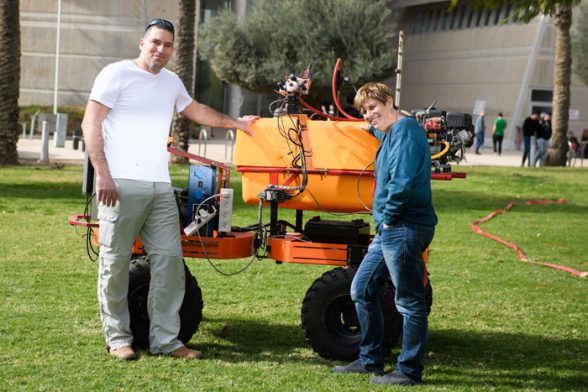
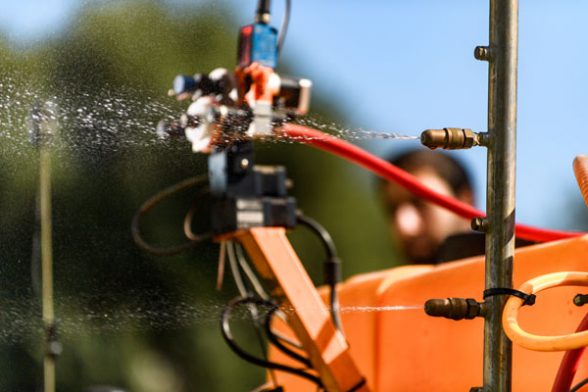
Ben-Gurion University of the Negev researchers, Dr. Ron Berenstein and Professor Yael Edan addressed a major challenge in pesticide application and successfully designed a site-specific human-robot sprayer for effective spraying of pesticides. They anticipated that the device would help in saving up to 60% of the spray because the spray is selectively applied on the affected areas. The work is a significant contribution to the agricultural sector and it is now published in the journal, Field Robotics. Additionally, they designed, implemented and evaluated an automatic adjustable spraying device for site-specific agricultural application which has been published in IEEE Transactions on Automation Science and Engineering.
From the designed experiment implemented to evaluation of the performance of the collaborative human-robot sprayer, Berenstein and Edan observed that the system saves more than half of the spray material, reducing the impact on the environment as well as on the human operator. From the decrease in False Positive (FP) and increase in True Positive (FP) rates, the experiment successfully showed the possibility of detecting and spraying the affected sites.
The results obtained in their study can be used to design and develop a human-operated robot for site-specific spraying. Site marking and the level of collaboration between the remote robot and the human operator can be selected by considering the TP and FP rates. For instance, freehand marking as a target selection method together with level 2 collaboration results to low FP rate while a high TP rate can be achieved by full manual collaboration method and constant circle diameter marking. The selection criterion is an advantage as various pests and diseases attack the farm at different times depending on the environmental conditions and seasons.
Berenstein and Edan also evaluated the performance of the spraying system and its impacts both on the environment and the operator. It is environment-friendly hence reduce the rate of pollution. It also relieves the human operator from the risks of getting into contact with the harmful chemicals that may lead to health complications. This is the first study to design and develop a remote human collaborative robot sprayer and will advance the field of agriculture by enhancing insects and diseases control and at the same time reducing the cost of production.

Reference
Berenstein, R., & Edan, Y. (2017). Human-robot collaborative site-specific sprayer. Journal of Field Robotics, 34(8), 1519-1530.
Berenstein, R., & Edan, Y. (2018). Automatic adjustable spraying device for site-specific agricultural application. IEEE Transactions on Automation Science and Engineering, 15(2),641–650.
Go To Journal of Field Robotics