Advances in Engineering Advances in Engineering features breaking research judged by Advances in Engineering advisory team to be of key importance in the Engineering field. Papers are selected from over 10,000 published each week from most peer reviewed journals.

Significance
As power networks continue to grow in complexity and scale, the demand on transmission infrastructure to deliver energy more efficiently, compactly, and reliably has never been greater. Among the technologies rising to meet this challenge, gas-insulated transmission lines (GILs) stand out as a particularly attractive solution—especially in urban centers or environmentally protected regions where traditional overhead lines are no longer viable. With their ability to carry high currents, maintain strong dielectric properties, and withstand harsh conditions, GILs represent a modern answer to several long-standing grid limitations. However, these advantages come with their own set of engineering hurdles—foremost among them is the difficulty of managing internal thermal behavior in a closed, high-voltage environment. The issue is rooted in the inherently multiphysical nature of GIL operation. When current flows through the central conductor, it generates heat via resistive losses. This heat doesn’t remain localized; instead, it propagates through solid and gaseous components alike—by conduction through metal, by convection within the SF₆ insulating gas, and by radiation across the concentric structure. The challenge is not just in understanding how heat forms, but in accurately mapping how it moves. Temperature monitoring is crucial, as excessively high temperatures can compromise insulation integrity, deform components, or push systems beyond regulatory safety margins. And because GIL structures can span several dozen meters and include a mix of repetitive and complex geometries, simulating them in full 3D quickly becomes a time-consuming—and often prohibitively expensive—computational task. Simplified approaches like the Thermal Network Method (TNM) have gained popularity for offering faster estimates, but they often fall short in cases where spatial detail and field coupling matter most. Faced with this trade-off between computational feasibility and modeling fidelity, New research paper published in Electric Power Systems Research and conducted by PhD candidate Mr. Xingxiong Yang, Dr. Shucan Cheng, and led by Professor Yanpu Zhao from the School of Electrical Engineering and Automation at Wuhan University (from July 2025, he is a professor in the College of Electrical Engineering of Sichuan University), the authors developed a hybrid-dimensional simulation framework that couples a 3D electromagnetic field model with a 2D fluid-thermal model to analyze GILs. This approach uses a hybrid mesh structure—combining tetrahedral elements at complex geometries with layered meshes in straight sections—to significantly reduce computational cost without sacrificing accuracy. By applying degree-of-freedom constraints and aligning mesh interfaces, the method accelerates simulation while capturing key physical behaviors like thermal buoyancy and radiation. It offers a validated, efficient tool for engineers to perform high-fidelity multiphysics analysis of large-scale power transmission systems.
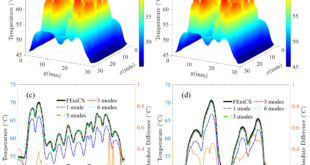
The research team at Wuhan University evaluated the performance of their new hybrid simulation method, they constructed an actual 40-meter-long GIL prototype and subjected it to thermal stress tests under real operating currents. This wasn’t just about heating a conductor and logging numbers. It was about capturing the interplay of heat, gas flow, and structure in a system. Key to this effort was the careful placement of thermocouples along both the conductor and enclosure walls. The system was energized across a range of load conditions, from moderate to very high, mimicking field-level demand. Meanwhile, the team ran detailed simulations using their proposed hybrid mesh and hybrid-dimensional (HMHD) method. They modeled electromagnetic fields in full 3D—necessary for accurate loss estimation—and used those results to drive a 2D simulation of fluid and thermal dynamics. This split-dimensional approach allowed them to preserve detail where it mattered while reducing the overall computational burden, especially across the long, repetitive segments typical of GILs. The authors found that simulated conductor temperatures were consistently within 1% of experimental values, and enclosure readings matched within 2%. But it wasn’t just about hitting temperature targets—it was the patterns that matched. The model reproduced the rising gas vortices, the thermal layering near the top of the enclosure, and the cool pockets near the base—subtle dynamics confirmed during physical observation. Those details are often where traditional methods fall short. The authors excluded thermal radiation from the simulation to gauge its impact. The error jumped dramatically—upwards of 10% in several cases—highlighting how non-negligible radiation is in these enclosed, coaxial systems. That realization alone makes a strong case for updating thermal models across the industry. Perhaps most importantly, their method cut the total simulation time by more than 40%. That’s not just a numerical win; it changes what’s feasible in practice. Engineers can now afford to iterate quickly, test edge cases, or simulate faults without waiting days for results.
The true impact of study by Professor Yanpu Zhao and his colleagues goes far beyond its methodological innovation. While the hybrid-dimensional framework proposed by the Wuhan University team is certainly a technical leap forward, its broader value lies in how directly it addresses long-standing pain points in power system design and analysis. As global energy infrastructure pushes into denser urban areas and faces growing demands for efficiency, reliability, and environmental compliance, solutions like GIL have taken center stage. However, modeling these systems—especially when it comes to their internal thermal behavior—has remained a daunting task. Full-scale 3D simulations, while accurate, are often too slow for iterative design. The approach put forward in this work reimagines that landscape. The authors successfully crafted a simulation method that is fast and remarkably accurate. For engineers, the implications are immediate. What once took hours—or even days—can now be modeled in several tens of minutes. That alone changes the pace at which design optimizations, failure analyses, or thermal assessments can be carried out. Moreover, this framework captures subtle details like the nuanced impact of thermal radiation within enclosed geometries—aspects often overlooked by simplified models. The fact that these features were validated experimentally gives engineers a level of confidence that’s rare in accelerated simulation schemes.



Reference
Xingxiong Yang, Yanpu Zhao, Shucan Cheng, Fast calculation of electromagnetic-thermal-fulid multiphysics coupling of GIL based on hybrid model, Electric Power Systems Research, Volume 238, 2025, 111074,