Advances in Engineering Advances in Engineering features breaking research judged by Advances in Engineering advisory team to be of key importance in the Engineering field. Papers are selected from over 10,000 published each week from most peer reviewed journals.

Significance Statement
Surface plasmon polaritons have recently been found useful in applications that require strong field enhancement on nanoscale spots. These applications include nonlinear plasmonics, near field microscopy, bio-sensing photovoltaics, field-enhanced microscopy and quantum plasmonics. The wide range of applications has mainly been driven by the rapid progress in nanofabrications and design capabilities. However, challenges have emerged when it comes to the delivery efficiency and light collection on the nanoscale, especially on an integrated optical fiber platform. The available near field optical microscopy techniques majorly depend on cantilevers and subwavelength aperture based probes and become inefficient when the aperture size falls below a given range.
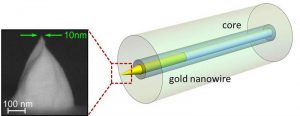
A research team led by professor Markus Schmidt at the Leibniz Institute of Photonic Technology in Germany developed a fully integrated fiber-based near-field nanoprobe for the broadband delivery of light to nanoscale dimensions using short-range surface plasmon polaritons on a metallic nanotip, having an apex size less than 10 nm, which would provide a new nanophotonic platform with the potential to break the current limits of near field microscopy. They aimed at developing a monolithic nanowire-enhanced fiber-based nanoprobe for the broadband delivery of light (550−730 nm) to a deep subwavelength scale by using short-range surface plasmons. The research work is now published in Nano Letters.
First, they formed the geometry by using a step index fiber with an integrated gold nanowire in its core and a protruding gold nanotip with sub-apex radius of 10 nm. The researchers then presented a new coupling scheme to excite short-range surface plasmons on a gold nanowire through a cylindrical polarized hybrid dielectric mode. The radially polarized hybrid mode propagated inside the nanowire section and was used to excite the plasmonic mode at the fiber end face. This in turn super focused down to nanoscale dimensions at the tip apex.
The researchers observed that in this plasmonic coupling scheme, the wire length could be orders of magnitude longer than the attenuation length of short-range plasmon polaritons, which reduces demands in fabrication. The broadband scattered light in the far field from the nanotip due to plasmonic excitation was observed to be axially polarized and preferentially excited by a radially polarized input, revealing that it originated from a short range plasmon propagating on the nanotip.
The short-range surface plasmon polaritons’ unique property of being able to nanofocus on a mechanically flexible and monolithic fiber platform will enable the nanoprobe to be applied in a wide range of applications. The researchers are highly optimistic that such nanoprobes will offer significant improvement in both spatial resolution and delivery efficiencies, when compared to currently used near-field tips.

Reference
Alessandro Tuniz1, Mario Chemnitz1,2, Jan Dellith1, Stefan Weidlich1,3, Markus A. Schmidt1,2,4. Hybrid-Mode-Assisted Long-Distance Excitation of Short-Range Surface Plasmons in a Nanotip-Enhanced Step-Index Fiber. Nano Letters volume 17 (2017) pages 631−637.
[expand title=”Show Affiliations”]- Leibniz Institute of Photonic Technology (IPHT Jena), Albert-Einstein-Strasse 9, 07745 Jena, Germany
- Abbe School of Photonics and Faculty of Physics, Max-Wien-Platz 1, 07743 Jena, Germany
- Heraeus Quarzglas GmbH & Co. KG, Quarzstrasse 8, 63450 Hanau, Germany
- Otto Schott Institute of Materials Research, Fraunhoferstrasse 6, 07743 Jena, Germany
Go To Nano Letters