Advances in Engineering Advances in Engineering features breaking research judged by Advances in Engineering advisory team to be of key importance in the Engineering field. Papers are selected from over 10,000 published each week from most peer reviewed journals.

Significance
Graphene is a revolutionary material that has captured the attention of scientists and engineers, around the world. It is a two-dimensional material made of carbon atoms arranged in a hexagonal lattice pattern, which makes it the thinnest and strongest material known to man. Its unique properties have made it an important subject of research in fields such as electronics, energy, medicine, and many others. One of the most significant properties of graphene is its high electrical conductivity. Graphene has a high carrier mobility, meaning that electrons can move through it at high speeds without scattering. This makes it an excellent material for electronic devices such as transistors, sensors, and solar cells. In fact, graphene has the highest electrical conductivity of any known material, which makes it a very promising material for the development of next-generation electronic devices. Graphene’s electrical conductivity is also highly tunable. It can be easily doped with impurities to change its electrical properties, which makes it very versatile and adaptable to a wide range of applications. For example, graphene can be doped with nitrogen or boron to create n-type or p-type semiconductors, respectively, which are essential components of electronic devices. Another important aspect of graphene’s electrical conductivity is its thermal conductivity. Graphene is an excellent conductor of heat, which makes it useful in thermal management applications. For example, graphene can be used as a heat sink in electronic devices to dissipate heat and prevent overheating. However, with all its great potential, there has been some challenges on how to incorporate graphene into composites without sacrificing other properties such as mechanical strength or manufacturing ease.
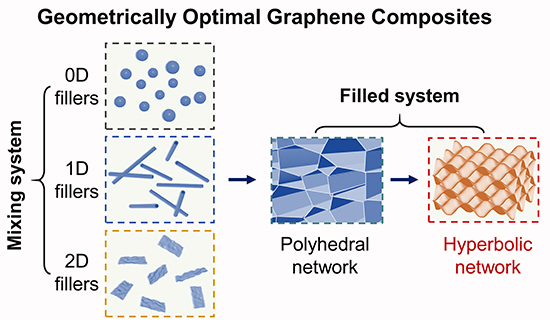
Here, the idea of a hyperbolic graphene framework is generated to increase the effectiveness of this material. In a new study published in the peer-reviewed journal ACS Nano, Dr. Xiaoting Liu, Dr. Kai Pang, Dr. Huasong Qin, Dr. Yilun Liu, Dr. Yingjun Liu, Dr. Chao Gao, and led by Professor Zhen Xu from Zhejiang University developed a three-dimensional (3D) hyperbolic graphene framework with a shape resembling a negatively curved surface. They were able to do this by using a procedure called chemical vapour deposition, which was followed by a series of chemical treatments that were used to build the one-of-a-kind structure. The most important discovery they made was the demonstration of extraordinary electronic and mechanical properties of the hyperbolic graphene framework. These properties have the potential to find applications in a variety of fields, including energy storage, nanoelectronics, and advanced materials engineering, amongst others. The optimal percolation threshold, which is the point at which the composite’s conductive qualities manifest, is made possible by this structure. By carefully regulating the nucleation and development of graphene during chemical vapor deposition, the researchers were able to create a hyperbolic graphene framework that performs better when added to conductive composites. The fact that the hyperbolic graphene framework dramatically lowers the percolation threshold when compared to ordinary graphene fillers is one of this research’s most noteworthy features. Because of this, less graphene is needed to get the right amount of conductivity. This makes composite materials lighter and cheaper. Moreover, the composites’ general mechanical qualities are improved by the negatively curved surface of the hyperbolic graphene framework, making them more robust without compromising conductivity.
The authors assessed the functionality of the new material by inserting the hyperbolic graphene framework into a variety of composite materials, including epoxy resins, thermoplastics, and elastomers. In each trial, they observed significant gains in mechanical characteristics, electrical conductivity, and thermal conductivity. These findings demonstrate how conductive composite design and production might be revolutionized by hyperbolic graphene.
Several sectors throughout the globe might profit from more effective and high-performance conductive composites, therefore this discovery has a broad range of practical applications. With this advancement, electronics equipment may be able to manage heat more efficiently, lasting longer and being less prone to overheat, with enhanced thermal conductivity. These lightweight and mechanically resilient composites might also aid in the development of wearable technology and flexible electronics, enabling more pleasant and long-lasting goods. The findings of this study may also impact the renewable energy sector via the creation of superior materials for energy storage devices like batteries and supercapacitors. Improved energy storage devices might pave the road toward a more sustainable future if hyperbolic graphene frameworks can improve electrical conductivity and mechanical properties.
In summary Professor Zhen Xu and colleagues developed a new strategy for enhancing the conductivity and functionality of composite materials. The novel hyperbolic graphene structure improves the mechanical characteristics of the composites, making them lighter, more affordable, and more robust while also lowering the percolation threshold. The new promising material has the potential to revolutionize many industries, including renewable energy, electronics, aircraft, and the automotive and auto industry. It is set to change the use of advanced materials going forward and open the door for new discoveries and advancements in technology. The hyperbolic graphene framework provides a viable solution that tackles present issues and pushes the limits of what is feasible in material science, as industries continue to seek more effective and high-performance materials.


Reference
Liu X, Pang K, Qin H, Liu Y, Liu Y, Gao C, Xu Z. Hyperbolic Graphene Framework with Optimum Efficiency for Conductive Composites. ACS Nano. 2022;16(9):14703-14712. doi: 10.1021/acsnano.2c05414.