Advances in Engineering Advances in Engineering features breaking research judged by Advances in Engineering advisory team to be of key importance in the Engineering field. Papers are selected from over 10,000 published each week from most peer reviewed journals.

Significance Statement
Free falling objects are of great importance in both engineering principles and theoretical research. This has led to near-exhaustive studies at both empirical and theoretical levels, of the topic. Fluid-structure interactions flow problems, which involve complicated dynamic characteristics and also a wide range of applications are usually involved here.
Researchers under the leadership of Professor Chang Shu from the Department of Mechanical Engineering at National University of Singapore proposed an immersed boundary -lattice Boltzmann flux solver in moving frame, to study three-dimensional freely falling rigid bodies in unbounded domains. Their work is now published in Journal of Fluids and Structures.
The team used an immersed boundary lattice Boltzmann flux solver which includes a predictor and corrector steps. Lagrangian markers were applied for the application of boundary conditions while the poignant Eulerian grid was used to calculate the flow field. No rotational motion was allowed in the Eulerian grid but instead a unique translational motion was applied.
Finite volume discretization followed closely where the fractional-step method was applied so as to divide the solution process into two steps; predictor and corrector steps. For the predictor step, intermediate flow field was predicted by solving equations obtained without considerations of the solid boundary present. Velocity corrections were then made, for the flow field, in the corrector step by using the improved boundary condition-enforced immersed boundary method.
Prediction of the transitional flow field was tested as proposed in the 3D-LBFS in a moving frame, in the immovable Cartesian coordinate system which is efficient for non-uniform fields. The numerical fluxes at cell interface between two adjacent cells were evaluated physically from the local solution of lattice Boltzmann equation. Both viscous and inviscid fluxes at each interface were reconstructed simultaneously by local application of the lattice Boltzmann method. Convective flux that was caused by the grid motion was evaluated directly by utilizing the speed of the moving grid. The team then conducted rigid body motion prediction using two accepted co-ordinate systems. A computational sequence finalized the process.
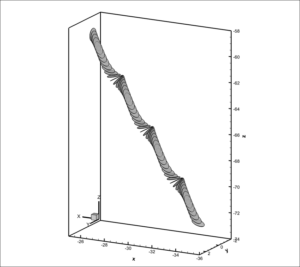
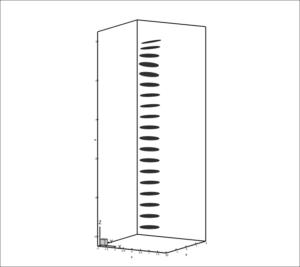
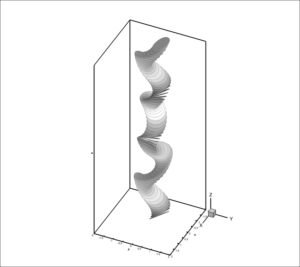
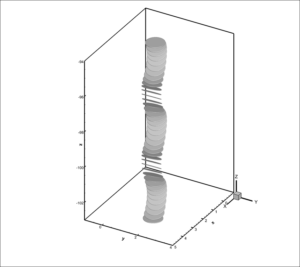
It was necessary that the team validated their numerical method by simulating three incompressible flows with a dynamic sphere, sole particle sedimentation in a rectangular vessel and flows with spontaneously falling disks of varying aspect ratios. Phase illustrations of the different falling patterns were developed.
Regardless of the success of empirical and theoretical studies, numerical investigations of this matter, which may yield more physical data about various instantaneous flow parameters and vortical structures, are still minimal due to its geometrical and dynamical intricates.
Empirical findings yield a classification of varying modes of a free-falling disk. The results obtained here synchronize well with theoretical and empirical data. This research demonstrates the capability of the proposed solver to capture intricate modes of a falling body.
Reference
Y. Wang1, C. Shu, L.M. Yang2, C.J. Teo1. An immersed boundary-lattice Boltzmann flux solver in a moving frame to study three-dimensional freely falling rigid bodies. Journal of Fluids and Structures 68 (2017) 444–465.
[expand title=”Show Affiliations”]- Department of Mechanical Engineering, National University of Singapore, 10 Kent Ridge Crescent, 119260, Singapore
- Department of Aerodynamics, College of Aerospace Engineering, Nanjing University of Aeronautics and Astronautics, Yudao Street, Nanjing 210016, Jiangsu, China
Go To Journal of Fluids and Structures