Advances in Engineering Advances in Engineering features breaking research judged by Advances in Engineering advisory team to be of key importance in the Engineering field. Papers are selected from over 10,000 published each week from most peer reviewed journals.

Significance
Climate change and greenhouse gas emission are among the current global problems that require immediate solution. Apart from the consumption of fossils fuels, building’s energy consumption has slowly but steadily risen to become among the greenhouse gas emitters due to the growth in population and human activities. For instance, 40% of global energy is currently consumed by the building sector. Therefore, considering the hazardous effects of global warming on human health and the ecosystem in general, efficient mitigation measures for controlling energy consumption and greenhouse gases emissions in buildings is highly desirable.
In a recently published literature, it has been showed that climate change will have a significant impact on the building’s energy consumption located in both hot and cold climatic regions even though the overall impact varies depending on the climatic zones. As such, residential and office building design and development should take into consideration the effects of climate changes on energy performance. This has attracted significant attention of researchers who are interested in developing efficient alternative strategies to reduce building energy consumption. Among the proposed strategies, bioclimatic approaches have proved a promising solution in lowering the energy consumption in buildings. But, a given bioclimatic strategy that today is appropriate in a certain place could not be the optimal choice if future climate change conditions are considered.
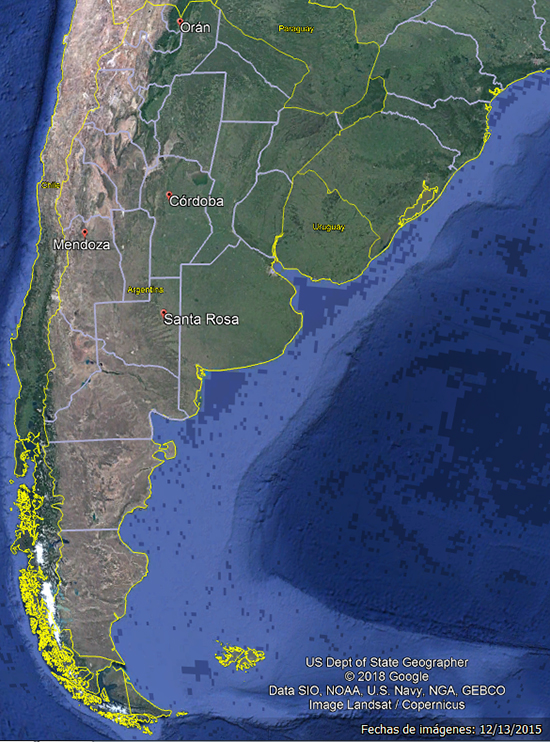
To this note, CONICET researchers: Dr. Silvana Flores-Larsen, Dr. Celina Filippín, and Dr. Gustavo Barea assessed the various ways in which the climatic changes will affect the building’s energy consumption. Specifically, Argentina climatic conditions were used as a case study. They wanted to evaluate appropriate bioclimatic strategies for the design of future residential and offices buildings with the aim of minimizing energy consumption taking into consideration the current and future climate changes. Their work is currently published in the research journal, Energy and Buildings.
In brief, the research team initiated their research work by exploring the temperate and warm climatic conditions for the four selected regions in Argentina. Next, they used EnergyPlus software and measured data to simulate conventional housing in these regions. Also, they analyzed the impact on energy consumption on the bioclimate strategies for both medium- and long-term climate change.
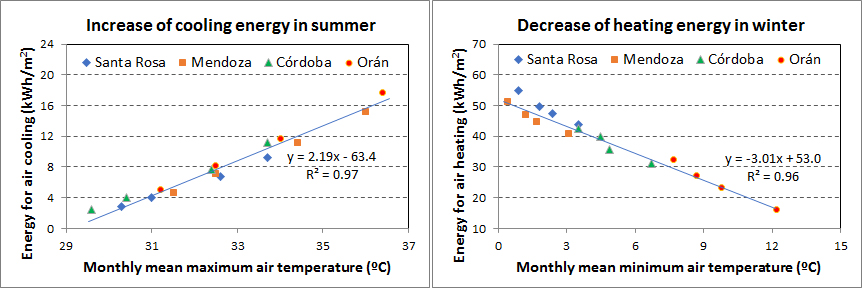
The Argentinian authors predicted a future increase in the air temperature ranging from 2.2 °C to 3.8 °C for all the four sites with the most affected regions being in the lower latitude. Also, an increase in the cooling loads and decrease in the heating loads is generally expected. Consequently, it was worth noting that three of the analyzed regions exhibited a general decrease in annual energy consumption.
In summary, it was important to note that depending on the local factors, global climate change affects different regions in different ways as depicted by four assessed regions in Argentina. In general, building design prototypes should be developed based on the climatic topologies of the desired region. Also, a combination of sun shading and minimizing direct solar gains proved a promising design solution for climate change in future buildings. Altogether, the study by Silvana Flores-Larsen and her colleagues provided vital information that will pioneer energy consumption reduction in residential building globally.



Reference
Flores-Larsen, S., Filippín, C., & Barea, G. (2019). Impact of climate change on energy use and bioclimatic design of residential buildings in the 21st century in Argentina. Energy and Buildings, 184, 216-229.
Go To Energy and Buildings