Advances in Engineering Advances in Engineering features breaking research judged by Advances in Engineering advisory team to be of key importance in the Engineering field. Papers are selected from over 10,000 published each week from most peer reviewed journals.

Significance
Presently, buildings are the most extensive energy consumers utilizing about 40% globally. We require the energy for various operations in our buildings such as air conditioning, heating, and cooling, ventilation, lighting among others. However, with current adverse climate change, global warming, and high energy costs, there is a tremendous and urgent need to reduce the energy consumption in buildings. Although thermal comfort is subjective, there is still need to develop a cost-effective housing heating and cooling system based on the climate conditions of the different places.
Dr. Zhengen Ren and Dr. Dong Chen at CSIRO Land and Water in Australia investigated the effects of the indoor thermal comfort criterial on energy consumption of Australian buildings taking into consideration the current and future climate changes in the various parts of Australia. They proposal reductions in the acceptable thermal comfort criterial which will, in turn, reduce the energy requirements for the residential housing thermal comfort. The study also involves other major components such as climate change, local climate and residential building types. Their research has been published in the journal, Applied Energy.
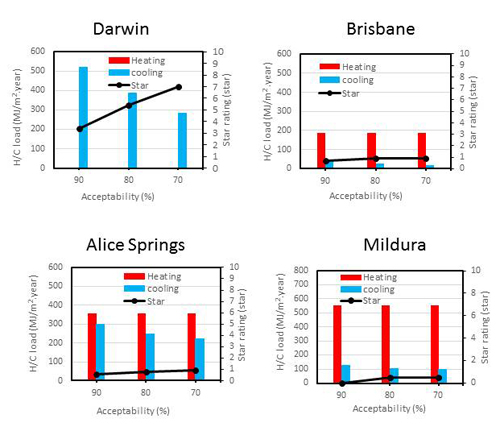
The researchers observed an insignificant effect on space cooling on heavyweight constructions in subtropics, temperate and warm temperate climatic zones when the thermal comfort acceptability limit is reduced to 70% from 90%. Areas such as Brisbane, Melbourne, and Sidney are found in the above listed climatic zones respectively. On the other hand, in tropical zones and regions experiencing hot summer, the reduction effect was significant for lightweight types of constructions. In fact, it leads to an increase in the rate of energy consumption. These climate zones include areas like Darwin and Mildura.
According to the authors, various methods can be employed to help to reduce the energy consumption rates in the buildings. They include lowering the limits for space cooling, getting rid of unwanted air-conditioning systems and using energy efficient technologies. The limits, however, depends on the specific use of the building, the local climate, and the design criterion. Comparing a narrow and wide indoor range, it was deduced that a small indoor temperature range requires more energy to maintain as compared to its wider indoor temperature range. The authors also observed that it is possible to reduce cooling space by lowering the acceptable limits through well-designed lighthouses mainly in tropical and sub-tropical regions of Australia, and as a result, low energy costs.
The most significant advantage of their study is that it is flexible as far as climate changes are concerned. It takes into consideration the present and future trends in climate. Although it was done concerning the Australian climate conditions, it can be adopted and used in any part of the world with entirely different climate conditions. Therefore, the research is very crucial in contribution to affordable thermal comfort both in Australia and the world at large.


Reference
Ren, Z., & Chen, D. (2018). Modelling study of the impact of thermal comfort criteria on housing energy use in Australia. Applied Energy, 210, 152-166.
Go To Applied Energy