Advances in Engineering Advances in Engineering features breaking research judged by Advances in Engineering advisory team to be of key importance in the Engineering field. Papers are selected from over 10,000 published each week from most peer reviewed journals.

Significance
Pharmaceuticals and pesticides are micropollutants that can be toxic to aquatic life. Typical activated sludge processes have been extensively applied in the treatment of municipal wastewater nowadays. However, these systems are not designed for micropollutants removal.
As opposed to typical activated sludge processes, membrane bioreactors are more efficient for micropollutants removal from municipal wastewater. This is mainly based on the fact that high sludge retention times are used in membrane bioreactors than in typical activated sludge processes. Unfortunately, even though higher sludge retention times often leads to some degradation of compounds with low biodegradability, it does not necessarily lead to efficient removal of micropollutants when using membrane bio-reactors alone.
Membrane technology, for instance, reverse osmosis has been proposed as a post-treatment process after conventional activated sludge and membrane bioreactor for effective removal of micro-pollutants. In addition, advanced oxidation processes, including ozonation, fenton, and photo-fenton have also been proposed as advanced micro pollutant treatment options. However, it has been found that advanced oxidation processes and reverse osmosis come with high operational costs, particularly due to high energy consumption, and high chemical adjustments.
The operational costs can be cut by replacing reverse osmosis with nanofiltration. As for the advanced oxidation processes, pulsed corona discharge oxidation has been found to be as twice energy efficient as the conventional ozonation. Therefore, the concept of implementing membrane filtration and/or advanced oxidation processes after typical activated sludge or membrane bioreactors seems promising for micro pollutants removal.
PhD researcher Kimmo Arola, Professor Mika Mänttäri, and Associate Professor Mari Kallioinen at Lappeenranta University of Technology in collaboration with Henry Hatakka at Wapulec Oy and a water treatment plant in Finland examined two novel processes for enhanced micropollutants removal from wastewater. Their decision to select the unit operations was centered on the objective to come up with a cost-efficient process, which could remove about 90% of the studied micropollutants while maintaining an appreciable removal of organic compounds as well as nutrients in order to mitigate eutrophication effect in the receiving waters. Their research work is published in journal, Separation and Purification Technology.
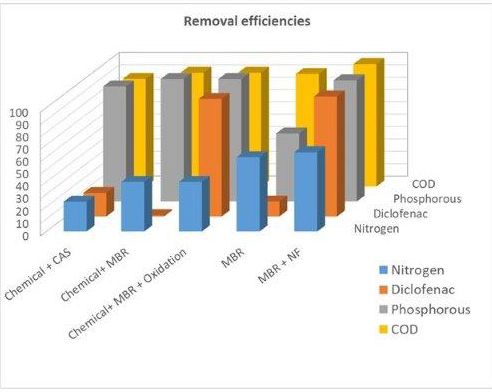
The authors examined two alternatives for the removal of micropollutants. They did the tests on a pilot scale with real wastewater of a small municipality. In the first alternative, they combined a membrane bioreactor process without phosphorus precipitation with a high permeability nanofiltration. In the other alternative, they combined membrane bioreactor with phosphorus precipitation with advanced oxidation applied by pulsed corona discharge.
The authors noted limited removal of unreadily biodegradable micropollutants such as diclofenac and carbamazepine in both membrane bioreactor processes. They recorded over 84% removal with nanofiltration for all the studied pollutants, apart from caffeine and hydrochlorothiazide. The performance of the pulsed-corona discharge oxidation, which was over 90%, surpassed that of nanofiltration.
High micropollutants removal was realized with the second alternative due to the high efficiency of the pulsed corona discharge oxidation. However, total removal of organic compounds was realized in the first setup where nanofiltration was adopted to refine the membrane bioreactor permeate. The authors recorded over 98% phosphorus removal in the two concepts. However, the first process alternative utilizing nanofiltration also allowed the recovery of phosphorus from nanofiltration concentrate. The findings of Lappeenranta University of Technology researchers will be useful for future wastewater treatment processes, considering that both of the studied concepts improved the quality of the effluent water significantly.
Reference
Kimmo Arola, Henry Hatakka, Mika Mänttäri, Mari Kallioinen. Novel process concept alternatives for improved removal of micropollutants in wastewater treatment. Separation and Purification Technology, volume 186 (2017), pages 333–341.
Go To Separation and Purification Technology