Advances in Engineering Advances in Engineering features breaking research judged by Advances in Engineering advisory team to be of key importance in the Engineering field. Papers are selected from over 10,000 published each week from most peer reviewed journals.

Significance Statement
A major part of the power consumption in the world goes to pumping. In the water industry the long distance pumping of waste water pumping takes a significant (and increasing) part of the energy. To maintain a high energy efficiency requires regular maintenance which in turn requires continuous monitoring. This actual article in Journal of Hydraulic Engineering (ASCE) describes a new principle for such a continuous monitoring of pump systems.
The inspiration for the actual idea emerged from the monitoring of the human pump system (the heart and the blood circulation) by the so-called heart cardiography where malfunction of the system can be identified by an automatic computer-analysis of the simple (and non-harmful) measurements. The article describes in more detail how a similar principle can be applied in water pump systems using the “natural” pressure fluctuations that occur during the operation of the system. The embedded and continuous analysis of the pressure signals detects the actual state of the health of the pump system and reveals the need for maintenance so that it can be decided for example whether or not the replacement of the pump impeller or a cleaning of the pipelines is required.
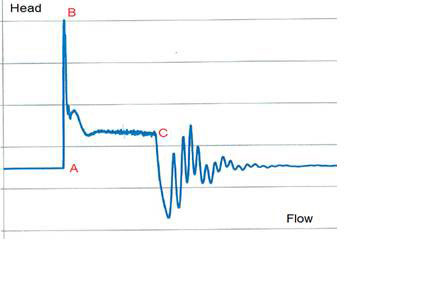
Figure Legend: Example of time progress of pressure measurement in sewer pressure main just downstream pump. Point A: Just before pump run up, pump sump is full. Point B: Immediately after pump has reached full rotation. Point C: Immediately before pump run down just when sump is empty.
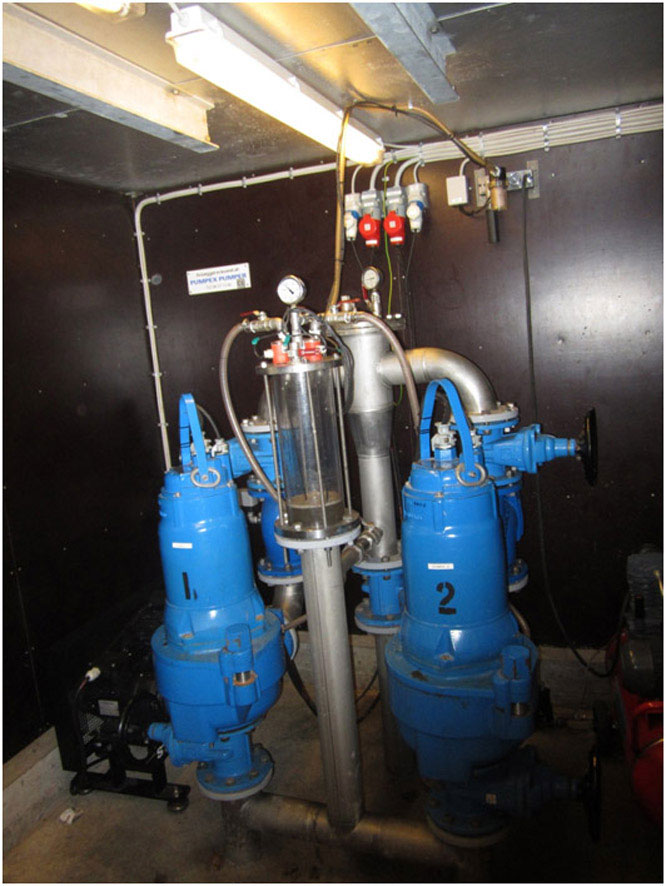
The automatic supervision of the pressure fluctuations takes place in a box situated beside the pump control in the pump station. The box contains the equipment and the computer.

Example of minor waste water pump station with 2 pumps
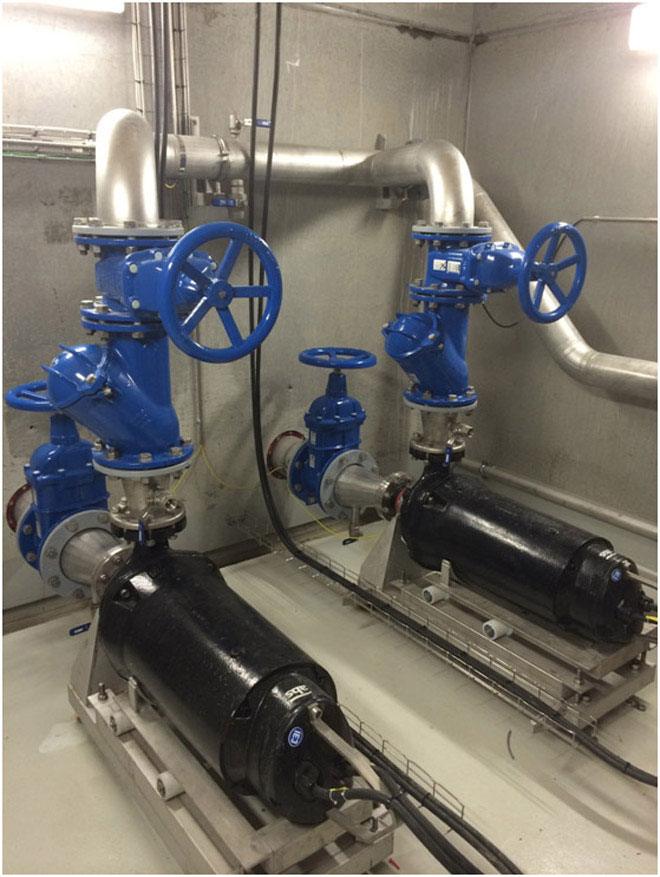
Example of minor waste water pump station with 2 pumps

Journal Reference
Journal of Hydraulic Engineering, Volume 142, Issue 2 (February 2016) .
Torben Larsen1 Mareike Arensman2; Ole Nerup-Jensen3
[expand title=”Show Affiliations”]- Professor, Dept. of Civil Engineering,Aalborg Univ., Sofiendalsvej 11, 9100 Aalborg SV, Denmark (corresponding author). E-mail: [email protected]
- Hydraulic Engineer,Envidan A/S Consulting Engineers, J. F. Kennedys Pl. 1K, 9000 Aalborg, Denmark. E-mail: [email protected]
- Head of Aalborg Dept.,Envidan A/S Consulting Engineers, J. F. Kennedys Pl. 1K, 9000 Aalborg, Denmark E-mail: [email protected]
Abstract
Wastewater pump systems decompose relatively rapidly compared to other pump systems because of the demanding properties of the pump medium. Only a systematic maintenance of the systems can prevent a significant and continuous decrease of the energy consumption per unit volume pumped (the specific energy). This article presents a method for a continuous supervision of the performance of both the pump and the pipeline in order to maintain the initial specific energy consumption as close as possible to the original value from when the system was commissioned. The method is based on pressure measurements only. The flow is determined indirectly from pressure fluctuations during pump run-up.
Go To Journal of Hydraulic Engineering