About the author
Nesreen Ghaddar is the Qatar Chair in Energy Studies Professor of Mechanical Engineering at the American University of Beirut (AUB). She is the Director of the Munib and Angela Masri Institute of Energy and Natural Resources. She joined AUB in 1991, and subsequently served as chair of the Mechanical Engineering Department (2001-2007), coordinator of the Chemical Engineering Program, and Associate Provost (2008-2015). Dr. Ghaddar primary research focus is in efficient cooling/heating, modeling and optimization of energy systems, energy conversion, heat and moisture transport processes in clothing, bioheat modeling, thermal comfort, indoor air quality, and personalized ventilators. Recent work in thermal comfort has addressed an integrated approach to experimentally testing and modeling of a clothed-human body heat and mass transport processes and their interaction with their indoor and outdoor environment. Dr. Ghaddar has received the Abdul Hameed Shoman Award for Arab Researchers (Green Engineering) for 2013. Dr. Ghaddar is a fellow of the American Society of Mechanical Engineers, the Islamic World Academy of Sciences; and the Lebanese Academy of Science. In 2014 she was listed by Muslim Science Monitor among the top-20 Most Influential Women in Science in the Islamic World describes as the Shaper of Energy Future, Kuwait and Lebanon. Dr. Ghaddar obtained a BE (1980) in mechanical engineering from Kuwait University; and a Master’s (1982) and PhD (1985) in Mechanical Engineering both from the Massachusetts Institute of Technology (MIT).

About the author
Dr. Kamel Ghali is currently the Chairman of the Mechanical Department at the American University of Beirut (AUB). He earned a BS in chemistry from AUB in 1983, and then joined Kansas State University (KSU) to complete his BS, MS, and PhD (1992) in Mechanical Engineering. Dr. Ghali was later awarded two postdoctoral fellowships, one at KSU in the field of air quality and indoor-air-velocity measurement and the other in the field of biomedical engineering at Case Western Reserve University’s School of Engineering where he worked on human airway system modeling.
In 1995 Dr. Ghali returned to Beirut and worked for two years on large-scale projects as senior mechanical engineer at Dar Al-Handasah. In 1997, he started his academic career as an assistant professor at Beirut Arab University and in 2009 he joined AUB as an associate professor. Dr. Ghali’s research interests are in heat and moisture transport through clothed human beings, energy conservation in buildings, and renewable energy. He has conducted extensive experimental and numerical modeling in indoor air quality and on energy efficient air distribution systems capable of delivering fresh air directly to the occupant’s breathing zone with minimal mixing with return air.

About the author
Ms. Mariam Itani is a PhD student specializing in mechanical engineering at the American University of Beirut, Lebanon. She received her M.D. from American University of Beirut in the applied energy program and her B.E. from Beirut Arab University. She is currently working on finding optimal design of a cooling vest that incorporates phase change material and reduces heat stress on workers performing outdoor activities in hot and humid climates. She has worked on optimizing the performance of integrated air conditioning systems and renewable energy sources.
Journal Reference
Energy and Buildings, Volume 105, 2015, Pages 26-36.
Mariam Itani, Kamel Ghali, Nesreen Ghaddar
Mechanical Engineering Department, American University of Beirut, P.O. Box 11-0236, Beirut 1107-2020, Lebanon
Abstract
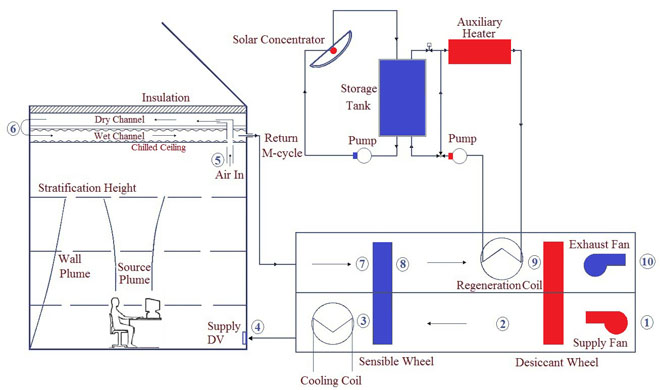
The study investigates the optimized and enhanced performance of combined displacement ventilation (DV) and evaporative-cooled ceiling (ECC) using Maisotsenko cycle (M-cycle). The DV/ECC system efficiency is expected to improve by dehumidifying the supply air using solid desiccant (SD) dehumidification system regenerated by parabolic solar concentrator thermal source. Predictive mathematical models of the conditioned space, SD and DV/ECC are integrated to study the performance of the proposed system while utilizing an optimized control strategy for typical offices in moderate humid climate. The developed model was validated with experiments in a climatic chamber at certain supply conditions and fixed load. Good agreement was found between measured and predicted temperatures and loads removed, with a maximum percentage error less than 6%.
A control strategy is adopted to determine optimal values of supply air flow rate and temperature and SD regeneration temperature while meeting space load, indoor air quality, and thermal comfort. The system performance is optimized to get minimal energy cost for a typical office case study in Beirut climate and compared to the cost of using chilled ceiling displacement ventilation (CC/DV) system. The use of the proposed system attained 28.1% savings in operational cost and electric power consumption over the cooling season.
Go To Energy and Buildings
 Advances in Engineering Advances in Engineering features breaking research judged by Advances in Engineering advisory team to be of key importance in the Engineering field. Papers are selected from over 10,000 published each week from most peer reviewed journals.