Advances in Engineering Advances in Engineering features breaking research judged by Advances in Engineering advisory team to be of key importance in the Engineering field. Papers are selected from over 10,000 published each week from most peer reviewed journals.

Significance Statement
Monitoring of injected subsurface carbon dioxide is essential for elucidating subsurface carbon dioxide behavior and thereby ensuring safety of carbon capture and storage (CCS). Information obtained from carbon dioxide capture and storage monitoring predicts the risk of carbon dioxide leakage from storage reservoirs, increase efficiency of carbon dioxide injection and reduction in risk of injection-induced seismicity.
Rock properties such as pore geometry and fluid states in pore spaces have shown good relevance in understanding of carbon dioxide behavior in reservoirs. Seismic and electrical surveys, despite their ability to detect and locate carbon dioxide distribution within injection reservoirs have difficulties in quantifying amount of subsurface carbon dioxide from seismic data. Hence, to estimate carbon dioxide saturation, the relationship between the saturation and P-wave velocity derived from seismic data must be determined. In order to provide unique response between P-wave velocities to carbon dioxide, saturation must be characterized by considering distribution in pore spaces.
Collaborative research team from Kyushu University and Kyoto University provided a quantitative survey description of carbon dioxide displacement in porous media and also made evaluation on the effect of carbon dioxide displacement on relationship between carbon dioxide saturation and P-wave velocity (Vp) via simulations. The work published in journal, International Journal of Greenhouse Gas Control used numerical methods; multiphase Lattice Boltzmann (LB) for carbon dioxide injection simulation and finite difference for dynamic simulation of wave propagation on a rotated staggered grid.
Multiphase flows of fluids such as carbon dioxide and water in porous media has been a subject of great interest in studies of carbon capture and storage technologies. From research, it has been proven also that distribution patterns influence geophysical properties of relevance to monitoring.
For the purpose of numerical simulations, a synthetic granular rock was used for Lattice Boltzmann simulation with a solid-fluid boundary condition. Grain-size to be well-sorted with a Gaussian spectral shape was assumed for grain-size distribution and a sorting parameter that represents spread of the grain-size distribution was used.
Density of carbon dioxide was set to that of water (994Kg/m3) and viscosities of both fluid were configured to be 10 times realistic values due to the fact that Lattice Boltzmann model used in the study cannot treat density contrast and small viscosities. This simulation assumption still mimics carbon dioxide injection into porous media because gravitational effect can be neglected and ratio of viscosities is fixed. Two cases, ‘Case 1’ and ‘Case 2’ was conducted with the former having a higher pressure. Finite difference algorithm on a rotated staggered grid was used for simulating dynamic wave propagation in order to estimate changes of P-wave velocity during carbon dioxide displacement.
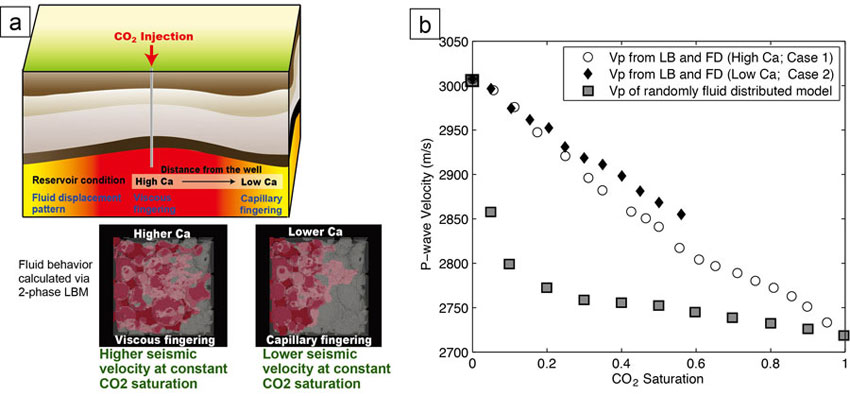
From Lattice Boltzmann numerical simulation results, there was a clear difference of carbon dioxide distribution between two cases. Equilibrium saturations in case 1 and case 2 were 95.1% and 56.0% respectively. The invading carbon dioxide flows via several fingers towards the outlet especially in case 1 while case 2 exhibited few fingerings.
The Lattice Boltzmann simulations demonstrated that P-wave velocity in case 1 was slower than that of case 2 when carbon dioxide saturation exceeded 30% even with the same carbon dioxide saturation. The high concentration of carbon dioxide distribution in case 2 mean large size of heterogeneity i.e. large carbon dioxide patch.
Compared with randomly-saturated media, the carbon dioxide phase in Lattice Boltzmann results forms larger bubbles which was partially due to the fact that injection process in case 1 and case 2 was drainage. The injected fluid continuously invades pore spaces, producing large carbon dioxide cluster under drainage conditions.
Even though differences in case 1 and case 2 was smaller than randomly-distributed models, there was a detectable difference of P-wave velocity response to carbon dioxide saturation caused by difference in displacement mechanisms and this difference cannot be neglected.
This study dynamic wave simulation with finite difference approach to Lattice Boltzmann results (case 1 and case 2) and randomly distributed media successfully evaluated the relationship of P-wave velocity to carbon dioxide saturation which is the most important relationship in geophysical monitoring of carbon capture and storage projects.
The capillary numbers vary with distance from the injection well. Low capillary numbers are expected far from the injection well and high numbers near the well. This study demonstrates that capillary number at each reservoir location (e.g., distance from injection well) should be considered to accurately estimate CO2 saturation from seismic velocity (i.e., monitoring data).

Journal Reference
Hirotatsu Yamabe1, Takeshi Tsuji2,3, Yunfeng Liang1, Toshifumi Matsuoka1. Influence of Fluid Displacement Patterns on Seismic Velocity during Supercritical CO2 Injection: Simulation Study for Evaluation of the Relationship between Seismic Velocity and CO2 Saturation. International Journal of Greenhouse Gas Control, 2016, Volume 46, pp 197-204.
[expand title=”Show Affiliations”]- Graduate School of Engineering, Kyoto University, Kyoto 615-8540, Japan
- International Institute for Carbon-Neutral Energy Research (I2CNER), Kyushu University, Fukuoka 819-0395, Japan
- Faculty of Engineering, Kyushu University, Fukuoka 819-0395, Japan
Go To International Journal of Greenhouse Gas Control