Advances in Engineering Advances in Engineering features breaking research judged by Advances in Engineering advisory team to be of key importance in the Engineering field. Papers are selected from over 10,000 published each week from most peer reviewed journals.

Significance
Plastics are extensively used in many applications owing to their unique mechanical features. Unfortunately, plastics are petroleum-based and non-recyclable. Therefore, researchers have been looking for alternatives and have identified bioplastics as promising candidates.
Among the most environmentally-friendly candidates within the bio-plastic family are the bio-based substances that are partially or entirely extracted from biomass such as proteins and polysaccharides. Among the biomass used, soy protein, which is a co-product with soybean oil, is highly attractive because it is one of the cheapest proteins. Soy protein shows high water-uptake owing to the presence of hydrophilic amino acids.
Bioplastics are made of a polymer matrix where a plasticizer is included to decrease the glass transition and improve the strain at break. Unfortunately, the mechanical features of bioplastics are still inadequate as compared to conventional plastics. Some additives can be incorporated in the composition in a bid to enhance the final bio-composites characteristics. Therefore, nanoclays such as montmorillonite have been applied as additives. Montmorillonite is a layer-type clay composed of two tetrahedrally coordinated sheets of silicon ions which surround an octahedrally coordinated sheet of aluminum ions. This nanofiller has been analyzed due to its low cost, abundance, and high surface area.
However, effective dispersion of nanoclays in biopolymer matrices is the main problem affecting biocomposite development, where exfoliation is the most desirable configuration so as to enhance the features of bio-composites. Injection moulding method is the most versatile polymer processing method, and is particularly useful for polymeric materials.
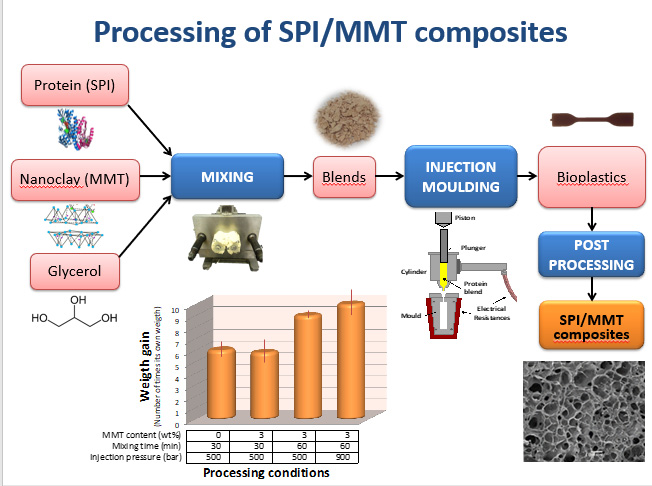
Researchers led by Professor Antonio Guerrero from the “Universidad de Sevilla” in Spain developed a Soy Protein Isolate-Montmorillonite nanocomposite plastic material implementing an injection moulding process. They analyzed the influence of processing conditions in the nanoclay incorporation, and then obtained the features of the final biocomposites. Their research work is published in European Polymer Journal.
The research team incorporated montmorillonite in order to enhance the physicochemical features of the Soy Protein Isolate/montmorillonite nanocomposites they prepared by injection moulding. This was with regards to water uptake capacity taking into account mechanical and rheological features. They studied the processing conditions in a bid to evaluate the modifications that took place in the microstructure and the properties of these nanocomposites.
It was necessary to control the nanoclay addition as well as the mixing process so as to achieve its integration. The authors did some modifications such as nanoclay addition, mixing time, and injection pressures in order to realize biocomposites with desired attributes. They observed that changing the mixing time had a huge impact on the final soy-based nanocomposites. Water uptake capacity was significantly improved and this could be attributed to the smaller nanoclay particles sizes. In addition, although changing the mixing time did not really enhance the tensile features, it led to an improvement in the bending properties.
The authors also observed that when they increased the injection pressure from 500 bar to 900 bar, the tensile features were improved by 100% and maximum stress by 52%. This could be hinged in the decrease in nanoclay particle size. However, this decrease initiated by injection pressure only yielded slight changes in water adsorption features and had no effect on the bending characteristics.




Reference
V. Bourny, V. Perez-Puyana, M. Felix, A. Romero, A. Guerrero. Evaluation of the injection moulding conditions in soy/nanoclay based composites. European Polymer Journal, volume 95 (2017), pages 539–546.
Go To European Polymer Journal