Advances in Engineering Advances in Engineering features breaking research judged by Advances in Engineering advisory team to be of key importance in the Engineering field. Papers are selected from over 10,000 published each week from most peer reviewed journals.

Significance
The magnetocaloric effect (MCE) relies on field-induced entropy changes in magnetic systems, which feels conceptually elegant compared with the compressors and greenhouse gas refrigerants still dominating the market. However, translating this principle into a practical technology is not straightforward. Thin films and nanostructured materials are promising in this application because researchers can probe how exchange interactions across layers can reshape fundamental magnetic responses and, carefully engineered heterostructures do more than tune transition temperatures; in some cases they actually invert the caloric response. This means a material can display conventional MCE, where entropy decreases under a field, or the inverse case, where entropy increases—a counterintuitive but potentially powerful effect.What makes this so appealing is not only the novelty but also the design freedom it implies. The prospect of moving between conventional and inverse behavior within the same architecture hints at multifunctional devices capable of broader thermal cycles. Despite theoretical predictions pointing in this direction, solid experimental demonstrations remain relatively few, which explains why this research feels both urgent and exciting.
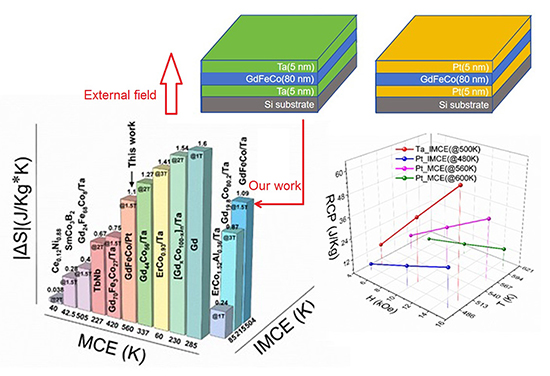
To this account, new research paper published in ACS Applied Electronic Materials and conducted by Miss Lisha Gu, Dr. Jagadish Kumar Galivarapu, Mr. Zhiwen Wang and led by Professor Ke Wang from the East China University of Technology, the researchers developed two ferrimagnetic heterostructures, Pt/GdFeCo/Pt and Ta/GdFeCo/Ta, to probe how heavy-metal interfaces control magnetocaloric behavior. Their models demonstrate that Pt interfaces sustain dual entropy responses, while Ta interfaces drive a pronounced transition to inverse MCE with enhanced relative cooling power. The researchers fabricated two sets of thin-film heterostructures: Pt/GdFeCo/Pt and Ta/GdFeCo/Ta, each comprising an 80 nm Gd35Fe5Co60 layer encapsulated by 5 nm heavy-metal contacts. The picked Pt and Ta because both elements possess strong spin–orbit coupling but exhibit different work functions and hybridization tendencies with FeCo, thereby imposing distinct electronic environments on the ferrimagnetic core. Deposition was carried out via RF and DC magnetron sputtering under controlled argon atmospheres, ensuring amorphous GdFeCo layers of uniform thickness. Structural confirmation came from grazing-incidence X-ray diffraction, which showed only substrate peaks and no crystalline ordering, verifying amorphous character. Scanning electron microscopy further validated film thickness and layer uniformity.
They performed magnetic characterization using vibrating sample magnetometer across the 100–700 K range, with fields up to 18 kOe which showed temperature-dependent magnetization curves with marked differences between the two contact-layer systems. The authors found that the Pt-capped film has a compensation temperature of 324.1 K, whereas the Ta-capped film shifted this value significantly upward to 389.7 K. Similarly, Curie temperatures rose from 586.8 K (Pt) to 664.3 K (Ta). They believed these variations highlight the profound role of interface-driven charge transfer and exchange interactions in dictating sublattice balance. The researchers conducted field-dependent magnetization loops which confirmed differences in coercivity and saturation and found the Pt structure displayed higher coercivity (170 Oe) compared to Ta (50 Oe), while Ta yielded greater saturation magnetization. Such contrasts indicate that interfacial exchange between Gd and FeCo is more strongly perturbed in the presence of Pt, likely due to stronger 3d–5d orbital hybridization.
It is noteworthy to mention their entropy change measurements derived from isothermal magnetization data via Maxwell relations which showed that Pt/GdFeCo/Pt had dual behavior: a conventional MCE peak of 1.18 J/kg·K near the Curie region, accompanied by an inverse peak of 0.78 J/kg·K at lower temperatures. In Ta/GdFeCo/Ta, the behavior shifted decisively toward the inverse regime, producing a maximum inverse entropy change of 1.08 J/kg·K at 500 K under a 15 kOe field. The transition from conventional to inverse entropy change was thus not only evident but tunable by the choice of contact layer. Moreover, refrigeration capacity (RC) and relative cooling power (RCP) analys is demonstrated that Pt structures achieved RCP values of ~38 J/kg in the conventional regime, while Ta structures exhibited a remarkable 63 J/kg under inverse conditions. Specific heat variations and temperature-averaged entropy change (TEC) measurements revealed consistent trends, with TEC decreasing as ΔTlift expanded, but retaining higher values at small temperature spans—advantageous for micro-refrigeration cycles. Together, these findings firmly demonstrate that interfacial engineering can dictate not only the magnitude but also the sign of magnetocaloric responses in ferrimagnetic thin films.
In conclusion, the research work of Professor Ke Wang and colleagues extend well beyond the characterization of GdFeCo thin films and successfully provided a clear demonstration that interfacial contact layers can switch a system between conventional and inverse MCE, and the authors highlight interface design as a new paradigm for entropy engineering. From an application perspective, the ability to toggle between entropy-reducing and entropy-enhancing states offers a unique advantage. Conventional and inverse MCE could, in principle, be harnessed in a single device, enabling bidirectional thermal control. Such versatility could underpin Ericsson-cycle refrigeration, where constant entropy change over a wide temperature span is highly desirable. Moreover, the relatively low fields required make integration into practical magnetic cooling devices more realistic compared to bulk materials requiring several Tesla.
Moreover, the novel findings also resonate with developments in spintronics. Pt and Ta are widely employed as spin–orbit torque layers, and their demonstrated influence on magnetocaloric behavior underscores the common thread linking spin transport, interfacial magnetism, and thermal management. In the longer term, this could lead to multifunctional devices where logic, memory, and cooling coexist within shared thin-film platforms. Future research will focus on few challenges that still remain: scaling thin-film phenomena to bulkier systems suitable for domestic or industrial cooling will require creative stacking strategies or hybrid architectures. Stability under repeated thermal cycling must be verified, particularly given the metastable nature of amorphous ferrimagnets. Additionally, theoretical modeling that couples spin-lattice dynamics with interfacial charge transfer would provide deeper microscopic insights into the observed entropy inversion. In a nutshell, the findings of the new study establish interfacial engineering as a viable strategy for controlling both the magnitude and the sign of magnetocaloric responses and provide a concrete framework for designing next-generation thin-film refrigeration devices.
Our findings not only provide a deeper understanding of the interplay between interface interactions and magnetic dynamics but are helpful in designing multilayered structures with enhanced magnetocaloric properties for next-generation refrigeration microdevices based on ferrimagnetic GdFeCo alloy film.”, Prof. Ke Wang comments.




Reference
Gu, Lisha & Kumar G., Jagadish & Wang, Zhiwen & Wang, K. (2025). Interface-Induced Conventional and Inverse Magnetocaloric Properties of GdFeCo Thin Films. ACS Applied Electronic Materials. 7. 10.1021/acsaelm.4c02066.