Advances in Engineering Advances in Engineering features breaking research judged by Advances in Engineering advisory team to be of key importance in the Engineering field. Papers are selected from over 10,000 published each week from most peer reviewed journals.

Significance
In engineering and construction industries, the growth of fatigue cracks in welded joints is a significant concern due to the potential for catastrophic failures. These fractures can initiate and propagate within the joints, posing a threat to structural integrity. The complex process of fatigue fracture growth is influenced by various factors, including specimen geometry, material type, loading conditions, and the surrounding environment. Additionally, welding residual stress (WRS) resulting from the welding procedure significantly affects the strength of welded joints. It is essential to comprehend the factors influencing fatigue fracture growth for the design of safe and dependable structures.
Previous research has primarily focused on either the effect of specimen thickness without considering WRS or the effect of WRS using fixed specimen thicknesses. This leaves a gap in our understanding of the relationship between crack growth and the interaction between thickness and WRS. Furthermore, the variation in crack driving force caused by changes in thickness, welding heat input, and mean stress has not been sufficiently investigated. Addressing these aspects is crucial as they have wide-ranging implications for numerous engineering and construction industries.
In a recent study published in the peer-reviewed Journal of Constructional Steel Research, researchers Dr. Ramy Gadallah, Dr. Masakazu Shibahara, and Professor Hidekazu Murakawa from Osaka Metropolitan University and Osaka University in Japan conducted a numerical investigation using finite element analysis. Their study aimed to examine the effects of thickness, welding heat input, WRS, and mean stress on fatigue crack growth behavior in centrally cracked steel specimens.
The researchers utilized the Joining and Welding Research Institute ANalysis (JWRIAN), an in-house code based on the Finite Element Method, to simulate welding and predict WRS. JWRIAN performed consecutive coupled thermal and mechanical finite element analyses to calculate temperature profile, WRS, and welding distortion in welded components. Due to the nonlinear nature of the welding problem, the evolution of stress and strain is traced incrementally with respect to the change in temperature. The efficacy of JWRIAN was validated by comparing the calculated results for weld penetration and WRS components to measured values, showing excellent agreement.
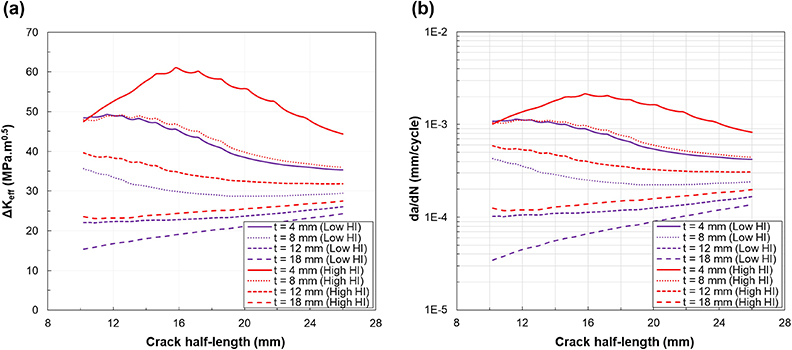
The research team discovered that greater welding heat input increased the average temperature, while thicker specimens decreased it. The distribution of residual stresses revealed tensile tensions in the center of the specimen and compressive stresses along the perimeter. Higher welding heat input led to higher residual stresses, while thicker specimens resulted in reduced residual stresses. The researchers utilized the Interaction Integral Method implemented in the open-source code WARP3D to calculate fracture parameters. This method provides actual and auxiliary fields including displacement, strain, stress, and mixed-mode stress intensity factors (SIFs), and using the I-integral parameter, which determined the crack driving force, the effective SIF range was calculated. Crack growth calculations were performed using the Paris-Elber power model that considers the crack closure effect.
The researchers employed a pair of Finite Element models, one for simulating welding and the other for conducting crack growth calculations. The calculated WRS was introduced into the crack growth finite element model using the mapping technique. Thinner specimens exhibited more homogeneous residual stress distributions compared to thicker specimens, which displayed variable stress distributions through the thickness. Higher welding heat input increased SIFs near the welded surface, particularly for thicker specimens with short crack lengths. Welded thinner/thicker specimens had lower fatigue lives and faster crack growth rates compared to base metal cracked specimens. Increasing welding heat input accelerated crack growth rate and shortened fatigue life at a certain thickness. With increasing mean stress, fatigue life decreased, and the retardation effect disappeared with increasing mean stress for the thinnest and thickest specimens. The retardation effect was generated due to the presence of the crack in a compressive stress field. Generally, at a given mean stress, the thickest specimen had a longer fatigue life than the thinnest specimen.
To summarize, Dr. Ramy Gadallah and colleagues demonstrated the influence of thickness, welding heat input, WRS, and mean stress on crack driving force and fatigue crack growth in welded joints. Understanding these factors is crucial for predicting crack behavior and optimizing welding parameters to ensure safe and reliable structures in engineering and construction industries.



Reference
Ramy Gadallah, Hidekazu Murakawa, Masakazu Shibahara. Investigation of thickness and welding residual stress effects on fatigue crack growth. Journal of Constructional Steel Research, Volume 201, February 2023, 107760.