Advances in Engineering Advances in Engineering features breaking research judged by Advances in Engineering advisory team to be of key importance in the Engineering field. Papers are selected from over 10,000 published each week from most peer reviewed journals.

Significance
Morphology is a qualitative property of nanostructured matter and is often articulated by visual inspection of micrographs. Properties of porous materials with technological interest such as mechanical strength, wettability, surface area, gas sorption capacity and thermal conductivity, depend to a large extent on the morphology of their solid frameworks. For deterministic procedures that relate nanomorphology to synthetic conditions, it is necessary to express nanostructures numerically – a process that may have a much broader impact than just in the field of material science.
At present, numerous attempts to infer nanomorphology from quantifiable material properties have focused on mechanical strength, which, therefore, has been assumed as the de facto link between nanomorphology and synthetic conditions. However, as it turns out, many material properties, including density, mechanical strength and the elastic modulus, are not single-valued functions of morphology. That is, two samples with completely different morphologies may have the same value of any of those properties. Thereby, there is a need for a different morphology descriptor.
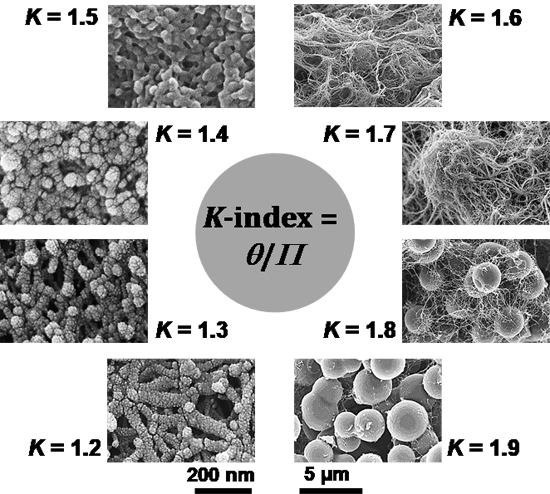
In a recent publication, a Missouri University of Science and Technology team comprised of Curators’ Distinguished Professor Nicholas Leventis (now retired), Tahereh Taghvaee (PhD candidate), Dr. Suraj Donthula, Parwani M. Rewatkar (PhD candidate), Dr. Hojat Majedi Far and Professor Chariklia Sotiriou-Leventis investigated the possibility of quantifying the preverbal impression from visual inspection of scanning electron micrography (SEM) of a nanostructure, which, they reasoned, is related to its openness and its texture. This openness is quantified by porosity, Π, and texture is oftentimes reflected on hydrophobicity, which, in turn, is quantified by the contact angle, θ, of a water droplet on the surface of a material. The θ-to-Π ratio, henceforth referred to as the ‘K-index’, turns out to be an accurate descriptor, predictor, and correlator of complex nanomorphology to other material properties. Their work is currently published in the research journal, ACS Nano.
In brief, by selecting polyurea aerogels as a model system with demonstrated potential for rich nanomorphology, and guided by a statistical design-of experiments model, they prepared a large array of materials (208) with identical chemical composition but quite different nanostructures. The authors reported that the polyurea samples adopted for the study could be put in eight K-index groups with separate nanomorphologies ranging from caterpillar-like assemblies of nanoparticles, to thin nanofibers, to cocoon-like structures, to large bald microspheres. Various characterization methods including nuclear magnetic resonance, porosimetry, thermal conductivity and quasistatic mechanical compression were applied to all samples. The first validation of the K-index as a morphology descriptor was based on compressing samples to different strains: it was observed that as the porosity decreased, the water-contact angle decreased proportionally, and thereby the K-index remained constant, as it should, because compression brings nanoscopic features closer, but otherwise leaves them intact.
In summary, the K-index was presented as a resilient descriptor and predictor of the diverse nanomorphology of polyurea aerogels, a correlator of nanostructure to material properties, and a quantitative tool for materials design. The nanostructure predictive power of the K-index was demonstrated with 20 polyurea aerogels prepared in 8 binary solvent systems. In the end, the authors went on to identify synthetic conditions and prepare nanoporous polyurea aerogels with any targeted nanomorphology prescribed a priori. Altogether, identification of three-way quantitative relationships among nanostructure, properties, and synthetic conditions is expected to be an essential point of departure for fundamental bottom-up simulations of nanostructure formation.


Reference
Tahereh Taghvaee, Suraj Donthula, Parwani M. Rewatkar, Hojat Majedi Far, Chariklia Sotiriou-Leventis, Nicholas Leventis. K-Index: A Descriptor, Predictor, and Correlator of Complex Nanomorphology to Other Material Properties. ACS Nano 2019, volume 133 page 3677-3690.
Go To ACS Nano