Label-Free Electrical Detection of Enzymatic Reactions in Nanochannels

Significance Statement

Label free assays have wide application in the medical sector. Field effect transistors, nanotubes, micro cantilever arrays and surface plasmon resonance are some of the label free techniques which depend on surface reaction for the detection of analytes. However, when the analyte concentration is low, the corresponding surface reaction is a slow process as diffusion of analytes to the surface is limited due to the presence of a large depletion layer. It is thus difficult to detect low concentration analytes using these label free techniques, within a short time.

In principle, this issue could be addressed if the substrates and the analytes are confined in nanoscale spaces. In such cases, analytes only need to travel a short distance to reach the surface and interact with the substrates. Assays based on this concept have been developed already and have their applications in bio-sensing and enzyme kinetic characterization. Yet, separate signal transducers are required for these assays for the conversion of reaction progress into readable signals. This leads to system complexity and increases the operation cost. Furthermore, in these nanoconfinement based assays, the analytes still need to be continuously supplied from the reservoir(s), which is still a very time-consuming process.

Dr. Chuanhua Duan, Dr. Arun Majumdar and colleagues developed a label-free nanochannel based sensor, in which the nanochannel itself is the signal transducer, to detect enzymes using surface enzymatic reactions. In these reactions, the target analytes, the enzymes, are not consumed as they are catalysts. Although it is still a long distance for the enzymes to diffuse from one end to the other end of the nanochannel, repeatability of the enzymes to interact with the immobilized substrates leads to short response time. The research work is published in peer-reviewed journal, ACS Nano.

Enzymatic reactions are very important for many biological processes. To quantify the activity of enzymes, fluorogenic or chromogenic labeled substrates are among the current approaches generally being used. These approaches consume more time and are expensive. Using nanochannel devices to detect the enzyme activity brings a low cost, highly sensitive approach. In this paper, the authors demonstrate the enzymatic reactions (on immobilized substrates) in nanochannel devices by electrical detection. They also discover that nanoscale confinements would lead to significant changes in reaction kinetics.

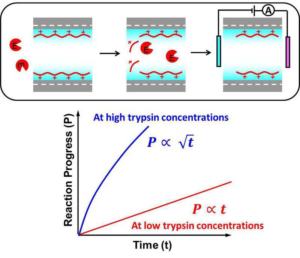
The nanochannel devices, containing ten nanochannels, four reservoirs and two microchannels are fabricated by the classical “etching and bonding scheme”. The enzymatic reaction that they investigate is the trypsin-poly-L-lysine reaction and trypsin is their target enzyme. In a typical experiment, the authors first introduce poly-L-lysine into the silica nanochannel. The electrostatic interactions cause the ploy-L-lysines, which are positively charged, to bind to the negatively charged silica nanochannel surface. Trypsin is then introduced to digest the poly-L-lysines into di- and tri-lysines. By measure ionic conductance of the nanochannel device before and after the introduction of trypsin, the authors can correlate the conductance change, which is a function of surface charge and reflects the progress of the surface enzymatic reaction, to the trypsin concentration. They demonstrate detection of trypsin with concentrations ranging from 5 ng/ml to 50 mg/ml within an hour. They also demonstrate the specificity of this nanochannel sensor by comparing the activity of trypsin and the activity of two other proteases, i.e. thrombin and chymotrypsin.

In addition to demonstrating the excellent performance of the nanochannel enzyme sensor, the authors also use it to quantitatively study enzyme kinetics in nanoscale confinements. They find that the reaction progress reveals a linear time dependence at low enzyme concentrations and a square-root time dependence at high enzyme concentrations. These dependences are not observed for enzymatic reactions in solutions or on plain surfaces, which result from the catalytic nature of enzymes and non-specific enzyme-surface interactions in nanoscale confined spaces, respectively.

In summary, this study demonstrated detection of enzymes using 2D nanochannel devices as fast label-free electrical bio-sensor. The designed nanochannel sensor can also be considered as a suitable platform for measuring enzyme kinetics in confined spaces.
Label-Free Electrical Detection of Enzymatic Reactions in Nanochannels - Advances in Engingeering

About the author

Chuanhua Duan is an assistant professor in the Department of Engineering at Boston University. He received his B.S. and M.S. degrees in Engineering Thermophysics in 2002 and 2004 from Tsinghua University, China. He obtained his Ph.D. in Mechanical Engineering from the University of California at Berkeley in 2009 under the guidance of Prof. Arun Majumdar. After staying in Berkeley for two more years as a postdoctoral researcher at the Lawrence Berkeley National Laboratory, Dr. Duan joined the Department of Mechanical Engineering at Boston University as an assistant professor in 2012.

He is currently leading the Nanoscale Energy-Fluids Transport Research Group at BU. His research focuses on the study of micro- and nanofluidic transport phenomena and the development of new fluidic devices/approaches for applications in healthcare, energy systems, and thermal management.

About the author

Mohammad Amin Alibakhshi earned his B.Sc. and M.Sc. degrees in Fluid Mechanics in 2006 and 2009, from Iran University of Science and Technology, Tehran, Iran. During his undergraduate and Master’s study he conducted research in the fields of Acoustics and wave propagation. In 2009, he joined the Nonlinear and Biomedical Acoustic Laboratory at Boston University where he performed experimental and theoretical research on application of ultrasound in lithotripsy. In 2012, he shifted the focus of his research to the study of transport phenomena at the nanoscale and joined the Nanoscale Energy-Fluids Transport Laboratory at Boston University where he later obtained his Ph.D. in 2016.

During the course of his Ph.D. he worked on liquid transport, ion transport, and phase change at the nanoscale as well as development of nanochannel-based and nanopore-based techniques for biomarker detection. Currently he is a postdoctoral research associate at the Nanoscale Biophysics Lab at Northeastern University focusing on development of novel nanopore structures for low-noise biomarker detection applications.

About the author

Dong-Kwon Kim is an associate professor in the Department of Mechanical Engineering at Ajou University, South Korea. His current research interests include power generation, energy storage, and energy transfer by using micro/nanostructures. He received his doctoral degree in Mechanical Engineering from KAIST (Korea Advanced Institute of Science and Technology) in 2007.

He worked as a visiting postdoctoral scholar in the Department of Mechanical Engineering at University of California, Berkeley in 2008 and 2009.

About the author

Christopher Brown holds a B.S in Microbiology from Clemson University and a PhD in Biochemistry and Molecular Biology from the University of California, San Francisco. His graduate work focused on the development of novel tools to identify active proteolytic enzymes associated with human disease.

About the author

Charles Craik is a Professor in the Department of Pharmaceutical Chemistry at the University of California at San Francisco. He is also the founder and director of the Chemistry and Chemical Biology Graduate Program. He received his education and training at Allegheny College (BS), Columbia University (Ph.D.) and UCSF (Postdoctoral). He joined the UCSF faculty in 1985 where his research interests focus on defining the roles and the mechanisms of enzymes in complex biological processes and on developing technologies to facilitate these studies.

Craik is a Fellow of the American Association for the Advancement of Science (AAAS) and the National Academy of Inventors (NAI) and is the 2016 awardee of the Emil Kaiser Award by the Protein Society.

The current research in the Craik lab focuses on the chemical biology of proteolytic enzymes, their receptors and their natural inhibitors. A particular emphasis of his work is on identifying the roles and regulating the activity of proteases and degradative enzyme complexes associated with infectious diseases and cancer. These studies coupled with his global substrate profiling and noninvasive imaging efforts are providing a better understanding of both the chemical make-up and the biological importance of these critical proteins to aid in the rapid detection, monitoring and control of infectious disease and cancer.

About the author

Dr. Arun Majumdar is the Jay Precourt Professor at Stanford University, a faculty member of the Departments of Mechanical Engineering and Materials Science and Engineering (by courtesy) and co-director of the Precourt Institute for Energy, which integrates and coordinates research and education activities across all seven Schools and the Hoover Institution at Stanford. 

Dr. Majumdar’s research in the past has involved the science and engineering of nanoscale materials and devices, especially in the areas of energy conversion, transport and storage as well as biomolecular analysis.

His current research focuses on using electrochemical reactions for thermal energy conversion, thermochemical water splitting reactions to produce carbon-free hydrogen, understanding the limits of heat transport in nanostructured materials and a new effort to re-engineer the electricity grid.

In October 2009, Dr. Majumdar was nominated by President Obama and confirmed by the Senate to become the Founding Director of the Advanced Research Projects Agency – Energy (ARPA-E), where he served till June 2012 and helped ARPA-E become a model of excellence for the government with bipartisan support from Congress and other stakeholders. Between March 2011 and June 2012, he also served as the Acting Under Secretary of Energy, enabling the portfolio that reported to him: Office of Energy Efficiency and Renewable Energy, Office of Electricity Delivery and Reliability, Office of Nuclear Energy and the Office of Fossil Energy, as well as multiple cross-cutting efforts such as Sunshot, Grid Tech Team and others that he had initiated. Furthermore, he was a Senior Advisor to the Secretary of Energy on a variety of matters related to management, personnel, budget, and policy.

After leaving Washington, DC and before joining Stanford, Dr. Majumdar was the Vice President for Energy at Google, where he created several energy technology initiatives, especially at the intersection of data, computing and electricity grid, and advised the company on its broader energy strategy. 

Prior to joining the Department of Energy, Dr. Majumdar was the Almy & Agnes Maynard Chair Professor of Mechanical Engineering and Materials Science & Engineering at University of California–Berkeley and the Associate Laboratory Director for energy and environment at Lawrence Berkeley National Laboratory. 

Dr. Majumdar is a member of the National Academy of Engineering and the American Academy of Arts and Sciences.

He currently serves as the Vice Chairman of the US Secretary of Energy’s Advisory Board and is also a Science Envoy for the US Department of State with focus on energy and technology innovation in the Baltics and Poland. He is a member of the Councils of the National Academy of Engineering, the Electric Power Research Institute, as well as the Science Board of the Stanford Linear Accelerator Center (SLAC) and the Oak Ridge National Laboratory. He is a member of the International Advisory Panel for Energy of the Singapore Ministry of Trade and Industry and the US delegation for the US-India Track II dialogue on climate change and energy.

Dr. Majumdar received his bachelor’s degree in Mechanical Engineering at the Indian Institute of Technology, Bombay in 1985 and his Ph.D. from the University of California, Berkeley in 1989.

Reference

Chuanhua Duan1, Mohammad Amin Alibakhshi1, Dong-Kwon Kim2, Christopher M. Brown3, Charles S. Craik3, Arun Majumdar4, Label-Free Electrical Detection of Enzymatic Reactions in Nanochannels, ACS Nano, Volume 10, 2016, Pages 7476-7484.

[expand title=”Show Affiliations”]
  1. Department of Mechanical Engineering, Boston University, Boston, Massachusetts 02215, United States
  2. Department of Mechanical Engineering, Ajou University, Suwon 443-749, South Korea
  3. Department of Pharmaceutical Chemistry, University of California, San Francisco, California 94158, United States
  4. Department of Mechanical Engineering, Stanford University, Stanford, California 94305, United States
[/expand]


Go To ACS Nano 

Check Also

Thermoelectric Optimization through Quantum–Classical Transport Crossover in WSe₂ Nanojunctions

Significance  Figure 4. Contour plots depict the quantum-to-classical transition. Contour plots of ζ ≡ (GSC–GQM)/(GSC+GQM) …