 Advances in Engineering Advances in Engineering features breaking research judged by Advances in Engineering advisory team to be of key importance in the Engineering field. Papers are selected from over 10,000 published each week from most peer reviewed journals.

Significance
Antennas are essential components of wireless communication and radar systems, providing a means of transmitting and receiving electromagnetic waves. At high-frequency (HF) and very-high-frequency (VHF) bands, conventional metallic antennas can require substantial physical dimensions because their size is related to the wavelength of the transmitted signal. This creates challenges for aircraft and satellites, where available space, structural weight, and antenna configuration are important design considerations.
An alternative is to use plasma, an ionized gas containing free electrons, as the radiating element of an antenna. Unlike a permanent metallic conductor, plasma can be generated when needed and does not require a rigid physical structure. Plasma-based antennas have previously been investigated using ionized gas enclosed within glass tubes. These systems demonstrate that plasma can support electromagnetic radiation, but the enclosing structures impose restrictions on antenna length, geometry, and physical configuration.
Laser-induced plasma filaments offer another possibility. When an intense, ultrashort laser pulse travels through air, nonlinear optical effects can produce a narrow, elongated region of ionized gas. The formation of this filament involves a balance between laser self-focusing and plasma-induced defocusing, allowing the ionized channel to extend beyond the distance expected from ordinary optical focusing. The resulting plasma contains free electrons that can interact with externally applied electromagnetic fields.
For a plasma filament to function as an antenna, radio-frequency energy must be transferred into the ionized channel and subsequently radiated into the surrounding space. Establishing this process presents a technical difficulty. Metallic antennas are commonly energized through direct electrical connections, but contact with a laser-generated filament can disturb its formation. A contactless method is therefore needed to couple electromagnetic energy into the plasma without disrupting the channel.
Another challenge is distinguishing radiation associated with the plasma filament from radiation produced by the feeding structure itself. A convincing experimental demonstration requires measuring the electromagnetic signal under comparable conditions with and without the filament.
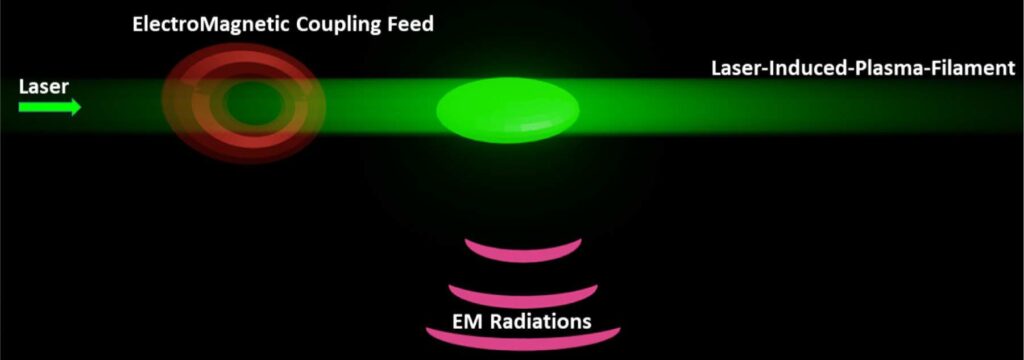
In a recent research paper published in IEEE Journal of Microwaves, Prya Darshni and Professor Paul Franzon from North Carolina State University, together with Professor Arthur Dogariu, affiliated with Princeton University and Texas A&M University, investigated whether a laser-induced plasma filament could transmit a 30 MHz radio-frequency signal. Their approach combined laser-generated plasma in atmospheric air with a contactless capacitive feed and a receiver designed to measure the filament’s contribution to the electromagnetic signal.
Experiments and Findings
The team generated a plasma filament in air at atmospheric pressure using an ultrafast laser that delivered pulses approximately 100 femtoseconds long. A focusing lens directed the laser beam to produce an ionized channel approximately 20 cm in length and 0.1 mm in diameter.
Filament formation depends on the interaction between two competing optical processes. At sufficiently high laser intensity, the intensity-dependent refractive index of air causes the beam to focus more strongly. The increasing intensity ionizes the surrounding gas, producing plasma that counteracts the focusing effect. This dynamic balance allows a narrow plasma channel to form and persist over an extended distance.
The laser operated at a peak power substantially above the estimated critical power for self-focusing, providing the conditions required for filament generation. The resulting plasma channel served as the experimental antenna element.
A key consideration was the relationship between the frequency of the applied radio signal and the characteristic plasma frequency, which depends on the density of free electrons. The antenna operated at 30 MHz, well below the estimated plasma frequency of the generated filament. Under these conditions, electromagnetic energy may propagate along the plasma boundary through surface-wave behavior instead of penetrating deeply into the ionized region. The authors used this physical principle to guide their antenna concept, although detailed characterization of surface-wave propagation and attenuation remains a subject for further investigation.
To energize the filament without physical contact, the team constructed a coaxial capacitive feed consisting of two concentric copper cylinders. The feed surrounded the narrow plasma channel and was connected to a radio-frequency signal generator. An applied 30 MHz signal, with an amplitude of 4 V peak-to-peak, established an electric field that coupled electromagnetic energy into the filament.
The feed was approximately 1 cm long, much shorter than the 20 cm plasma channel. Its dimensions also provided sufficient clearance for the laser beam to pass through without striking the metallic structure. This arrangement allowed the researchers to introduce radio-frequency excitation near the filament’s center without interfering with its formation.
The central experiment compared two operating conditions. First, the laser beam was blocked, leaving the capacitive feed energized by the radio-frequency generator but preventing plasma formation. This established the received signal attributable to the feed and experimental arrangement alone.
The laser was then unblocked, creating the plasma filament inside the same energized feed. The radio-frequency input and receiver configuration were kept consistent, allowing the contribution associated with the filament to be evaluated.
A receiving antenna approximately 12 cm long was positioned about 5 cm from the transmitting structure, within its unobstructed near field. Both antennas had matching linear polarization orientations. The receiver incorporated a low-distortion radio-frequency mixer, and the resulting electrical signal was recorded using an oscilloscope.
Because the laser-generated plasma was transient, the measurements were synchronized with the laser pulses. A photodetector provided a timing reference, allowing the receiving system to record the signal during the relevant period of filament formation.
The comparison revealed a clear increase in received signal strength when the plasma filament was present. The measured peak signal reached approximately 0.5 mV with the capacitively fed filament, representing an increase of about 0.3 mV relative to the configuration containing only the feed. The authors reported that the received signal was approximately 2.5 times stronger, equivalent to a 150% increase.
To assess whether this difference could be distinguished from measurement variability, the team analyzed repeated waveform acquisitions under both conditions. Five waveforms were evaluated without the filament and seven with the filament. The recorded signals exhibited consistent baseline behavior, with average coefficients of variation close to 5% in both configurations.
Additional signal-to-noise analysis and high-resolution oscilloscope acquisition supported the reliability of the measured signal increase. The nearly identical baseline offsets between the two configurations also indicated that the observed difference could not be explained simply by a change in the instrument’s baseline.
These measurements provided experimental evidence that introducing the laser-generated plasma filament increased the electromagnetic signal detected by the nearby receiver. The authors interpreted this enhancement as confirmation that the capacitively excited filament contributed its own electromagnetic radiation.
Engineering Significance
The new study demonstrated the experimental establishment of a laser-generated plasma channel as a radio-frequency radiating element without requiring direct electrical contact. The distinction matters because generating an ionized filament and transferring electromagnetic energy into it are separate technical requirements. Both must be achieved for the plasma to function as an antenna.
The controlled comparison between the energized feed alone and the energized feed containing plasma was essential to the demonstration. A capacitive feed produces an electromagnetic field even in the absence of a filament. Measuring that contribution separately allowed the team to identify the additional received signal associated with the laser-generated channel.
The study also establishes a practical feeding configuration for an antenna element that cannot tolerate conventional metallic contact. This provides an experimental basis for investigating how feed geometry, electromagnetic coupling, and plasma properties influence antenna performance.
The 30 MHz operating frequency is significant because its free-space wavelength is approximately 10 m, much longer than the 20 cm filament used experimentally. The demonstration establishes detectable radio-frequency transmission from this compact plasma structure in a near-field arrangement, although it does not yet establish its efficiency or performance as a practical far-field antenna.
The authors identify several directions for further development, including improving capacitive coupling efficiency, increasing transmitted power, and developing more accurate electromagnetic models of the plasma-feed system. They also discuss the possibility of extending the concept to longer filaments for satellite and aircraft applications, including synthetic-aperture radar.
Current experimental performance does not yet provide the gain and beamforming precision needed for those applications. Nevertheless, the findings establish a measurable interaction between an externally applied radio-frequency signal and a laser-generated plasma filament, providing a basis for continued investigation of antennas whose radiating structures are formed optically rather than constructed from permanent metal components.



Reference
Darshni, A. Dogariu and P. D. Franzon, “Laser-Induced-Plasma-Filament Antenna Transmitting 30 MHz VHF,” in IEEE Journal of Microwaves, vol. 6, no. 5, pp. 1174-1183, 2026, doi: 10.1109/JMW.2026.3722433