Advances in Engineering Advances in Engineering features breaking research judged by Advances in Engineering advisory team to be of key importance in the Engineering field. Papers are selected from over 10,000 published each week from most peer reviewed journals.

Significance
The properties of biomaterial surfaces are now more controllable using laser microprocessing. With the increasing growth in demand for biomaterials, many companies have largely invested in developing novel biomedical materials with desirable properties for medicinal purposes. Surface performance is crucial for many of the clinical applications of biomaterials, ranging from orthopaedical implants to biomonitoring. Yingchun Guan, from Beihang university and her co-workers have shown how different laser-microprocessing methods enhance surface applications of the biomaterials.
Laser-microprocessing involves laser melting, laser texturing and so on. In laser microprocessing process, the deposition of ablated material and melting of material occur on the material surface, and these behaviors affect different aspects of manufacturing varying from nanometer to micrometer scale.
Guan and co-workers investigated how different micro/ nanoscale morphology affect the surface properties of magnesium and titanium alloys including corrosion resistance, cell behavior and surface-enhanced Raman scattering. “Magnesium and titanium alloys have been extensively used in medical applications such as dentistry, orthopaedical and other implants, which is mainly attributed to their reliable strength, fracture resistance, biocompatibility and electrical conductivity.” Guan explains.
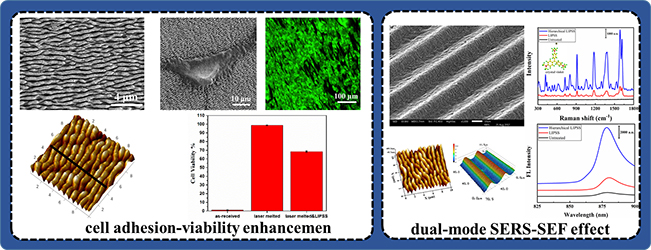
By examining corrosion resistance of Mg-Gd-Ca alloy samples post-melt, Guan and co-workers found that hydrogen evolution rate of the laser melted specimen was lower than the tolerant value in the human body. The direct cell culture observations showed that the cells exhibited good viability and adhesion behavior on the laser-texturing surface. This research work is currently published in the Journal of Laser Micro/Nanoengineering. According to Guan, a hybrid method combining both laser melting and laser surface texturing could be considered when improve the biocompatibility of magnesium alloys make it ideal for biomedical applications.
Guan and co-workers also developed a dual-mode surface enhanced Raman scattering (SERS) and surface enhanced fluorescence (SEF) structures on a single bio-metallic substrate via direct ultrafast laser microprocessing. This research work is currently published in Nanomaterials. “Due to the combined effect of surface plasmon resonance and “hot spots” induced by the hierarchical laser induced periodical surface structures (LIPSS), the substrate shows dual-mode SERS−SEF phenomena with enhancement factors of 7.85 × 10⁵ and 14.32, respectively.” Guan explains. The integration of SERS and SEF in a single bio-metallic substrate is promising to improve the sensitivity and reproducibility of detection in biomedical investigations.

References
[1] Zhang, J., & Guan, Y. (2019). Tayloring Surface Properties for Biomedical Application Induced by Laser Microprocessing. Journal of Laser Micro/Nanoengineering, 54.
[2] Lu, L., Zhang, J., Jiao, L., & Guan, Y. (2019). Large-scale fabrication of nanostructure on bio-metallic substrate for surface enhanced raman and fluorescence scattering. Nanomaterials, 9(7), 916.